By Marilyn Odendahl
The Indiana Citizen
July 10, 2026
Indiana’s shift to partisan school board elections and limits on education-related referendums will require Hoosier voters to study harder before casting their ballots in November.
The changes the Indiana General Assembly made to state laws regarding school boards and referendums in recent years are coming to fruition in this election cycle. On their ballots, voters could see political party labels after some of their school board candidates’ names and will possibly be asked to approve a referendum, which would raise their taxes in order to provide their local schools with additional funding.
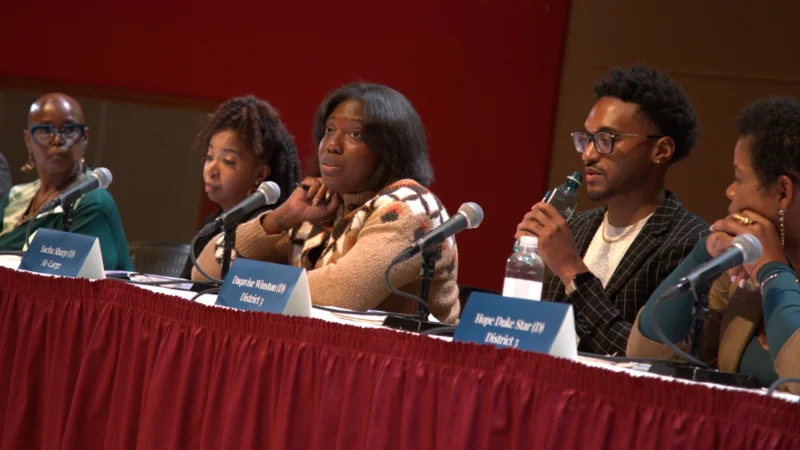
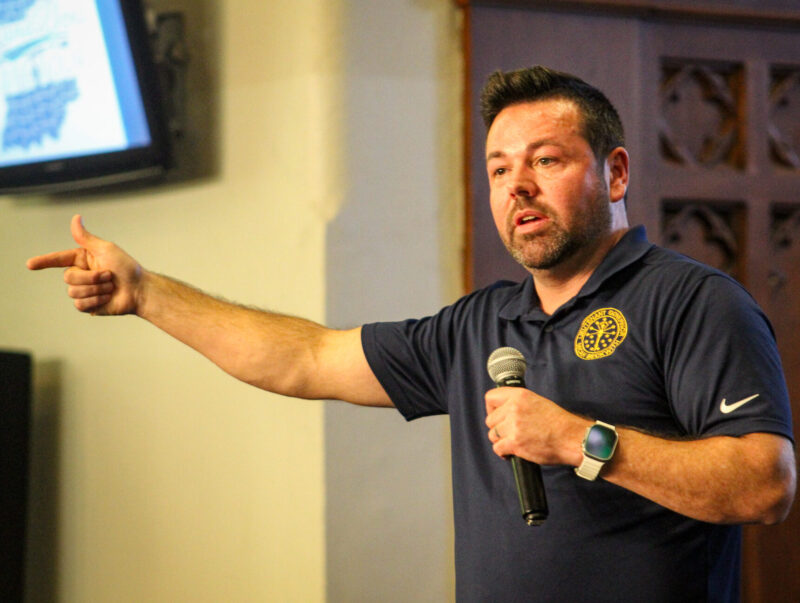
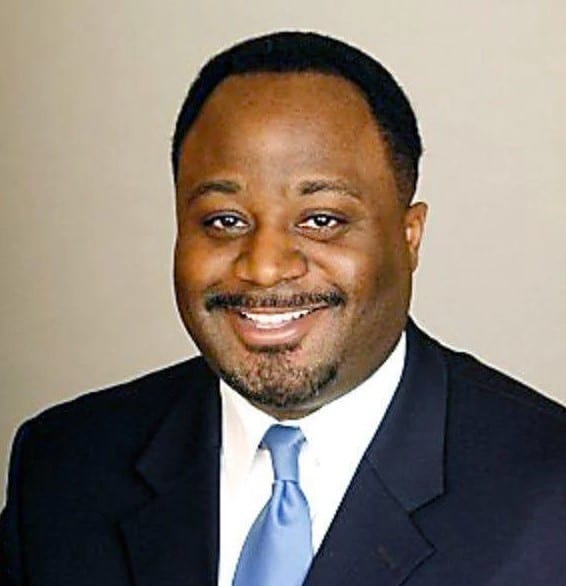
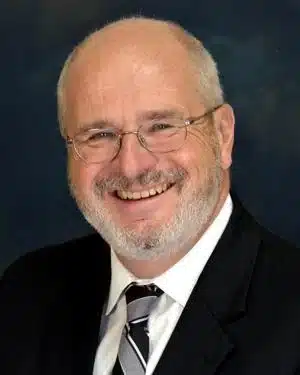
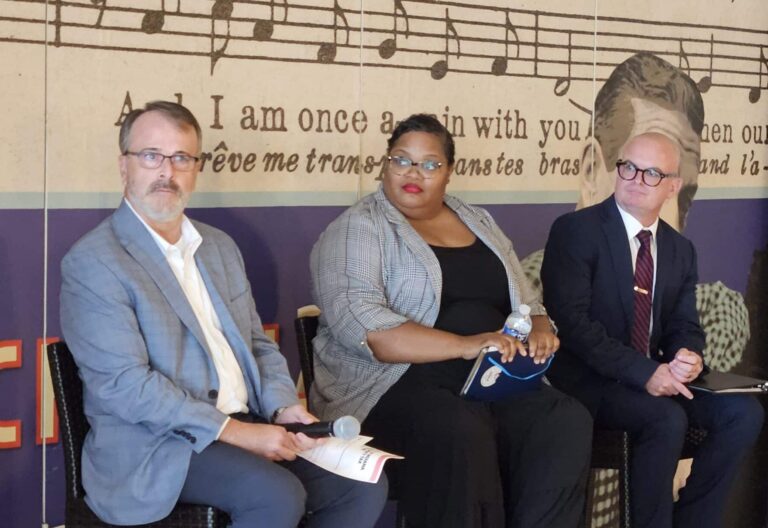
Recently, three experts reviewed the changes and the potential impact on classrooms and communities as part of a panel discussion hosted by Chalkbeat Indiana, a nonprofit news organization focused on education. Held at the Eugene and Marilyn Glick Indiana History Center in Indianapolis on Wednesday, the forum posed a series of questions, including some from the audience, to the three panelists: Terry Spradlin, executive director of the Indiana School Boards Association, Ashley Thomas, Indianapolis Public Schools commissioner and member of the Indianapolis Public Education Corp., and David Roof, director of the Center for Economic and Civil Learning at Ball State University.
Chalkbeat reporter Aleksandra Appleton moderated the discussion.
The door to partisan school board elections was opened by Senate Enrolled Act 287, which made Indiana the 10th state to allow school board candidates to run under the label of a political party. Previously, all these candidates were nonpartisan and while they can remain unaffiliated with any party, they can also declare as either a Republican, Democrat, Independent or Libertarian.
SEA 287 was a divisive and controversial piece of legislation. Supporters of the bill said school board races have been partisan and enabling candidates to openly affiliate with a particular party will provide the electorate with more information about their political beliefs. Opponents countered the job of school boards is nonpartisan and injecting politics into the process could impair the work of the board and damage the relationship between the members.
Thomas had spoken at the Statehouse against partisan school board elections and urged state lawmakers to keep school boards nonpartisan, but now that the law has been changed, she said she is “not going to complain or cry over spilled milk.”
Still, Thomas has concerns as to how the political parties will exert their influence and what the potential flood of money from the parties and partisan groups will mean for campaigns and candidates. Fewer individuals running for the local school boards, she said, are going to be afraid or nervous about accepting donations from political organizations, which will make the races very different and, at least for a time, chaotic.
“It meant a lot to me to run nonpartisan,” Thomas said of her campaign in 2024. “It meant a lot to me to have a conversation across party lines.”
Spradlin speculated that some of the school board incumbents declared a party just to dissuade the chair of their county political party from recruiting a candidate to run against them. Also, he said, a lot of the school board association members told him not only did they not want to declare a party, but they also would not run for reelection if they had to pick a political party.
The filing deadline for school board candidates was June 18. Spradlin provided the following statistics on the November school board races:
The split between nonpartisan and partisan candidates is about even with the breakdown as follows:
Of the partisan candidates:
While Thomas was surprised at the number of candidates affiliating with a political party, Roof said he was “a little less surprised.” Candidates who did not declare a party might be perceived as “hiding something,” he said, and since school board elections historically have a low turnout with races being decided by a few hundred votes, candidates might see the party label as a way to attract more votes.
Even so, Roof shared some of Thomas’ concerns about the injection of partisan politics into school boards.
Roof pointed to the duties of school boards, which include adopting an annual budget, hiring and evaluating a school superintendent, and ensuring school policy complies with federal and state laws, and he questioned how much insight party affiliation would provide voters as to how the candidates might decide such matters.
“One of the worries that I have is that people will begin to see those decisions through a partisan lens and interpret those decisions that are made through a kind of partisan framework,” Roof said.
Spradlin agreed that the core duties of school boards have not been driven by politics. Yet, he noted, the election of partisan members could create divisions along party lines, so that rather than seeking agreement among all the members, the majority will just ignore the minority’s objections or suggestions.
“Some boards currently function with division, but generally they try to form a consensus,” Spradlin said. “So, will this inject some division into the board room? We hope not.”
Nearly 40 school corporations in Indiana have filed for a referendum this year as public education tries to navigate a revenue squeeze created by the 2026 property tax reform and a new mandate that referendum questions can only appear on the general election ballot in even-numbered years.
The panelists were in agreement that Indiana schools need the extra dollars that referendums can bring. They noted that while lawmakers say the state is spending 47% of its revenue on education, the funding formula that includes shifting money into charter schools and vouchers reduces the public school appropriation to about 38%.
“I always feel like public schools have been accepting crumbs,” Thomas said. “I know different folks might have a different opinion about how public schools have functioned, … but the truth of the matter is, public schools are the foundation and a pillar in how we educate our children. It’s worthy of being funded and funded well.”
Spradlin said schools are pushing for referendums to shore up their budgets. The additional revenue is not being earmarked to support new programs or fund new construction projects, but rather schools are just trying to get more money to maintain their status quo. If the referendums fail, he said, classrooms would feel the impact, as schools could be forced to cut personnel and delay maintenance on their facilities.
Even as they struggle with funding, Spradlin pointed out that Hoosier schools are outperforming many of their counterparts across the nation.
Indiana’s 4th and 8th graders ranked sixth in the country in reading and ranked ninth and 13th, respectively, in mathematics. Also, Indiana just recorded the highest graduation rate in state history and is first in the nation for students earning college credit while in high school.
“We have produced education outcomes that are amazing,” Spradlin said. “I call it the Indiana miracle.”
While school officials can boast about student achievement, convincing taxpayers to approve a referendum, which would essentially increase their taxes, will be difficult, the panelists said. Households are fighting to stretch their money as inflation continues and the job market is unsteady.
Also, Spradlin noted the support for education referendums has been declining. From 2016 to 2020, 78% of the referendums were approved by voters, but just 63% were passed in the last five years.
“It’s a tough sell,” Spradlin said.
Dwight Adams, an editor and writer based in Indianapolis, edited this article. He is a former content editor, copy editor and digital producer at The Indianapolis Star and IndyStar.com, and worked as a planner for other newspapers, including the Louisville Courier Journal.
The Indiana Citizen is a nonpartisan, nonprofit platform dedicated to increasing the number of informed and engaged Hoosier citizens. We are operated by the Indiana Citizen Education Foundation, Inc., a 501(c)(3) public charity. For questions about the story, contact Marilyn Odendahl at marilyn.odendahl@indianacitizen.org