This story was originally published by Chalkbeat. Sign up for their newsletters at ckbe.at/newsletters
By Lily Altavena
Chalkbeat
Sign up for Chalkbeat’s free weekly newsletter to keep up with how education is changing across the U.S.
Teenage boys are coming to school with new vocabulary words: over-under, parlay, and prediction markets.
They’re not just talking about gambling. They’re placing bets and hanging their hopes on the outcomes of football games.
Data obtained by Chalkbeat from GoGuardian, an education software company that provides institutions tools to block and restrict certain webpages, shows that the rate of sites blocked in its gambling, betting and fantasy sports category has increased nearly 30% since the company started tracking in 2022, from a low of 13.48 blocks per 1,000 students to 17.4 this year.
The company blocks roughly 140,000 attempts to access such sites on average every month — although that’s still a tiny fraction of the 86 million monthly attempts to access blocked content.
Teachers said they have seen a fixation with gambling take hold in their students, who show little awareness of gambling’s risks.
This surge in gambling has prompted some educators to bring in new concepts like sports betting to financial literacy classrooms. Massachusetts is developing a sports betting curriculum, and other states have added gambling awareness to their academic standards. But teachers also said they are still trying to get a handle on a growing problem.
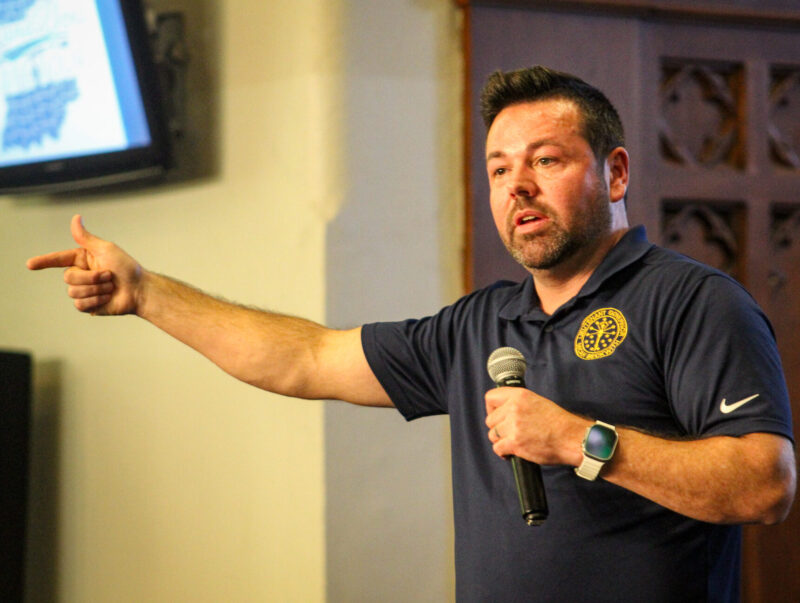
“I don’t think anybody has a grasp on this problem,” said Matt Pierson, associate director with the Nebraska Council on Economic Education. “Now that we can gamify it with an app and make it so incredibly easy, the barrier to entry is gone.”
The U.S. Supreme Court cleared the way for sports betting to become widely legal in 2018. A Siena University poll found 27% of Americans in February reported that they had an active online sportsbook account, up from 19% in 2024.
Though gambling is banned in most states for anyone under 21, teens have also found their way into sportsbooks, teachers said.
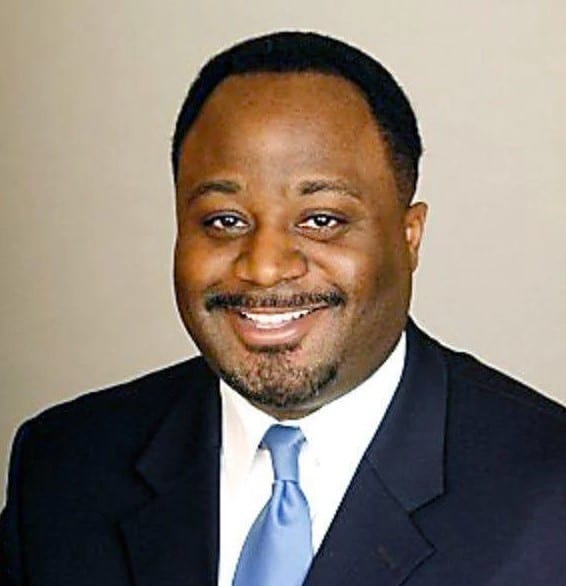
Richard Bryant, executive director of the Kentucky Financial Empowerment Commission, a nonprofit that offers financial literacy education across the state, said some students believe sports betting is equivalent to making a smart investment. In a 2025 NerdWallet survey, 31% of sports bettors said they viewed gambling as an investment.
“This is so detrimental to these kids’ financial literacy, where they’re trying to start out in the world, get a job, start earning money,” Bryant said.
Pierson said he can tell right away that teenagers, especially boys, are betting. In classroom visits where he makes financial literacy presentations, “they have the vocabulary of someone who’s very into sports betting,” he said. To students seeking instant money, sports betting can seem like a feasible option: If they monitor scores and watch enough, they can win.
And that’s where financial literacy education around gambling often starts: teaching students that life is unpredictable, Pierson said.
In one game, Pierson has students guess how many paper balls a student can throw into a trash can in 30 seconds over several rounds, to show the unpredictable nature of sports betting.
“These are human beings you’re betting on,” he said. “Have any of you had a bad day?”
Pierson and his colleagues have authored a three-lesson unit on sports betting and gambling for Federal Reserve Education, a collaborative among economics educators.
But like sex education, teachers are walking a fine line between stressing abstinence or a more moderate position — that it’s OK to gamble if you understand the risks and do so in moderation.
In Diane Thole’s financial literacy class at School of the Future in New York City, students have looked at the toll gambling stress can take on the body and mind — consequences as dramatic as heart and sleep problems. And she tries to get students thinking about wise investing, saving for retirement, and repaying student loans.
But she doesn’t say it’s not OK to gamble.
“I’m not going to be like, ‘hey, let’s all download an app and bet together,’” she said. “But you do have to think about the realism of the situation.”
Lily Altavena is a national reporter at Chalkbeat. Contact Lily at laltavena@chalkbeat.org. Lily is on Instagram, Tik Tok, and Facebook.
Chalkbeat is a nonprofit news site covering educational change in public schools.