By Marilyn Odendahl
The Indiana Citizen
July 29, 2026
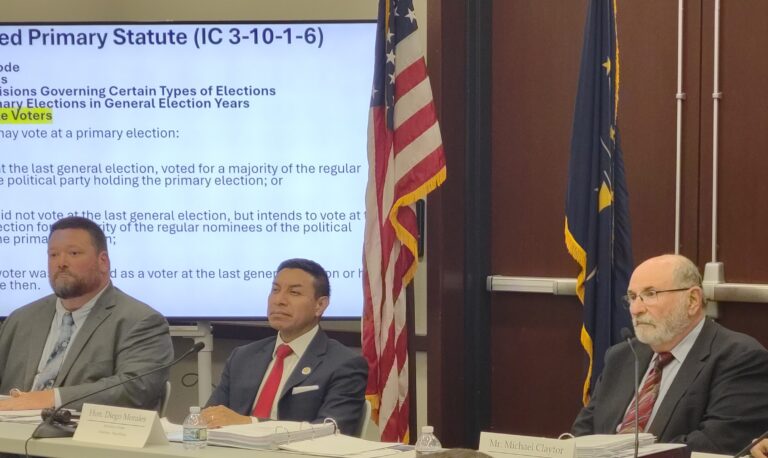
After nearly four hours of listening to arguments over allegations of illegal votes and the extent of ballot secrecy in the recount of the Senate District 23 Republican primary, Indiana Secretary of State Diego Morales offered his assessment: All of this could have been avoided if the General Assembly had closed primary elections.
“The past two sessions, I think everybody can attest, I’ve been promoting that we pass legislation and encouraging our General Assembly to close our primaries,” Morales said during the Indiana Recount Commission hearing on Tuesday. “I am a proud Republican and I believe that’s the way to go. I will encourage the General Assembly next session to hopefully, this time, pass legislation and close our primaries once and for all.”
With only three votes separating that Republican primary’s winner, state Sen. Spencer Deery, R-Lafayette, and his challenger, Paula Copenhaver, Morales’ statement was particularly significant. His words bolstered the Indiana Republican Party’s push for closing the state’s primaries and prefaced his vote at the Recount Commission meeting that would deal a blow to Copenhaver, the candidate endorsed by President Donald Trump and U.S. Sen. Jim Banks, R-Indiana.
Since falling short in the May primary, Copenhaver petitioned for a recount in the district, which includes six counties, and filed a series of motions and requests that pushed at the boundaries of contesting election results.
Morales made his statement before the three-member Recount Commission voted on a motion that would have allowed Copenhaver to depose 11 voters who had seemingly posted on social media that they asked for a Republican ballot for the primary solely for the purpose of casting a ballot against her.
In addition to admonishing state lawmakers for not passing legislation that would close Indiana’s primaries and prevent such crossover voting, Morales also stated his opposition to forcing Hoosiers to reveal for whom they voted.
“I don’t believe that’s the right thing to do,” Morales said. “I believe everybody has the right to go and vote, but they need to do it the right way. … I encourage the General Assembly next session to close our primaries, so we can avoid all of this.”
Morales, chair of the Recount Commission, then joined Michael Claytor, the Democratic member of the commission, in defeating Copenhaver’s motion in a 2-to-1 vote. Paul Mullin, the Republican member, supported the motion.
Copenhaver, former Fountain County Circuit Court clerk and current staff member in Indiana Lt. Gov. Micah Beckwith’s office, is being represented in the recount battle by William Bock III, a partner at Kroger Gardis & Regas in Indianapolis.
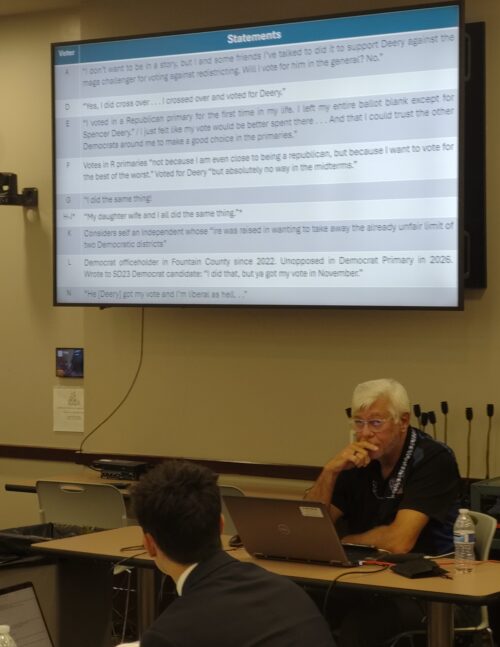
Bock argued before the Recount Commission that the 11 Hoosiers had violated state statute regarding eligible voters: Indiana Code 3-10-1-6. The provision allows individuals to vote in the Democratic or Republican primary only if they either voted for a majority of that party’s candidates in the last general election or intend to vote for the party’s nominees in the upcoming November contest.
Including the alleged posts of the 11 voters in his exhibits, Bock asserted a Republican primary is meant to enable Republican voters to choose the Republican candidate who will run in the general election. Instead, the excerpts from social media highlighted the voters’ messages about pulling a GOP ballot so they could support Deery, even though they would be voting for the Democratic candidate in the November midterm election.
“Everybody should be able to vote for who they decide is the best candidate in the general (election),” Bock told the Recount Commission. This case is “about whether you can kind of, under the radar, try to illicitly undermine the other party’s candidate …. We shouldn’t be allowed to violate Indiana law to manipulate the outcome of an election.”
Bock characterized the depositions as challenging the 11 voters in order to ascertain whether the ballots they cast in the May GOP primary were legal. Pointing to legal precedent and Indiana Code 3-10-1-9, which allows voters in a primary election to be challenged if they are suspected of not being affiliated with the particular party, Bock asserted the voters can be asked what lever they pulled or box they checked when inside the voting booth.
Ultimately, the voters’ answers, Bock said, will determine whether the individual votes were illegal and therefore should be excluded from the recount.
“We have strong evidence that shows that they’re not Republican voters,” Bock said of the 11 individuals. “Every one of them voted in the 2024 general (election) and so they have to answer, yes or no, ‘Did you vote for Republicans in the ’24 general?’ If they didn’t, then they weren’t entitled to vote in the primary and we’re entitled to ask them who did they vote for? That’s the basis of our request.”
Samantha DeWester, legal counsel for Deery, scoffed, describing Copenhaver’s request for depositions as “dog whistling the General Assembly” to close the primaries.
Arguing that deciding which candidate to vote for is “one of the most personal, private decisions” an individual can make, DeWester repeatedly asserted Copenhaver’s team had not validated that the 11 voters had actually made the posts on social media. Also, she pointed out that Copenhaver had dropped three voters from the deposition list after finding out that none of them lived in Senate District 23, despite their claims that they had voted for Deery.
The voters are nonparties to this case, DeWester said, and Copenhaver has no idea how any of the 11 voted, but she wants to “drag them into a deposition.”
“There is nothing that (the voters) could be prosecuted for. If you look at voter fraud, it doesn’t include voting in a primary. There is no ramification,” DeWester told the Recount Commission. “However, they are an issue in search of an argument, and this is the vessel for that argument, so we can dog whistle everyone about how we must change our laws.”
At one point, DeWester read a social-media post she had discovered. The individual who made the post indicated Copenhaver had personally thanked a “staunch Democrat” for pulling a Republican ballot in the May primary and voting for her.
“So, should we track down that person and maybe subpoena them to a deposition and say, ‘Hey, did that really happen?’” DeWester asked. “No, that’s ridiculous. We’re better than that.”
Copenhaver’s motion for depositions was one of 10 the Recount Commission considered during the July 28 hearing.
The deposition motion was among the last to get a vote. In response to the denial, Bock made an oral motion requesting the 11 voters be subpoenaed to attend the final recount hearing in this matter and answer roughly the same questions that would have been asked during the depositions. Again, the commission denied the motion in a split decision with Morales joining Claytor in voting “no.”
The commission also voted unanimously against Copenhaver’s request for access to the federal Systematic Alien Verification for Entitlements database and her three motions to obtain documents and depose Tippecanoe County Circuit Court Clerk Julie Roush about a single absentee ballot that was added to Deery’s vote total the day after the May primary. Also, Deery’s motion to depose Copenhaver was unanimously denied.
Copenhaver’s objection to an alleged alteration of the certified election results in Park County was tabled until the commission’s final recount hearing.
Conversely, the Recount Commission unanimously approved Copenhaver’s motion to hold the final recount hearing in Senate District 23. At that time, Copenhaver and Deery are expected to dispute the counting of several hundred ballots.
Deery’s motion to dismiss the contest portion of Copenhaver’s claims came at the beginning of the hearing. Recount Director Evan Norris’ team described Deery’s submission as presenting a threshold issue and likely the commission could not rule on any of the other motions before deciding whether to dismiss.
Granting Deery’s motion would have gutted most of Copenhaver’s claims and just left the dispute over the validity of the ballots.
Bock and DeWester offered much of the same arguments on the dismissal motion as they articulated over Copenhaver’s deposition motion. The attorneys sparred over deposing the 11 voters and clashed over how much information the individuals could be forced to divulge about their voting behavior.
Similarly, the Recount Commission split 2-to-1 in denying Deery his request; however, Morales sided with Mullin in the vote.
DeWester warned that not dismissing Copenhaver’s claims and allowing her to question voters under oath would set a precedent for future elections. Voters could be subpoenaed after every primary or general election, she said, before speculating that voters might be plucked at random and asked questions about how they voted.
Also, DeWester focused on social media, describing it as a public space and arguing that issuing subpoenas to “innocent voters” over comments they may have made online was an infringement of their First Amendment right to free speech. People are not always truthful when they post, she said, but they are allowed to comment as they want.
“A voter’s right to vote in secrecy and by secret ballot is fundamental,” DeWester said. “We have a fundamental right to vote as much as we have a fundamental right to the First Amendment to say what we want to in the public interest.”
Bock countered that asking Hoosiers who they voted for would not violate their privacy rights. He asserted that voters have to pick either a Democrat or Republican ballot, so they are already affirming how they voted in the past and how they will vote in the future.
“Our position is that when one votes in a partisan primary, they waive their secrecy because they’re saying that they voted and how they voted in the past,” Bock said.
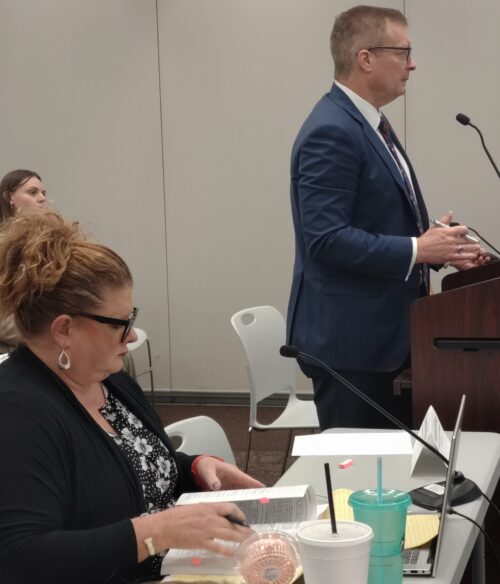
Bock and DeWester were civil throughout the hearing, always addressing their arguments to the Recount Commission and never snapping at each other. Still, they were a contrast in styles. Bock made his presentations from a podium and used his laptop computer to display documents and charts related to points he was making. Conversely, DeWester remained seated at her table, with a laptop computer and yellow legal pad perched in front of her as she gestured while explaining her position.
Commission member Mullin complimented both attorneys on their “impressive legal briefing.” He said their work had spelled out all the issues that were presented to the commission during the hearing.
Copenhaver also attended the hearing, but she did not testify or participate in the proceeding. Deery was not in attendance. DeWester said after the hearing that she told him not to come, because it would have been a waste of his time and he had “a lot of stuff he needs to be doing, (including) preparing for the general election.”
Reflecting on the hearing itself, DeWester indicated she was planning on reviving the motion to dismiss at the next recount hearing. Also, she said, if Deery ended up losing the recount, she is prepared to take the case to the Court of Appeals of Indiana.
“It gets concerning to a certain extent, but, I mean, I always have to place my beliefs and trust in the system and the process and that we aren’t going to disenfranchise Hoosier voters – several hundred of them – over the wishes of one losing candidate,” DeWester said.
After the hearing, Bock dismissed the question whether he was frustrated that the Recount Commission did not act on Copenhaver’s motions sooner. She had filed a motion in June, requesting the commission allow her to depose the voters in advance of the recount hearing, but the commission did not consider any of her submissions and requests until July 28.
The deadline for the Indiana Election Division to certify all the candidates who are running in the 2026 general election is Aug. 21.
“The best thing that I can always do is try to put my trust in the Lord and rely upon Him and lean not on my own understanding,” Bock said. “I mean, things happen when they happen and sometimes that’s good and sometimes it’s bad and sometimes you don’t know till you get to the end. I really try not to be frustrated because I’m not in control.”
The Recount Commission will hold its next hearing on the Senate District 23 dispute on Aug. 18 in Senate District 23.
Dwight Adams, an editor and writer based in Indianapolis, edited this article. He is a former content editor, copy editor and digital producer at The Indianapolis Star and IndyStar.com, and worked as a planner for other newspapers, including the Louisville Courier Journal.
The Indiana Citizen is a nonpartisan, nonprofit platform dedicated to increasing the number of informed and engaged Hoosier citizens. We are operated by the Indiana Citizen Education Foundation, Inc., a 501(c)(3) public charity. For questions about the story, contact Marilyn Odendahl at marilyn.odendahl@indianacitizen.org.