By Sydney Byerly
The Indiana Citizen
July 30, 2026
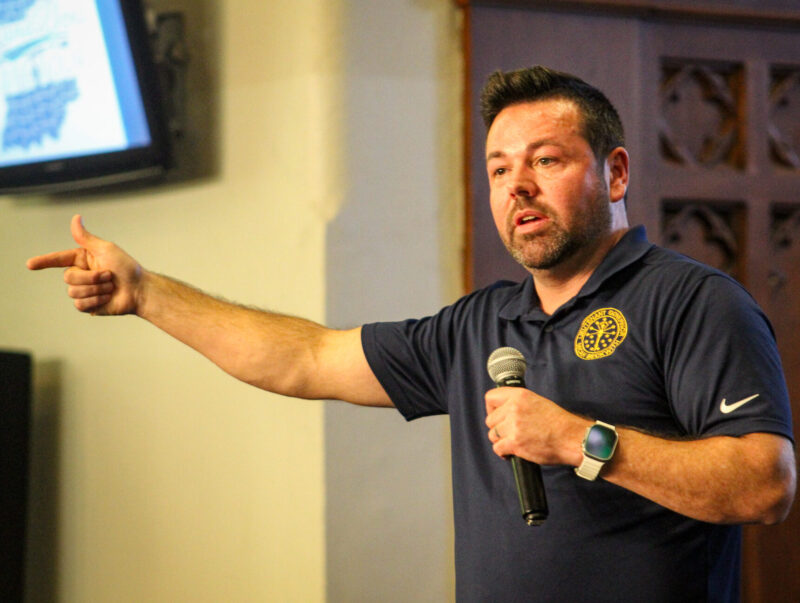
MARION, Ind. — Indiana Lt. Gov. Micah Beckwith said Wednesday that Indiana should amend its constitution to require candidates for public office to profess their belief “in Judeo-Christian orthodoxy” – a religious oath similar to those found in Revolutionary-era state constitutions.
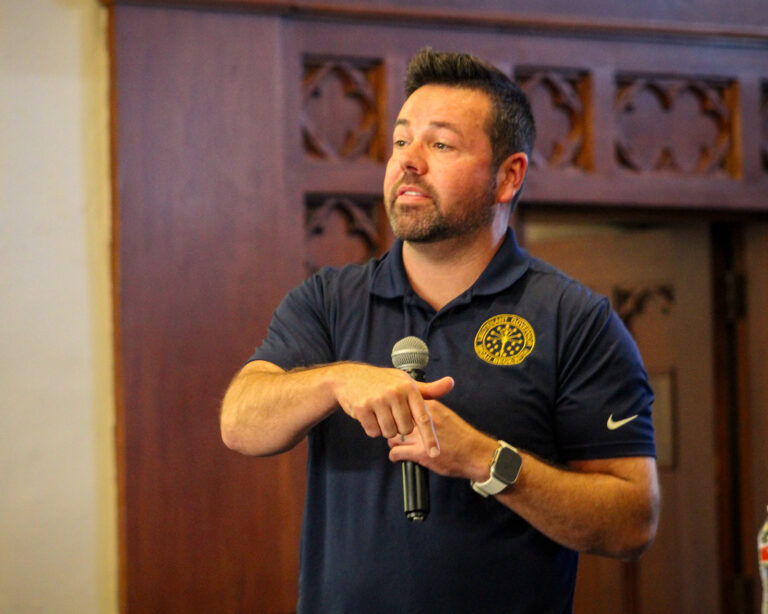
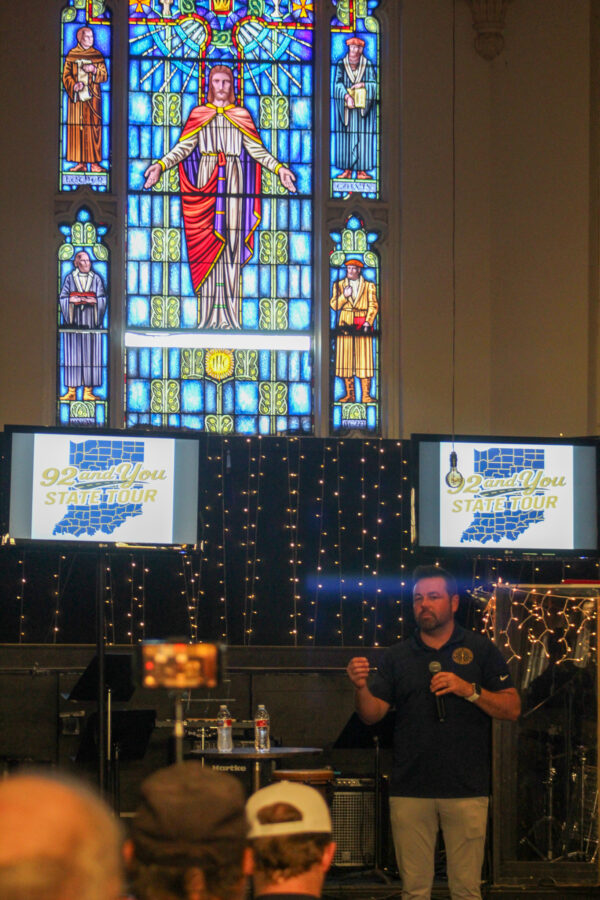
His comments came during a more than two-hour town hall at God’s House in Marion, where an audience member questioned Beckwith, a first-term Republican, about previous remarks he had made lambasting Islam. The discussion evolved into a broader debate over the role of religion in American government.
Beckwith told the crowd of about 50 attendees he would like to restore the religious oaths contained in some states’ early constitutions – which the Supreme Court in 1961 said were in violation of the U.S. Constitution’s First Amendment.
“Well, I want to go back to the way it was in the first 13 state constitutions, because there was a public declaration required, in Judeo-Christian orthodoxy, in order to hold office, because we are a Christian nation,” Beckwith said. “That doesn’t mean you have to be a Christian; doesn’t mean you have to swear allegiance to Jesus Christ as your Lord and Savior. It means you recognize what the foundations of this nation are. I would love to see that.”
An audience member immediately challenged Beckwith’s comments, asking about Native American religions and arguing Christianity was not the first religion practiced on the continent. Beckwith responded that he was referring to the foundations of the United States, not the religious beliefs that existed before European settlement of the continent.
Beckwith later clarified that he was not advocating ignoring Indiana’s current constitution, which explicitly bars religious tests for office, but instead said he would support changing it to resemble what he described as the intent of the earliest state constitutions.
“I wouldn’t say we should just legislate a religious test right now because it’s going to be a violation of our state constitution,” Beckwith said. “But I will say we should advocate for changing the constitution.”
Beckwith argued that early state constitutions required officeholders to publicly affirm Christian beliefs and said he would like to restore similar provisions. Several early state constitutions once required elected officials to profess Christianity, Protestantism or belief in God.
Indiana’s first constitution, adopted in 1816, however, prohibited religious tests for office, stating that “no religious test shall be required as a qualification to any office of trust or profit.” Indiana’s current constitution contains a similar prohibition. Also in 1961, the U.S. Supreme Court’s ruling in Torcaso v. Watkins found that requiring religious qualifications for public office violated the First and Fourteenth Amendments.
The exchange began after an audience member asked Beckwith whether reports were accurate that he had called for making Islam illegal in the United States. Beckwith said he did not call for outlawing Islam in its entirety, but did call for the state to take steps to ban the Islamic call to prayer and said mosques’ funding should be investigated.
“I love Muslims. I want them to feel free to worship,” Beckwith responded, before arguing that Islamic law is incompatible with what he described as America’s Christian foundations and expressing concern that Muslim communities could eventually reshape American culture if they gained political influence.
Throughout the discussion, Beckwith repeatedly argued the First Amendment’s Establishment Clause was intended to prevent the federal government from favoring one Christian denomination over another, rather than to create what he described as a modern separation of church and state. He cited the constitutions of the first 13 states, Benjamin Franklin’s call for prayer during the Constitutional Convention and other historical examples to support his interpretation.
Beckwith also cited Thomas Jefferson’s ownership of a Quran, saying Jefferson acquired it because he wanted to understand how to “destroy Islam” before it gained a foothold in the United States.
The Marion event was part of Beckwith’s “92 & You State Tour” and lasted more than two hours, covering topics ranging from Medicaid, immigration and data centers to foreign policy and faith-based initiatives. The Indiana Citizen also posted a full recap of the Marion town hall.
Editor’s Note: An earlier version of this story incorrectly stated that Indiana’s 1816 Constitution required officeholders to affirm a belief in God and in future rewards and punishments. While some early state constitutions included religious qualifications or declarations for public office, Indiana’s 1816 Constitution prohibited religious tests for office, stating that “no religious test shall be required as a qualification to any office of trust or profit.” The story has been corrected.
Sydney Byerly is a political reporter who grew up in New Albany, Indiana. Before joining The Citizen, Sydney reported news for TheStatehouseFile.com and most recently managed and edited The Corydon Democrat & Clarion News in southern Indiana. She earned her bachelor’s in journalism at Franklin College’s Pulliam School of Journalism (‘Sco Griz!).
The Indiana Citizen is a nonpartisan, nonprofit platform dedicated to increasing the number of informed and engaged Hoosier citizens. We are operated by the Indiana Citizen Education Foundation, Inc., a 501(c)(3) public charity. For questions about the story, contact Marilyn Odendahl at marilyn.odendahl@indianacitizen.org.