By Sydney Byerly and Marilyn Odendahl
The Indiana Citizen
July 31, 2026
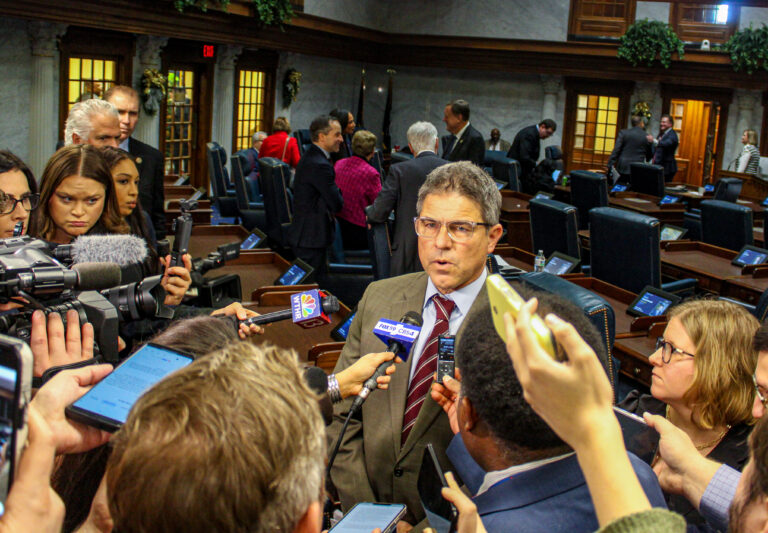
Noting Republican lawmakers could put their political careers in jeopardy simply for supporting him, Senate President Pro Tempore Rodric Bray announced Friday he will be stepping down from his leadership position.
Bray, R-Martinsville, who has served as Senate president since 2018, will not be seeking re-election to the upper chamber’s top position when the Indiana General Assembly reconvenes in November.
“Serving as the President Pro Tem of the Senate for eight years has been among the most significant honors of my life, but it’s time for the Senate to choose another leader,” Bray said in his statement.
Bray will continue to serve as Senate president and manage its day-to-day operations until the next leader is chosen by the Republican caucus on Organization Day.
The Indiana Senate selects a new president in November of every other year. Bray was first elected to the pro tem position in 2018, succeeding David Long. Bray represents Senate District 37, which includes Morgan County and portions of Johnson, Owen and Putnam counties.
Bray will be the first pro tem in recent history to step down from leadership but continue his term in the Senate. Bob Garton served as Senate president from 1982 to 2006, when he was defeated in the Republican primary. Long wIelded the gavel from 2006 until he retired in 2018.
Bray’s colleagues in the General Assembly responded to his announcement by calling attention to his leadership.
House Speaker Todd Huston, R-Fishers, issued a statement calling Bray “a great friend and legislative partner.”
“I admire his many legislative accomplishments, but what I admire most is his commitment to family and to our state,” Huston’s statement reads. “I look forward to continue working alongside him as a Senator and continuing our long friendship.”
Senate Minority Leader Shelli Yoder, D-Bloomington, said in a statement that Bray “led the Indiana Senate with integrity and a steady hand.”
“I respect his commitment not just to his constituents, but to all of Indiana as he served in leadership over the last eight years,” Yoder said. “Although he is stepping down as President Pro Tem, I wish him the very best as he continues to serve District 37.
Gov. Mike Braun did not release any official statement.
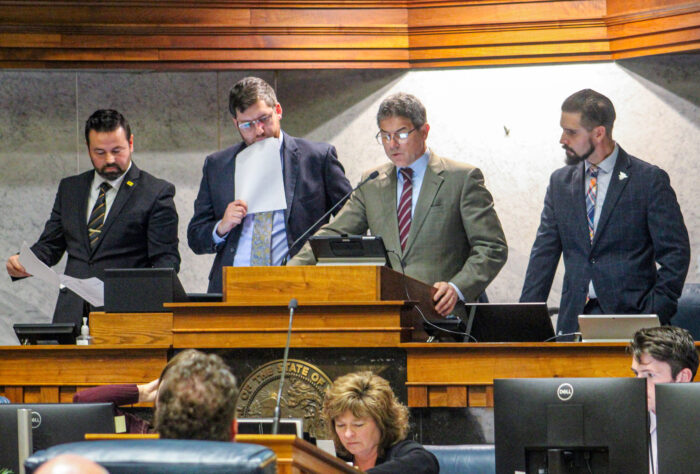
Bray’s tenure as Senate president was marked at the end by the bitter fight over redistricting. Last year, President Donald Trump pressured legislators in red states to redraw their congressional district maps in the middle of the decade in order to put GOP candidates in position to capture more seats and ensure Congress remained in Republican hands after the midterm election.
Braun called a special legislative session in November to undertake an unprecedented midcycle redistricting. Trouble developed immediately, as Bray and the Senate Republicans resisted, but once Huston scheduled the House to convene in December, Bray followed suit, and a bill that supporters said would put Republicans in all nine of the Hoosier State’s congressional seats was introduced.
The new map cleared the Indiana House, even though the entire Democratic caucus and several Republicans voted against it. In the Senate, the push to redistrict was blocked, with 21 Republicans joining all 10 Democrats to hand Trump his first redistricting defeat.
Bray said at the time the proposal lacked sufficient support within the Republican caucus and argued lawmakers should instead focus on other priorities.
The vote exposed a rare split within Indiana’s Republican supermajority. Trump and Braun sharply criticized Republicans who opposed the redistricting plan, and eight of those Republican senators who voted the map down later faced well-funded primary challengers in the 2026 election cycle, with most losing their seats.
Bray became a punching bag. Trump and other leaders in the Republican party blamed the lawyer from Martinsville for single-handedly foiling the GOP’s chances of retaining control of Congress.
State Sen. Greg Walker, R-Columbus, scoffed at that characterization.
“People have given him too much responsibility for the choice of the Senate caucus, as if he imposed his will,” Walker said. “I would argue the opposite. He’s allowed us to be very thoughtful and contributing and engaging on the issues that have faced the Senate both from a policy standpoint and politically.”
Walker was among the six GOP senators who voted against redistricting and then lost in the May primary, brought down by a barrage of money and negative advertising. Pushing back on the notion that he is disappointed by his election loss, Walker said he still has his personal integrity after serving 20 years in the Statehouse and he credits that to Bray, who he says never tried to force caucus members to vote a particular way.
Still the Senate has gotten a bit of a reputation of being obstructionist, because the upper chamber has often had different viewpoints and priorities on issues than the governor or the House. Even so, Bray did not impose his will but rather walked the senators through the choices they had and the potential outcomes.
Shortly after Bray made his announcement Friday morning, Trump posted a gleeful response on social media. Trump disparaged Bray’s leadership, saying he “foolishly led the Indiana State Senate” and cost six longtime senators, who voted against redistricting, their seats. Also, Trump blamed Bray for potentially causing the GOP to lose control of Congress.
“Rodric Bray should be ashamed of himself for costing our Country, mainly the Republican Party, two U.S. House Seats, and for costing all his colleagues who went along with him, an Election loss!” Trump wrote on his social-media site, Truth Social.
Walker speculated Bray decided to step down from leadership after seeing the political climate change and “authoritarian bullies” rising to power. “He’s not a bullying character.”
However, Walker said if the next Senate president pro tem takes a more heavy-handed approach and pounds into submission any GOP lawmaker who falls out of line, the ability of caucus members to think for themselves and act independently will erode and they will become “rhesus monkeys up there that are trained to press green or red” to vote yea or nay as they are told.
As a result, Hoosiers will see less of the decision-making process. Walker noted as a state senator, he attended public meetings in his district and was transparent about what was happening, regardless of the political fallout.
“We’ll lose that,” Walker said. “There’ll be more fear. There’ll be more keeping to the vest all decisions for fear of repercussions.”
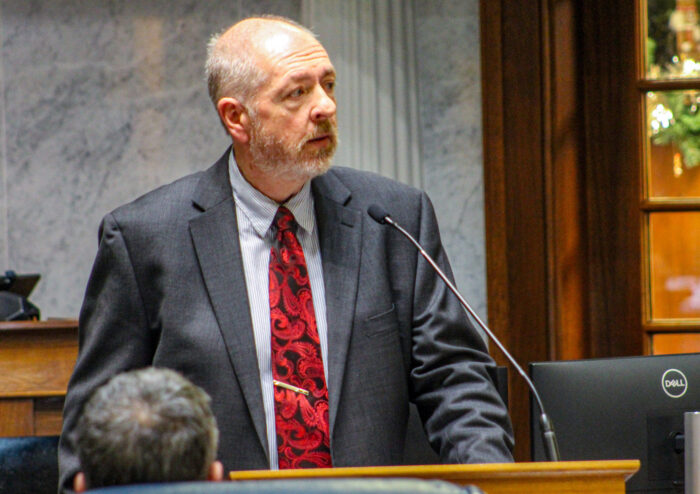
Laura Merrifield Wilson, an associate professor of political science at the University of Indianapolis, said Bray’s decision appears to be the culmination of months of political fallout after the failure of midcycle redistricting.
The primary defeats of several Republican senators who opposed redistricting, Merrifield Wilson said, likely made it increasingly difficult for Bray to maintain enough support within the caucus to remain the Senate president pro tempore.
“This is fallout,” Merrifield Wilson said. “This is a consequence and outcome of that decision back in December.”
Although Bray’s announcement came months after the May primary and surprised some observers, Merrifield Wilson said the timing likely reflects political calculations that have been unfolding behind the scenes.
The Senate president pro tempore is one of the most powerful positions in state government, responsible for setting legislative priorities, assigning committee leadership and serving as a key negotiator alongside the governor and House speaker. While many Hoosiers may not know who holds the position, Merrifield Wilson said the office plays a significant role in determining which proposals advance in the legislature and in building consensus within the Republican caucus.
“The Senate president pro tem is responsible for creating legislative priorities” and serving as one of the public faces of the General Assembly, she said.
Retired Republican state Sen. Jim Merritt said Bray’s exit adds more chaos to the GOP caucus that has been under siege and fighting amongst themselves since the 2022 special session, when the General Assembly passed the near-total abortion ban.
Already the Senate majority leader and caucus chair positions are open. Moreover the level of legislative experience will be declining, especially since those six GOP incumbents will not be returning next session after being defeated in their primaries.
The individual who wants to be the next Senate president will have to get at least 21 votes. A common strategy to secure the top job has been to get the support of the committee chairs, but this year, Merritt noted, that path is a little uncertain since some of the chairs lost their primaries.
“What will be happening is that people in the caucus will be hot on the phone, promising chairmanships and seeing if they can put 21 votes together,” Merritt said, adding those wanting to be the next Indiana Senator leader will also likely be assembling the team to fill the majority leader and caucus chair positions. “Right now, it’s a scramble.”
Indiana Lt. Gov. Micah Beckwith, who presides over the Senate but does not vote except to break ties, signaled that he hopes the transition will move the chamber further to the right. In a statement, Beckwith said Bray’s departure gives Republicans an opportunity to create an even more conservative Senate, while advancing Trump’s agenda.
“With Senator Bray stepping aside, this gives Hoosiers a real chance to build one of the most conservative senates in the country while following President Trump’s bold vision for the future,” Beckwith said. “I look forward to working with the new Pro Tempore to make sure this happens!”
The leadership transition also comes as Braun prepares for his third legislative session as governor and lawmakers begin shaping the next two-year state budget. Merrifield Wilson said the relationship between the governor and Senate president can have a major influence on how quickly an administration’s priorities move through the legislature, but she emphasized that the Senate president’s role is not simply to carry out the governor’s agenda.
“The relationship between the governor and Senate president is incredibly important,” she said. “Sometimes the leadership is benefited by having disagreements with the governor because they’re able to flex their legislative muscle.”
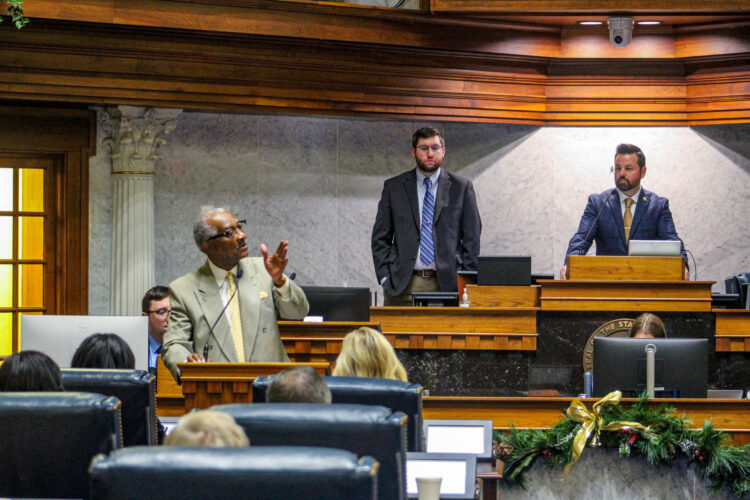
Julia Vaughn, executive director of Common Cause Indiana, has been a fixture in the Statehouse, advocating for voting rights and government transparency. She helped lead the grassroots opposition that blocked redistricting, handing Trump one of the few defeats of his second term.
“I’m extremely disappointed to hear that Senator Bray will not continue to be the top leader in the Senate,” Vaughn said. “His calm and steady leadership during the mid-cycle redistricting fight made it clear that his primary concern was to preserve the integrity and independence of the Indiana Senate, which is commendable. It is unfortunate that he and others who did the right thing and stood up to tremendous pressure are paying a high political price. His practice of putting the institution before politics will be missed.”
Andrew Bradley, senior director for policy and strategy at Prosperity Indiana, believes Bray’s leadership style created a culture among senators to be receptive to listening and learning.
Each year, Prosperity Indiana, a nonprofit focused on community economic issues, such as housing affordability and wage inequality, hosts a series of “Policy & Pizza” conversations with state legislators. Regularly, one of these events would be held in Bray’s Senate district and he would be in attendance. Bradley noted Bray would spend most of his time listening and taking notes.
“He didn’t come in and start off by telling us what we ought to be thinking, or what we ought to be telling the Hoosiers with the greatest needs in the communities,” Bradley said. “He came in first and listened and then gave his perspective about where he thought there were areas of opportunity.”
Bradley believes Bray’s approach gave an example that other lawmakers emulated. Prosperity Indiana and its partners are often in the Statehouse talking about consumer issues like medical debt, lending practices, and wage garnishment, initiatives which were usually met with strong opposition from powerful business associations and lobbying groups.
Even so, Bradley said Bray’s conduct set the tone. Legislators would listen and be receptive to a different point of view.
Bray’s attendance and attention at Prosperity Indiana’s pizza meetings might have helped set that culture, Bradley said. “It’s important for policy to be informed by the experiences of what Hoosiers are seeing.”
Bray is one of the few lawyers in the General Assembly. Paje Felts, legislative counsel for the Indiana State Bar Association, pointed out Bray has a deep connection to the Indiana Senate.
“Sen. Rod Bray’s leadership of the Indiana Senate reflects a lifetime commitment to public service, the rule of law, and the principles of representative democracy,” Felts said in a statement. “Like his father, who also chaired the Senate Judiciary Committee, Sen. Bray carries forward a family tradition dedicated to strengthening Indiana’s institutions and ensuring the law is applied fairly and thoughtfully. His leadership is grounded in respect for the legislative process, constitutional government, and the responsibility to serve Hoosiers with integrity and steady judgement.”
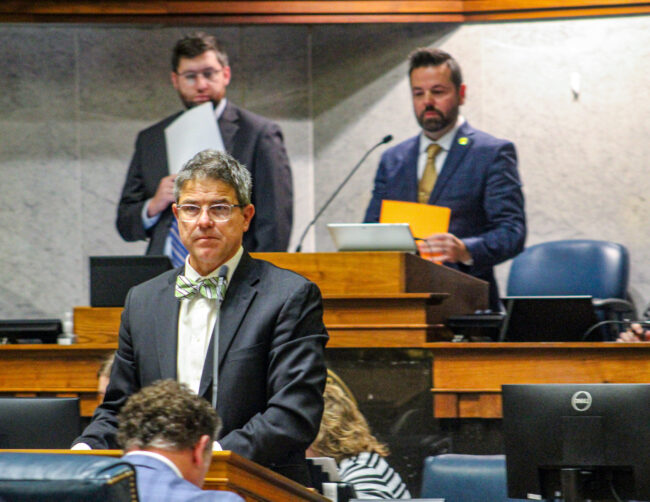
The Senate president pro tempore, Merrifield Wilson said, provides lawmakers with the opportunity “to listen, to work with the governor, but also to pursue their own interests.”
That dynamic has already surfaced during Braun’s first year in office.
In February 2025, Bray reportedly issued a written reprimand to Beckwith over his conduct while presiding over the Senate, highlighting tensions between the Senate’s institutional role and the governor’s administration.
The tensions between Beckwith and Bray became public in December, when Beckwith criticized Republican state senators on X who he said were failing to act on congressional redistricting, arguing that “too many Republicans are sitting back and letting it happen.”
After a user on social media criticized Beckwith for live-tweeting during Senate proceedings, despite his earlier reprimand, Beckwith dismissed the rebuke from Bray, writing that it carried “about as much weight as a crossing guard scolding you for jaywalking” and saying the Senate “doesn’t run me.”
Looking ahead, Merrifield Wilson said one of the biggest questions will be whether Republicans choose a successor who follows Bray’s approach or moves the chamber in a more conservative direction. She described Bray as part of the party’s more moderate wing and said the leadership race could reveal whether ideological alignment or governing style carries more weight within the caucus.
She also said the next Senate president’s ability to navigate the budget process could be a major factor as lawmakers prepare for a difficult spending debate in 2027.
“Experience with the state’s budget process could become an important selling point” for whoever ultimately seeks the position, she said.
Merritt agreed. He said the next 90 days leading to the general election will be filled with a lot of whispering and electioneering inside the Senate’s Republican caucus.
“There could be some exhaustion,” Merritt said. “There are a lot of people that are very short on experience in the Senate and it’s going to be really fascinating to see how politics and policy collide.”
Dwight Adams, an editor and writer based in Indianapolis, edited this article. He is a former content editor, copy editor and digital producer at The Indianapolis Star and IndyStar.com, and worked as a planner for other newspapers, including the Louisville Courier Journal.
The Indiana Citizen is a nonpartisan, nonprofit platform dedicated to increasing the number of informed and engaged Hoosier citizens. We are operated by the Indiana Citizen Education Foundation, Inc., a 501(c)(3) public charity. For questions about the story, contact Marilyn Odendahl at marilyn.odendahl@indianacitizen.org.