By Marilyn Odendahl
The Indiana Citizen
July 9, 2026
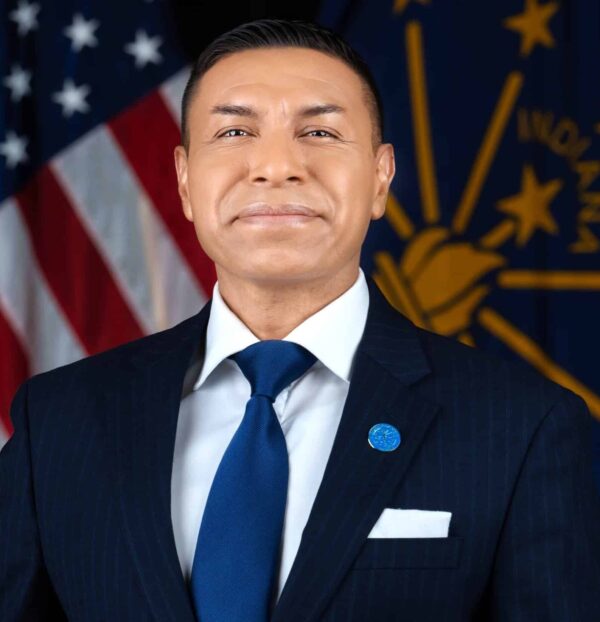
Indiana Secretary of State Diego Morales’ office has confirmed he received a letter from the Civil Rights Division of the U.S. Department of Justice asserting that state election officials can face criminal prosecution if ineligible voters cast ballots in their elections.
The DOJ letter, believed to have been sent to officials in all 50 states, highlights federal laws that state and local election officials must follow to “ensure free, fair, and transparent elections.” Specifically, the letter is focused on noncitizens and says any election officer who knowingly retains noncitizens on their state’s voter rolls and allows noncitizens to vote could be charged with a federal crime.
Also, the letter, dated July 7 and signed by U.S. Assistant Attorney General for Civil Rights Harmeet Dhillon, gives election officials five days to explain how the state is complying with federal election laws and how the Justice Department can assist. The states are asked to respond in writing.
Attached to the letter is a four-page memo reviewing the requirements in federal statutes that state and local elections officials must follow. The memo, like the letter, points to the provisions pertaining to the duty of election officials to ensure only eligible individuals are allowed to register and vote and to the potential criminal liabilities for not upholding those duties.
David Becker, executive director of the nonpartisan Center for Election Innovation & Research, told Votebeat the letter seemed to be more of an attempt to pressure election officials rather than launch criminal proceedings.
“If you really thought they committed a crime, you wouldn’t be sending a letter,” Becker told Votebeat. “You’d be bringing criminal indictments.”
In a response to a request for comment from The Indiana Citizen, the secretary of state’s office said the issue of election integrity is “deeply personal” to Morales, because he is a naturalized citizen.
The office took credit for Indiana’s new proof-of-citizenship voting laws, saying it “was the main proponent and the reason the Indiana General Assembly passed” House Enrolled Act 1264 and HEA 1680. Both laws require election officials to crosscheck voter rolls and voter registration applicants against the Indiana Bureau of Motor Vehicles’ temporary credentials database. Anyone flagged as having a temporary driver’s license or identification card will have to provide documentary proof of his or her citizenship status.
Voter-advocacy groups are challenging both laws in federal court, arguing the state’s proof-of-citizenship voting requirement violates the National Voter Registration Act of 1993 and the Civil Rights Act of 1964.
The Chicago Lawyers’ Committee for Civil Rights said the Justice Department’s letter “does not change what is already true”: Individuals registering to vote have to attest to their citizenship under penalty of perjury and no evidence has been presented of widespread voting by noncitizens in elections.
“States must ensure that efforts to verify voter eligibility do not come at the expense of eligible citizens’ right to vote,” CLCCR said in an email. “Since Indiana’s documentary proof of citizenship laws took effect, the state has canceled or rejected more than 1,200 voter registrations because registrants did not provide documentary proof of citizenship within the required 30-day deadline—despite those individuals having already attested to their citizenship under penalty of perjury, as every Indiana voter does when registering.”

Other measures that Morales’ office said protected Indiana’s elections include the 2024 initiative that provided every polling site across the state with a sign stating only U.S. citizens could vote.
Also, the office pointed out it has been using the Systematic Alien Verification for Entitlements system. Under President Donald Trump, more information about individuals living in the United States has been pulled from other federal databases and dumped into the SAVE system, which is housed in the U.S. Department of Homeland Security and has been used to check immigrant status.
Critics say the revamped SAVE system is unreliable and violates privacy laws.
A few weeks before the November 2024 presidential election, Morales and Indiana Attorney General Todd Rokita asked the U.S. Citizenship and Immigration Services to verify the citizenship status of 585,774 registered Hoosiers voters. According to Morales’ office, the Biden administration “ignored the request,” which led to the Trump administration “making substantive changes to the SAVE platform” when Trump began his second term in the White House in 2025.
Morales’ office said the state is “currently working on investigations” into noncitizens identified either through the SAVE system or the state’s proof-of-citizenship laws as having registered and voted.
However, the office did not specify the number of noncitizens that have been discovered on the state’s voter rolls and whether anyone has been prosecuted for voting without citizenship status. In September of 2025, Morales announced at a press conference that a Vigo County resident who was not a U.S. citizen had voted in previous elections, but, at that time, no charges had been filed.
The Indiana Citizen has sued the Office of the Indiana Secretary of State and the Office of the Indiana Attorney General to get access to the 2024 list of voters. The case is still pending in Marion County Superior Court.
Indiana touting its use of the SAVE database comes a little more than two weeks after the U.S. District Court for the District of Columbia blocked the Trump administration from utilizing the system to check the citizenship status of voters. Granting a summary judgment in a lawsuit brought by the League of Women Voters and other groups, the court found checking immigration status by using the revamped SAVE system violated the Social Security Act, the Administrative Procedures Act and the Privacy Act.
“The federal government has knowingly trampled on the privacy rights of American citizens in a manner that threatens the sacred right to vote,” Judge Sparkle Sooknanan wrote in her June 22 order. “This Court cannot stand idly by while that happens.”
On Tuesday, a U.S. district court in Florida ruled Indiana and three other Republican-led states can still use the SAVE system to check their voter rolls. The court found the settlement agreement the four states had reached with the Trump Administration for access to the database could not be blocked by the order from the D.C. district court.
Julia Vaughn, executive director of Common Cause Indiana, is concerned the recent DOJ letter is a harbinger of things to come in the November election. She said the fears in immigrant communities that police or Immigration and Customs Enforcement agents will be at the polling places are not unjustified.
“Instead of focusing on non-existent problems like ineligible people casting ballots, Secretary of State Morales should spend his last few months in office cleaning up the messes he had made and leave our voter list alone,” Vaughn said in an email.
Morales, a Republican who is in his first term as secretary of state, lost his bid to run for reelection, when the Indiana GOP Party at its June convention nominated Max Engling for the position.
This is not the first letter Morales has received from the Department of Justice. Last summer, the secretary of state received a request from the Justice Department to turn over the state’s voter rolls to federal officials. Morales announced in September 2025 that he had submitted the information, which included each voter’s address, driver’s license number and last four digits of his or her Social Security number
Many states received similar requests from the DOJ, but while most refused, Indiana was among the handful that provided the data
Dwight Adams, an editor and writer based in Indianapolis, edited this article. He is a former content editor, copy editor and digital producer at The Indianapolis Star and IndyStar.com, and worked as a planner for other newspapers, including the Louisville Courier Journal.
The Indiana Citizen is a nonpartisan, nonprofit platform dedicated to increasing the number of informed and engaged Hoosier citizens. We are operated by the Indiana Citizen Education Foundation, Inc., a 501(c)(3) public charity. For questions about the story, contact Marilyn Odendahl at marilyn.odendahl@indianacitizen.org