By Marilyn Odendahl
Indiana Citizen
August 13, 2026
Warren County does not have a traffic light or a Catholic church, but after Monday’s hearing of the Indiana Recount Commission, the rural county will forever have a place in Hoosier election history.
Of the 10 ballots the Recount Commission rejected in the fierce fight for the Republican nomination in Indiana Senate District 23, two were from Warren County. The commission decided those two absentee votes were invalid because neither were stamped with the seal of the circuit court clerk.
“It’s just basically human error, honey,” Deb Hiatt, Warren County Circuit Court clerk, said, explaining how the seal got left off the ballots. “That’s all it is, is human error.”
Similarly, human error appears to be the culprit leading to the Recount Commission’s decision to toss one ballot in Fountain County, two ballots in Vermillion County and five ballots in Montgomery County. The handful of ballots discarded in the primary was enough to overturn the initial result of the May election and instead make challenger Paula Copenhaver the winner over incumbent state Sen. Spencer Deery, R-West Lafayette.
Hiatt said the “two gals” who handled the absentee ballots in May have regularly been processing the mail-in and early-voting ballots for about 15 years, working from 8 a.m. to 4 p.m., or until the last voter goes home, during the 30 days leading to the election. The two absentee clerks put their initials on every primary ballot, as required by Indiana statute, but forgot to stamp the “little Lady Justice seal” on a pair of the votes.
“On Election Day … we opened all the absentee ballots – the ones that are (cast) in-person and the ones that are mailed – and every ballot had their initials,” Hiatt said. “We didn’t check for the stamp.”
The Indiana State Board of Accounts, which did the labor-intensive work of physically recounting every ballot from Senate District 23, did not find any questionable or problematic votes. Instead, the board concluded its part of the recount process with the same vote total as announced after the primary: Deery with 6,337 and Copenhaver with 6,334.
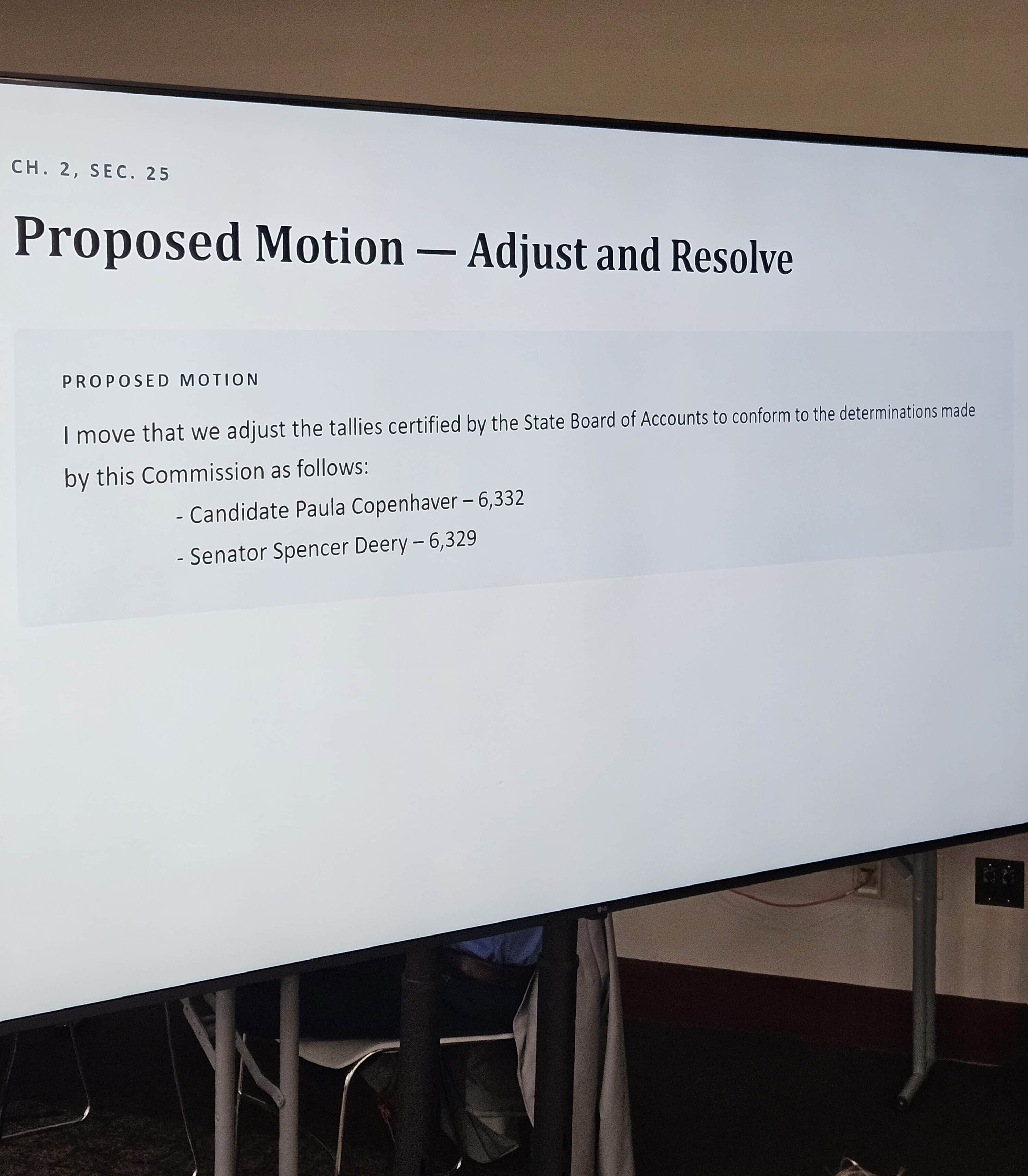
However, the Recount Commission rejected four absentee ballots because they lacked the initials of two bipartisan election workers and tossed six absentee ballots for not having the signature or seal of the county clerk. Consequently, the final tally gave Copenhaver 6,332 votes to Deery’s 6,329.
While Indiana law clearly states votes without the proper initials are invalid, the language is more ambiguous about missing signatures and seals.
William Bock III, attorney representing Copenhaver, asserted the “reliability indicators” of initials, signatures and seals were all required to ensure the integrity of absentee ballots. Conversely, Samantha DeWester, attorney for Deery, argued that even without the clerk’s signature or seal, the ballots should still have been counted, because the statute states votes without the clerk’s markings should be rejected in cases of fraud and misconduct but not in cases of error or oversight.
During the Recount Commission’s Aug. 10 hearing, the disputed ballots were tossed largely on split votes. Paul Mullin, the Republican member, and Indiana Secretary of State Diego Morales, also a Republican and chair of the commission, voted to reject the ballots. Michael Claytor, the Democratic member, voted to accept them.
Marion County Circuit Court Clerk Kate Sweeney Bell, a Democrat, said the commission’s decision to discard the ballots without the clerk’s markings was voter suppression. She said Hoosiers took time away from their day to go to the polls and cast a ballot, but because of “the equivalent of a Scrivener’s error,” their voices are not going to be heard.
“Shame on the members of the commission who voted for (rejecting the ballots), because, I believe, you err on the side of counting the vote, instead of looking for reasons to throw it out,” Sweeney Bell said. “This is disgusting and, really, the ramifications are unknown.”
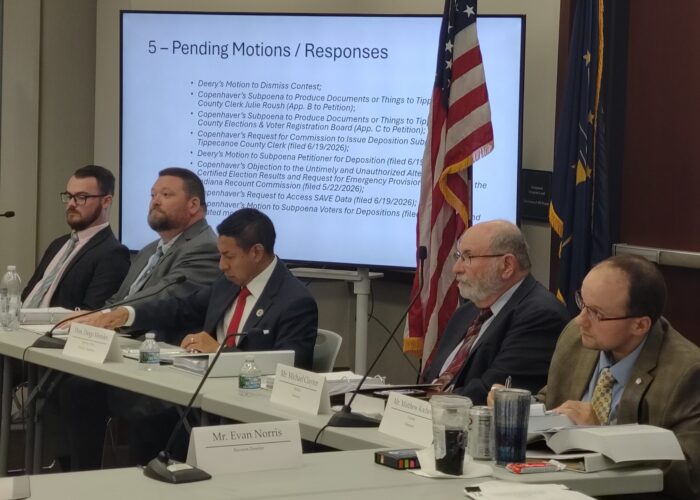
The Recount Commission discarded three ballots cast for Deery and two for Copenhaver in Montgomery County.
Sondra Sixberry, Montgomery County Circuit Court clerk, said the mail-in ballots are always initialed and signed before they are sent to the voters. Also, she tucks a note into the envelope, telling the recipients the steps to take to ensure their votes are counted, which includes double-checking that their ballots have the clerk’s markings.
Sometimes, the ballots can be processed and ready for mailing but be held up waiting for the two bipartisan election workers to sign their initials, Sixberry said. She recalled one instance where a ballot without the two sets of initials was accidentally dropped into the mail. The clerk’s office quickly realized the error and immediately contacted the voter with instructions to return the ballot for a new one.
Also, Sixberry said, when the mail-in ballots are returned, the election workers check the outside of the ballot envelope to make sure the voter has signed and properly marked it. When an envelope does not have the signature and date, again, the voter is contacted and given the opportunity to fix the issue, she said.
However, Sixberry noted, the election workers cannot see whether the initials and clerk’s signature are on the ballot until Election Day when the envelopes are opened.
Sixberry attributed the missing initials and clerk’s signatures on the handful of Senate District 23 ballots from her county to an error in poll worker training. Still, she said, voters need to pay attention.
“At the end of the day, I strongly believe that the elections belong to the people and the people need to step up and make sure they understand all the rules and they follow them appropriately,” Sixberry said.
Claytor, the Democratic member of the Recount Commission, succinctly summed up the reason for the signature-less ballots. “Somebody screwed up,” he said during the Aug. 10 hearing.
Then, taking a close look at the Indiana Code, Claytor echoed DeWester that unlike ballots without initials, votes without the clerk’s signature or seal are not required to be tossed. And he advocated for the Recount Commission to err on the side of the voter.
“When the legislature says we can figure it out and count it or not, I lean towards counting,” Claytor said.
Kay Kilgore, Posey County Circuit Court clerk and past president of the Association of Clerks of the Circuit Courts of Indiana, said the handling of ballots is not a one-size-fits-all procedure. Every county has a little different approach to preparing and processing absentee ballots.
“In defense of the workers, in many counties they’re overwhelmed,” Kilgore said. “They’re sending out hundreds (of ballots) a day and to get them initialed, I mean, they’re doing their best effort. I can’t fault any of them.”
In Posey County, which is not part of Senate District 23, the mail-in ballots are preprinted on the back with the clerk’s seal and a box for the election workers’ initials. As in Montgomery County, the clerk’s office in Posey County includes instructions to the absentee voters to check that their ballots have the proper markings.
Kilgore’s election team then begins opening the mail-in vote envelopes at 6 a.m. on Election Day. For any ballot that is missing the initials, Kilgore makes what she described as a “horrible call.”
The voter is telephoned with the news that their ballot is invalid, but they have until 5 p.m. on Election Day to get to a polling location and cast their vote in person. Voters’ reactions can vary, Kilgore said, with some voters during a low-key election year shrugging and opting to stay home, while other voters, particularly in presidential election years, will quickly head to the vote center.
Kilgore highlighted some legislative fixes that could streamline the ballot-handling process and could have likely prevented the majority of the problems that got the ballots rejected in the Senate District 23 recount. Although human error will always be present, changes to state statute could eliminate many of the steps in the early voting process that can jeopardize an early-voting ballot from being counted.
“I don’t know that there’s much more that you can do,” Kilgore said. “I don’t know of any magic potion or anything that would cause it not to happen.”
Meanwhile in Warren County, Hiatt said she is standing behind the two absentee ballot election workers, who are just “absolutely amazing,” but she knows they will be upset when they learn the Recount Commission rejected two ballots they processed. As a result, she said, that pair of workers will be paying even closer attention to “every flipping ballot come fall.”
County clerks across the state will probably be doing the same and possibly putting a little extra energy into what Hiatt said was the clerks’ prayer: “We don’t really care who wins. We just want them to win big.”
Editor’s note: This story has been updated to clarify Kay Kilgore’s comment about steps the legislature could take to make the ballot-handling process more efficient.
Dwight Adams, an editor and writer based in Indianapolis, edited this article. He is a former content editor, copy editor and digital producer at The Indianapolis Star and IndyStar.com, and worked as a planner for other newspapers, including the Louisville Courier Journal.
The Indiana Citizen is a nonpartisan, nonprofit platform dedicated to increasing the number of informed and engaged Hoosier citizens. We are operated by the Indiana Citizen Education Foundation, Inc., a 501(c)(3) public charity. For questions about the story, contact Marilyn Odendahl at marilyn.odendahl@indianacitizen.org.