This story was originally published by Capital B Gary.
By Calvin Davis
Capital B Gary
June 30, 2026
The meetings had been going well.
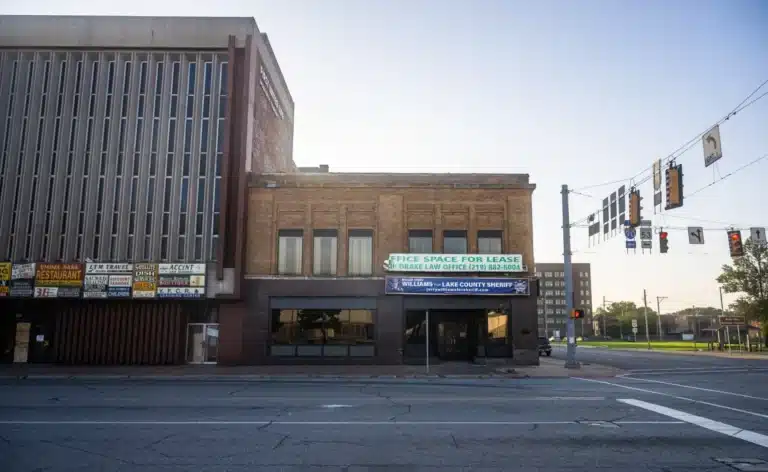
For months in early 2025, attorney Macarthur Drake and his family met with Gary officials about the future of downtown Broadway. The conversations centered on how the city planned to protect Drake’s building at 487 Broadway while demolishing the vacant structure next door.
Four meetings. Maybe five. Each one focused on the same thing: what the city would do to safeguard his building during the demolition of 475 Broadway, the Mecca Building, which had sat abandoned and deteriorating in plain view of City Hall for more than a decade.
Then a contractor from Oakland County, Michigan, walked into the room.
He came with Carla Morgan, Gary’s corporation counsel, and the city’s chief operating officer, Michael Suggs.
The contractor went through the details methodically, how they’d cover the roof, shutter the windows, protect the structure. Drake and his family listened. And then, toward the end of the meeting, almost as an aside, the contractor mentioned something no one from the city had ever said in any of the previous meetings.
It would be cheaper, he said, to just demolish 487 Broadway, too.
Drake sat with that for a moment. Then he asked why.
The answer he got back was vague, something about costs, something about the difference in price. Drake asked for it in writing. It never came.
What came instead, weeks later, was a two-page letter with a number on it: $282,500. That was the city’s offer to purchase 487 Broadway, a three-story, 18,000 square foot building on the northeast corner of Fifth Avenue and Broadway that Drake’s family had occupied since 1985, owned since 2016, and built into what is today one of the only functioning commercial addresses in downtown Gary. Lake County records place the building’s assessment at $348,200.
Drake hadn’t offered to sell.
“We were never aware of what they intended to do,” he said. “We still weren’t aware.
The letter was signed by Morgan on behalf of the city of Gary. It cited a single justification: The city needed the building in order to safely demolish the Mecca Building next door.
The Drake family countered at $1.2 million.
The city, Drake said, came back with something that wasn’t a number. The family still isn’t sure what it was. Then the correspondence stopped.
On Nov. 4, 2025, without any further negotiation, the city filed a condemnation complaint in Lake County Superior Court. The Drake family didn’t find out through any official channel. They found out because someone saw it in the court record system and called.
“The lawsuit was filed Nov. 4,” Drake’s son, Russell Drake said. “However, we were not aware that it had been filed. We became aware in the middle of November. That’s how we found out.”
What followed was six months of legal maneuvering that illustrated, in sharp relief, how Indiana’s eminent domain law is designed to work and who it is designed to protect.
The fight over 487 Broadway has become more than a dispute over one downtown building. It raises broader questions about how far cities can go when pursuing redevelopment, what protections property owners have under Indiana’s eminent domain laws, and whether longtime Black-owned institutions that survived decades of decline will have a place in Gary’s planned revival.
On March 11, 2026, both sides appeared in Lake County Circuit Court in front of Judge Marissa McDermott, a Notre Dame law school graduate and the wife of Hammond Mayor Thomas McDermott Jr. The hearing lasted less than 40 minutes. No witnesses were called. No exhibits were entered into evidence. Both attorneys made legal arguments.
Then McDermott ruled from the bench: The defendant’s objections were overruled. Appraisers would be appointed. The city had the right to take 487 Broadway.
The city has maintained throughout the case that acquiring 487 Broadway is necessary to safely demolish the adjacent Mecca Building and advance broader redevelopment efforts downtown. The defense has challenged the city’s authority to take the property, has questioned the legitimacy of the public purpose claim, and has asserted Gary never demonstrated why it actually needed 487 Broadway to demolish the building next door.
“If you look at that court transcript, when the legal team objected to them having a need for it, the city’s response, verbatim, is that because they’re the authority on what’s safe and condemnable, they don’t even need to provide anything because they said it is enough,” Russell Drake said.
City officials did not respond to requests for comment for this story.
Macarthur Drake’s wife, Linda, has watched all of it from across the street. For nearly 40 years, she has worked in the Lake County prosecutor’s office, directly across from 487 Broadway.
She also knows what people are asking.
“I work across the street in the prosecutor’s office,” she said. “People keep asking me, what’s going on with that building? Are they shutting it down? I tell them, it’s in litigation. The building’s still there. You can still go there and get legal services.”
What the city’s offer doesn’t account for, she said, is what 487 Broadway represents: an 18,000-square-foot building that once housed as many as 30 businesses, from barber shops and beauty salons to dental and law offices.
“They can make whatever offers they’re making,” she said. “My question to them is, build another 18,000-square-foot building and tell me how much that will cost. That’s what you want to do.”
She paused.
“I don’t think they realize what it is to move to a law office that you’ve had for almost 50 years,” she said. “It’s not like they’ve given you a place to relocate to.”
Nearly 100 historic photographs line the walls of 487 Broadway. They show a different era of downtown Gary: crowded sidewalks, busy storefronts, and community leaders such as Mayor Richard Hatcher, who Macarthur and Linda Drake served under as assistant city attorneys in the 1970s and who later maintained an office in the building.
“I was around when Broadway was a really busy corridor,” Macarthur Drake said. “Seeing the turndown in activity and businesses, just property turned to ruination by just sitting there, has been a disappointing sight. It still is.”
He stayed anyway. He kept the lights on and maintained one of the only functioning professional addresses on a stretch of downtown that had otherwise gone dark.
“Once you attack what would be an asset to our kids,” Drake said, “it’s also an attack and a disrespect to them.”
Russell Drake put it more pointedly.
“This is 100-plus years of legal experience contesting it right now. So if it’s a fight for us, what do you think it is for someone with zero months of legal experience?”
The history he is describing is well documented.
The U.S. Department of Transportation estimates that construction of the interstate highway system displaced 475,000 households and more than 1 million people nationwide between the late 1950s and early 1970s. By the department’s estimate, more than 1 million additional Black people were displaced through eminent domain.
The word used to justify most of those takings was blight.
The condemnation effort is unfolding amid a broader push by Mayor Eddie Melton’s administration to remake downtown Gary. Since taking office in 2024, Melton has made downtown redevelopment one of the defining priorities of his administration, securing state funding for blight elimination and partnering with the University of Notre Dame’s School of Architecture to develop a long-term revitalization blueprint for the Broadway corridor.
Macarthur Drake raised the highway parallel himself.
“We all know that there’s been some real tragic patterns where the interstates were put down across the country,” he said. “They went through some of those properties across the country, through some of those properties, they were easy to take. But unfortunately, people of color lived in those easy-to-take properties. So we can see the kind of pattern that could wipe out a lot of home ownership. And they did.”
Russell Drake sees the same pattern playing out on a smaller scale, in real time, on Broadway.
“This is happening all over the nation,” he said. “The business advocacy for businesses and individuals, their assets must be maintained. Because there are other people who are going through this. And they’re suffering in silence.”
The building itself tells a version of this story that no filing or court order can fully capture.
A congressional campaign has rented space there. A candidate for sheriff has operated out of the building. Legal services continue to be offered there today.
“Ask yourself,” Russell said, “if a congressman and a potential sheriff are renting space in this building, is there really a problem here with the physical structure? Or is there something else?”
Two weeks before the hearing, the defense introduced a 1994 National Park Service certification identifying 487 Broadway as a contributing resource within the Gary City Center Historic District and one of only two remaining structures associated with the city’s founding. Judge McDermott declined to consider the evidence, ruling that a motion to reconsider was not the proper vehicle for introducing new material.
The court-appointed appraisers have submitted their report. Once both parties review it, either side can file exceptions if they disagree with the valuation. One day after McDermott denied the family’s motion to reconsider, the 487 Broadway Co. filed a formal notice of appeal with the Indiana Court of Appeals.
But the legal fight, whatever form it takes next, will play out against a backdrop that has already been established. The city has been granted the right to take 487 Broadway. Architects and engineers have already been contracted to plan what comes next. The Notre Dame redevelopment blueprint for the Broadway corridor is already drawn. The question now is not whether Gary will redevelop this stretch of downtown. The question is who will be part of that future, and who will be asked to make way for it.
Macarthur Drake has watched Gary through decades of growth, decline and reinvention. He said he is not opposed to Gary’s comeback. He has been hoping for one his entire career.
“Our history is in that building,” he said, referring to the historical photographs on the walls. “[The pictures] represent a continuity, at least visually, between what Gary had been in terms of the activity level of that street. A reminder that all that was gone, but those pictures lived on.”
What he is opposed to is the idea that Gary’s future requires erasing evidence of what Gary was.
“We’re still in the middle of the fight,” he said.
Linda Drake said it more simply.
“We’ve been there all that time,” she said. “Show us some consideration.”
The building is still standing. The lights are still on. And somewhere between what Gary wants to become and what Gary has always been, a family of lawyers is fighting to make sure those two things don’t have to be mutually exclusive.
Calvin Davis is Capital B Gary’s government and politics reporter. You can reach Calvin at calvin.davis@capitalbnews.org. More by Calvin Davis
Capital B is a Black-led, nonprofit local and national news organizations reporting for Black communities across the country.