By Sydney Byerly
The Indiana Citizen
August 7, 2026
When Indiana politicians, clergy and advocacy groups invoke “religious liberty,” they often sound like they’re talking about the same principle.
But they’re frequently making very different arguments.
Conservative Christian politicians and groups often invoke religious liberty to assert that government should not force people to violate their beliefs. Jewish plaintiffs challenging Indiana’s near-total abortion ban claim religious liberty means the state cannot impose one religious understanding of when life begins on people with different beliefs. Muslim organizations responding to Lt. Gov. Micah Beckwith’s description of Islam as a “demonic death cult” say religious liberty also requires equal treatment for minority faiths and protection from government officials who single out a religion for condemnation.
Those competing interpretations have placed religious liberty at the center of debates over abortion, public schools, church autonomy, prison prayer, mosque construction and more — making the phrase one of the most frequently invoked and contested ideas in Indiana politics.
Scholars who study constitutional law and religious liberty say that Americans are increasingly turning to it in search of solutions for a broader range of conflicts.
“The word hasn’t changed. What people expect it to cover, and to justify, has gotten much bigger,” said Asma Uddin, an assistant professor of law at Michigan State University who writes about religious liberty and pluralism.
Despite how often the phrase appears in political debates, “religious liberty” isn’t a single provision of the Constitution.
It reflects several related constitutional protections, including the First Amendment’s guarantee of the free exercise of religion, its prohibition on government establishment of religion and the Constitution’s ban on religious tests for public office, said Daniel Conkle, a professor of constitutional law and the First Amendment at Indiana University Maurer School of Law in Bloomington.
Conkle said those constitutional protections reflect two broad principles that have shaped debates over religious liberty throughout American history: religious freedom and religious equality.
Religious freedom, he said, means individuals should be able to decide for themselves what they believe, free from government pressure. Religious equality means that different religious traditions should receive equal treatment under the law.
But those principles can be at odds when applied to specific disputes.
“They are framed with such generality that it in fact invites invocation by competing sides reaching different conclusions,” Conkle said.
Richard Garnett, a professor of law at the University of Notre Dame and the founding director of the school’s program on Church, State, and Society, highlighted how those principles operate in the American constitutional tradition.
“The government is secular, but it respects and protects the right of people and groups to live out their religious beliefs, in both public and private,” Garnett said.
Rabbi Aaron Spiegel, executive director of the Greater Indianapolis Multifaith Alliance, emphasized another part of that constitutional framework: government neutrality toward religion.
“When that’s followed — if there’s no established state religion — I think we have religious liberty,” Spiegel said.
Disagreements arise, though, over how the principle of religious liberty applies in specific situations. Some see government mandates that conflict with religious beliefs as the primary concern. Others see government endorsement of religion or unequal treatment of faith communities as the greater threat.
The phrase “religious liberty” took on new political significance in Indiana in 2015.
That year, then-Gov. Mike Pence signed Indiana’s Religious Freedom Restoration Act, commonly known as RFRA. Like a similar federal law passed in 1993, signed into law by then-President Bill Clinton, Indiana’s RFRA says the government generally cannot place a significant burden on someone’s sincere religious beliefs unless it has an exceptionally strong reason for doing so.
Supporters described the measure as a safeguard for people of faith. Critics warned it could allow businesses to refuse services to LGBTQ customers on religious grounds, such as a bakery declining to make a wedding cake for a same-sex couple.
The backlash quickly became national news. Businesses, sports organizations and civil rights groups criticized Indiana, and lawmakers amended the law to clarify that it could not be used to justify discrimination based on sexual orientation or gender identity.
The controversy reflected a broader debate over how religious exercise should be balanced with other legal protections, including civil rights protections. It reflected a deeper question that continues to shape religious liberty debates: when religious exercise conflicts with other claims of equality, which interest should prevail?
Conkle said the underlying constitutional debates are much older. He noted that when Congress passed the federal Religious Freedom Restoration Act of 1993, it did so with overwhelming bipartisan support from religious organizations, civil liberties groups and lawmakers across the political spectrum.
Over time, however, conflicts involving LGBTQ rights and religious exemptions became some of the most visible and politically divisive religious liberty debates.
Uddin said today’s confusion stems from the growing number of disputes people now describe as religious liberty issues.
The modern political fight over religious liberty also reflects a broader shift in the kinds of conflicts people now describe using that language.
The passage of the federal Religious Freedom Restoration Act of 1993 represented a rare moment of agreement among religious organizations, civil liberties groups and lawmakers across the political spectrum. But later disputes involving LGBTQ rights, abortion, public education and religious exemptions transformed religious liberty from a broadly shared legal principle into a much more politically contested phrase.
Behind the phrase “religious liberty” are several distinct types of constitutional disputes. They can involve an individual’s right to practice a religion, a religious organization’s independence from government control or requests for exemptions from laws that apply to everyone else.
“All three of those get called ‘religious liberty,’ but they’re really different claims resting on different logic,” Uddin said. “A parent asking for a curriculum exemption and a hospital system asking not to perform certain procedures are both invoking the same constitutional language, but they’re not making the same argument at all.”
Recent Indiana debates illustrate that evolution.
Many religious liberty disputes involve a simpler question: Can people practice their religion without unnecessary government interference?
Recent examples include military policies allowing Sikh service members to wear turbans and maintain unshorn hair while serving, along with theU.S. Supreme Court rulings requiring prisons to accommodate inmates’ sincere religious practices, including a Muslim prisoner’s request to grow a beard for religious reasons, and the 2023 decision strengthening protections for workers seeking Sabbath accommodations.
Similar disputes have broken out in Indiana as well.
In 2022, the Indiana Supreme Court recognized the authority of Catholic schools to make certain employment decisions without government interference.
In 2024, Muslim families sued after Hendricks County officials denied zoning approval for a proposed mosque and community center, arguing the county treated their application differently from comparable Christian churches. And in 2019, opponents unsuccessfully challenged plans for another mosque in Carmel, raising similar questions about whether Muslim congregations receive equal treatment under local land-use rules.

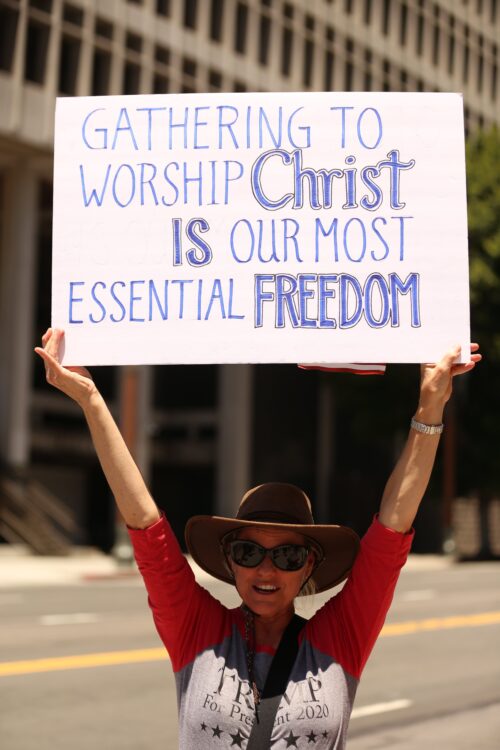
Conservative Christian organizations frequently invoke religious liberty when arguing government should not compel believers to take actions that violate their conscience.
That argument appears in debates over preferred pronouns, parental rights, adoption and foster care protections, and Attorney General Todd Rokita and Lt. Gov. Micah Beckwith’s “Churches’ Bill of Rights.”
In 2025, Rokita and Beckwith released the “Churches’ Bill of Rights,” a legal guide for Indiana churches outlining what they described as constitutional protections for religious organizations on issues ranging from worship services to political engagement. Announcing the guidebook in 2025, Rokita said religious liberty means ensuring Hoosiers can “practice their faith and participate in civil society to the fullest extent possible.”
That same framework has shaped Rokita’s legal arguments in cases involving religious objections to government policies, including the 17 state coalition he co-led in support of former Brownsburg High School orchestra teacher John Kluge, who said he was forced to resign after the district would not allow him to address all students only by their last names rather than use the preferred names and pronouns of transgender students.
Other groups invoke the same constitutional principle for a different reason.
Jewish plaintiffs challenging Indiana’s abortion ban argue the law imposes one religious understanding of when life begins on people whose faith traditions teach differently.
Earlier this year, a Marion County judge ruled the state’s abortion ban substantially burdened the religious exercise of a certified class of Hoosiers with sincere religious objections under Indiana’s Religious Freedom Restoration Act. Rokita has appealed that ruling. The case is scheduled for oral arguments before the Indiana Supreme Court on Sept. 10.
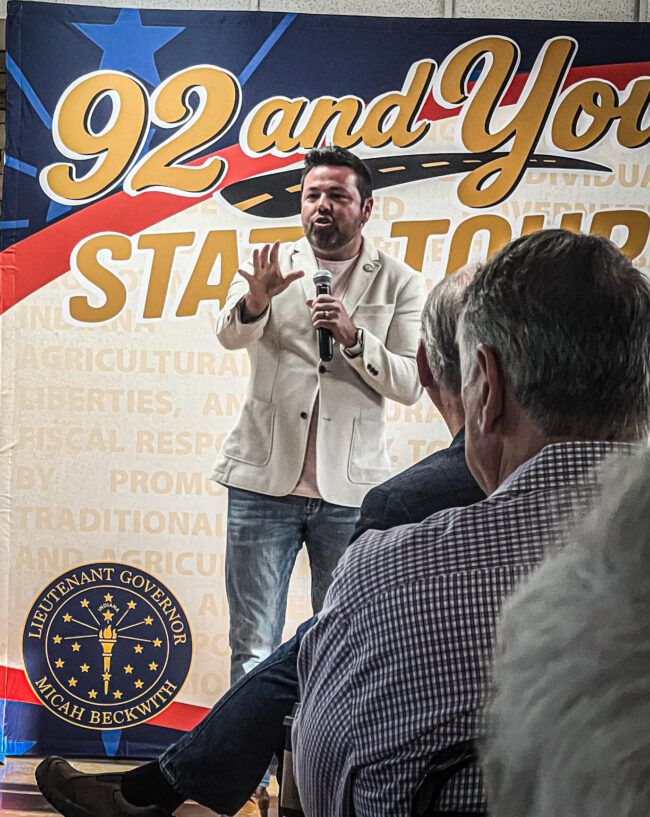
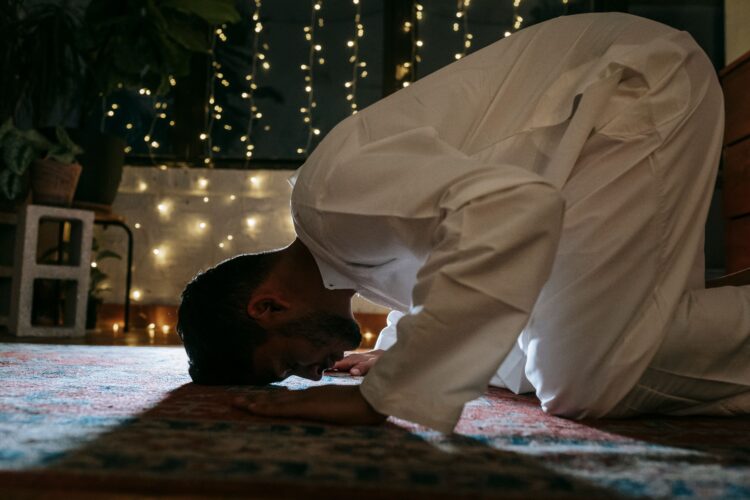
More recently, Beckwith’s calls to ban the Islamic “call to prayer” and his repeated criticism of Islam prompted Muslim organizations to argue religious liberty requires public officials to treat all religions equally and refrain from stigmatizing minority faiths.
Responding to Beckwith’s remarks, the Council on American-Islamic Relations said, “The Constitution guarantees religious liberty for every American, not government preference for one faith over another.”
Elected officials who responded to Beckwith’s comments framed religious liberty in similar terms, arguing that protecting one faith community requires protecting all faith communities.
During video remarks at a June Statehouse gathering, Sen. Spencer Deery, R-West Lafayette, said religious liberty depends on defending the rights of people across faiths.
“As long as any religion is threatened, all religion is threatened,” Deery said.
State treasurer Daniel Elliott, a conservative Republican and member of The Church of Jesus Christ of Latter-day Saints, said during the same rally that protecting religious liberty should transcend political divisions.
“This is a conservative issue, actually, because this is part of the founding of who we are as a people,” Elliott said. “If we start saying it’s okay to start hating the Muslim or the Jew or the Hindu or any other faith, pretty soon we start to say, ‘You’re not the right believer of Christianity, and it’s okay to hate you too.'”
Still other disputes focus on religion’s place in public institutions.
LifeWise Academy, proposals involving the Ten Commandments in schools, release-time religious instruction and school chaplain legislation all ask variations of the same question: What role should religion play in public education?
Supporters often argue these policies protect religious expression. Opponents contend religious liberty requires government neutrality and equal treatment for students of every faith.
Conkle said many of these debates turn on a distinction between separation of church and state and separation of religion from politics.
“You can argue about what the separation of church and state ought to be,” he said. “[But] the idea that politics can be entirely free of religion is really a non-starter.”
Religious people have always brought their beliefs into debates over public policy, he said, whether on civil rights, abortion, poverty or environmental stewardship.
The constitutional question instead is how far government itself may go in sponsoring, endorsing or participating in religious activity.
Garnett cautions against viewing religious liberty as a partisan idea.
“Many people, mistakenly, think that ‘religious freedom’ is inherently partisan, or that it only comes up in the context of so-called ‘culture war’ issues,” he said. “At its core, the religious-freedom issue is about the dignity of the human person and the limits on the power of the state.”
Sydney Byerly is a political reporter who grew up in New Albany, Indiana. Before joining The Citizen, Sydney reported news for TheStatehouseFile.com and most recently managed and edited The Corydon Democrat & Clarion News in southern Indiana. She earned her bachelor’s in journalism at Franklin College’s Pulliam School of Journalism (‘Sco Griz!).
The Indiana Citizen is a nonpartisan, nonprofit platform dedicated to increasing the number of informed and engaged Hoosier citizens. We are operated by the Indiana Citizen Education Foundation, Inc., a 501(c)(3) public charity. For questions about the story, contact Marilyn Odendahl at marilyn.odendahl@indianacitizen.org.