By Sydney Byerly
The Indiana Citizen
October 6, 2026
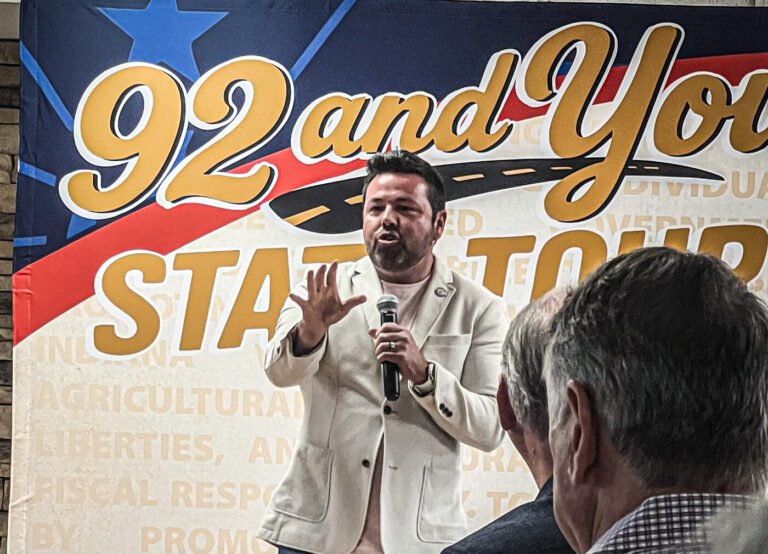
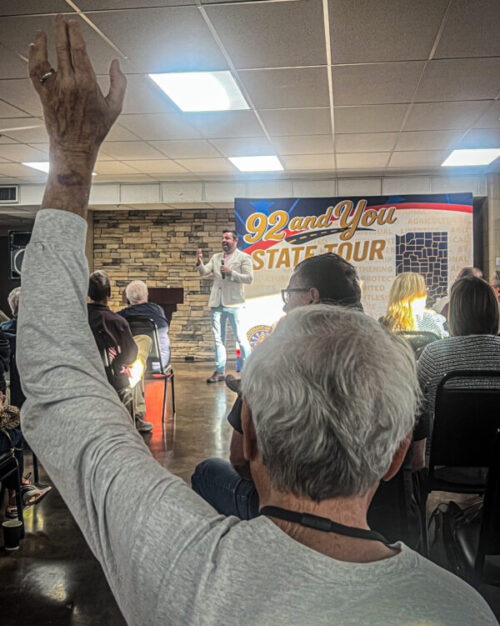
CLARKSVILLE, Ind. — Lt. Gov. Micah Beckwith urged both churches and voters Monday night to pay closer attention to Indiana’s school board races, arguing that local boards have an outsized influence over public education, including how matters of gender and sexuality are taught in classrooms.
“I think school boards are some of the most important elected offices that we have in this country,” Beckwith said at a town hall at Return Church in Clarksville. “They control tax dollars, but more importantly, they control the ideology that is taught to the next generation.”
Indiana school board elections, which were previously nonpartisan, are likely to take on a different tenor this fall under a new law allowing candidates to identify on the ballot as Republican, Democrat or independent, or decline to disclose a party affiliation. Beckwith said the change gives voters another piece of information but does not replace the need to research candidates.
“You have to do your homework,” Beckwith said. “You have to know who these people are.”
Beckwith said he has advocated for partisan school board elections for several years and would eventually like to see candidates run through party primaries. But he said voters should not rely solely on party labels when deciding how to vote.
“Don’t just take the ‘R’ or the ‘D’ or the ‘I’ and say, ‘Oh, that’s my guy,’” Beckwith said. “You’ve got to know what they believe.”
He also encouraged churches to help inform their congregations about school board candidates and endorsements, saying he has previously distributed his own candidate endorsement lists through his church.
“One of the hardest positions to do any research on was school board,” Beckwith said. He said over the years, he has tried to contact school board candidates directly to meet with them or organize forums where voters could hear from all of the candidates, but said “a lot of times they just kind of stay sort of undercover.”
Clark County GOP Chairwoman Fannie Broxon, who attended the town hall, also said she had struggled to get school board candidates to participate in an event. She said some candidates had not responded to her emails or phone calls, while only a few agreed to attend a party breakfast where voters could hear from them.
The comments came during a town hall that drew about 50 residents from across southern Indiana and at times became heated, with Beckwith fielding questions about immigration, transgender issues, books and curriculum in schools, Medicaid, property taxes, data centers, and Israel and Palestine.
The event drew both supporters and vocal critics of Beckwith. Several exchanges prompted shouting from the audience, and at least one person was removed after shouting at the lieutenant governor. The man continued to shout as he was escorted out, calling the lieutenant governor “a racist” and “a bigot.”
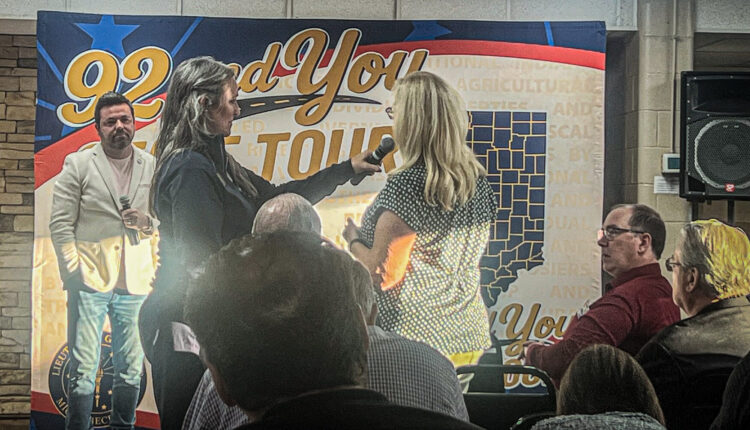
Beckwith repeatedly returned to schools throughout the roughly two-hour event, describing local school boards as a critical point of influence over what students are taught and how schools operate.
He pointed to his own experience working with students through his church, Life Church in Noblesville, where Beckwith remains a pastor — a full-time job he is working parallel to his duties as lieutenant governor — and described what he sees as a broader ideological battle over public education.
“We are in a fight for objective truth,” Beckwith said, pointing to debates over gender and sexuality as examples of what he considers challenges facing schools.
One attendee asked Beckwith about the controversy surrounding a Westfield High School band performance that he criticized on social media in April. Beckwith said students had sent him the material and questioned whether some content was appropriate for teenagers.
“I’d rather have parents doing that,” Beckwith said, arguing that parents, rather than schools, should decide when children are exposed to certain subjects.
He also said schools and libraries should remove material he considers pornographic or inappropriate for children, saying parents should be able to assume that material placed in children’s sections is safe for them.
Beckwith has previously been involved in similar debates as a member of the Hamilton East Public Library board, serving from September 2022 until resigning in January 2024. He stirred controversy when he pushed for the removal or relocation of books he considered inappropriate for children. The dispute drew national attention and a public response from author John Green, whose books were among those targeted in the library debate.
The discussion comes as conservative activists and elected officials across Indiana have increasingly focused on local school districts as a battleground over diversity, equity and inclusion, curriculum and what conservatives describe as “woke” ideology.
Immigration was another major point of discussion, with Beckwith drawing a distinction between welcoming immigrants through his church and enforcing immigration laws as a government official.
Beckwith said immigrants who come to the United States legally and assimilate into American culture should be welcomed and praised.
But he also used some of his strongest language of the night when discussing illegal immigration.
“I’ve always said immigration without assimilation is invasion, and we are being invaded,” Beckwith said. “We’ve seen the West is being invaded by third world countries who want to destroy everything that made us strong to begin with.”
He also criticized employers who knowingly use unauthorized labor, saying they are benefiting from taking advantage of immigrants who will work for little to nothing.
“I’m a secretary of agriculture,” Beckwith said, noting one of the duties Indiana assigns to the lieutenant governor’s office. “One of the sectors in the economy that gets hurt the most by cracking down on illegal immigration is agriculture.”
Beckwith said he hears from farmers who worry that they will not have enough workers if unauthorized labor is eliminated. He argued that farms and other businesses should instead rely on American workers and said labor shortages could push employers toward developing new tools and technology.
“If you’re hiring people who are here illegally, you’re participating in slave labor,” Beckwith said.
The town hall also included a personal discussion about Medicaid after a Clark County woman told Beckwith that her 20-year-old grandson, who has a brain injury and recently began working, lost his Medicaid coverage and needs medical care.
Beckwith said Medicaid is one of the largest parts of the state budget and that the administration is working to reduce waste, fraud and abuse. But he also acknowledged that people who legitimately need benefits can be cut off accidentally.
He asked the woman to provide information about her grandson’s case to his office so it could work with the Indiana Family and Social Services Administration to review the situation.
The exchange also reflected a broader theme Beckwith returned to throughout the night: his belief that government at all levels has assumed responsibilities that should be handled more often by churches and families.
When the woman said she was worried about who would help her grandson in the future, Beckwith asked whether their family was part of a faith community. He said churches are supposed to care for “the sick, the poor, the needy” and argued that government has taken on responsibilities that traditionally belonged to churches.
“What’s happened in America is we’ve kind of transferred that authority or that responsibility over to the government, and it doesn’t work as well,” Beckwith said.
Beckwith also faced questions about the growth of large data centers in Indiana, including a planned Meta facility in Clark County.
He said he opposes governments offering massive tax abatements to billion-dollar companies, arguing that companies will build data centers because of market demand regardless of whether governments offer incentives.
“I don’t think we should be giving tax abatements to billion-dollar companies,” Beckwith said.
Beckwith said communities should decide whether they want data centers rather than having the state force them to accept projects.
He said he is not opposed to data centers themselves and considers them strategically important in United States-based companies’ artificial intelligence race with China. But he said communities should require the companies that own the data centers to submit decommissioning plans and financial guarantees so taxpayers are not left with abandoned facilities if a company leaves.
Beckwith also pointed to energy demand as one of the biggest unresolved issues surrounding data centers and proposed small modular nuclear reactors as a potential solution. He said data centers could generate excess electricity for the broader power grid.
The town hall also became a forum for direct disagreement between Beckwith and some members of the audience.
During an extended exchange about immigration, one audience member challenged Beckwith over the detention of immigrants who have lived in the United States for years and, in some cases, had been working through the legal immigration process. The woman argued that immigration cases should be handled through the courts and that the system should emphasize due process and “kindness, not fear.”
Beckwith said the courts could not realistically handle individual cases for the millions of people in the country illegally, arguing that doing so would take decades. His response focused on the scale of the immigration court system rather than proposing that due process be suspended, and he maintained that the government has a responsibility to enforce immigration laws.
The exchange was followed by additional criticism from protesters who had gathered outside and were eventually invited into the event by Beckwith’s staff. The exchange became emotional before the group of protesters and other critics headed out of the meeting.
Later, “Free Palestine” was shouted from the doorway, prompting Beckwith to respond, “Palestine doesn’t exist! You’re freeing something that doesn’t exist! It’s Israel!”
After the event, Beckwith said he was glad the protesters had attended, arguing that disagreement can make for a more substantive conversation.
“I don’t want that to always be the case,” Beckwith said of having an audience that agrees with him. “I want there to be that pushback.”
Sydney Byerly is a political reporter who grew up in New Albany, Indiana. Before joining The Citizen, Sydney reported news for TheStatehouseFile.com and most recently managed and edited The Corydon Democrat & Clarion News in southern Indiana. She earned her bachelor’s in journalism at Franklin College’s Pulliam School of Journalism (‘Sco Griz!).
The Indiana Citizen is a nonpartisan, nonprofit platform dedicated to increasing the number of informed and engaged Hoosier citizens. We are operated by the Indiana Citizen Education Foundation, Inc., a 501(c)(3) public charity. For questions about the story, contact Marilyn Odendahl at marilyn.odendahl@indianacitizen.org.