By Marilyn Odendahl
The Indiana Citizen
July 27, 2026
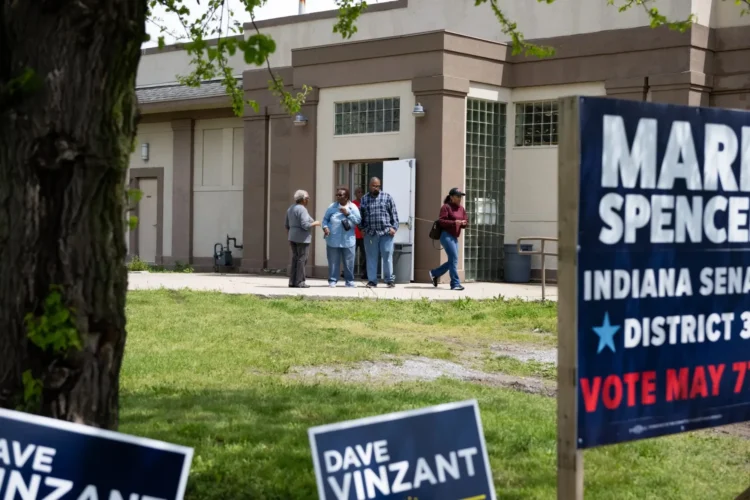
On Tuesday, the Indiana Recount Commission will have to decide questions about voter privacy as it wades into the fight for the Republican nomination for state Senate District 23.
Paula Copenhaver, the former Fountain County Circuit Court clerk who challenged Sen. Spencer Deery in the May GOP primary, filed for a recount after she lost by just three votes. Since then, she has filed multiple motions asking, among other things, for access to the federal SAVE database and permission to depose more than 10 voters who self-identified as casting a ballot in the Republican primary solely to vote against her.

Deery, R-Lafayette, who is vying for a second term in the Indiana General Assembly, won the primary with 6,337 votes to Copenhaver’s 6,334. He is pushing back on his opponent’s requests, describing them as fishing expeditions.
The Indiana State Board of Accounts finished recounting the ballots in the Senate district, which includes portions of six counties, on June 26 and now the dispute is returning to the Recount Commission. At its July 28 hearing, the commission will try to reduce what has been indicated as a number of disputed ballots and make determinations on six motions filed by Copenhaver and one filed by Deery, according to the order issued by Recount Director Evan Norris.
The commission will have to conclude its work by Aug. 21, the deadline for certifying the candidates who will appear on the November ballot.
Before the Recount Commission, Copenhaver is represented by attorneys William Bock III and Mark Colucci of Kroger Gardis & Regas. Deery is represented by Samantha DeWester of DeWester Law.
Copenhaver’s attempt to bring the controversial Systematic Alien Verification for Entitlements database into this recount fight comes a little less than a year after Indiana Secretary of State Diego Morales entered into a memorandum of agreement with the federal administration for access to the system.
Although SAVE has had its reliability questioned and is the subject of at least one lawsuit, Copenhaver has asserted the database can help determine whether any individuals who were not qualified to cast a ballot because of their age, residence or citizenship voted in Senate District 23’s Republican primary. She is asking for all poll books and poll lists, as well as all absentee ballot applications and affidavits from the primary, to get the names of the people who voted, which she then wants to run through the SAVE database to check their eligibility to vote.
Deery asserted Copenhaver’s request would expand the use of the federal database beyond its intended purpose of verifying voter registrations and maintaining the state’s voter rolls. SAVE cannot be “converted to a general discovery tool available to a private contestant in a post-election proceeding,” Deery stated in his motion opposing Copenhaver’s request.
Also, Deery noted, Copenhaver does not provide any specific information to support her request. She does not identify particular voters as noncitizens or provide facts establishing their ineligibility.
Rather, Deery asserted, Copenhaver wants to submit voters’ personal information into a federal database and use the “newly generated information to attack ballots already cast and counted. That is not a recount, contest or anything allowable within the statutes governing either, nor is it ordinary voter-list maintenance. This is a new post-election investigation designed to generate evidence after the election in an effort to alter the result of the completed election.”

Copenhaver is also seeking to depose more than 10 voters who allegedly claimed on social media that they had crossed over and pulled a Republican ballot so they could vote for Deery. In her petition, she described their actions as “tampering” with the election and argued they violated state law, rendering their votes invalid.
Deery filed a motion in opposition, asserting Copenhaver’s request would expand the recount proceeding into an “open-ended fishing expedition.” The depositions could become investigations that veer into questioning voters about their political association, political beliefs, and voting behavior, he said in his motion.
The voters were identified by their social-media posts about their votes in the Senate District 23 primary. Copenhaver argued in her petition that these voters violated Indiana Code 3-10-1-6, which essentially bars crossover voting, to block her from winning.
Consequently, Copenhaver is asking permission to depose those voters to determine whether their ballots should be counted. She asserted the voters waived “their privilege of ballot secrecy,” when they voluntarily disclosed how they voted in the May primary by either posting on social media or talking to a reporter.
Deery countered that Copenhaver has not verified that the online postings were actually made by the individuals now being targeted for a deposition.
Also, Deery asserted that crossover voting is not illegal under state statute. The law outlines who is eligible to vote in a party’s elections but says nothing about a vote being invalid by pulling a different party’s ballot. Moreover, the ballots are secret, even if the voters disclosed online who they selected.
Although Deery maintained the depositions are an “attempt to harass voters,” his motion carries a list of recommended protections if the commission grants Copenhaver’s request. Deery list includes prohibiting any questions about how the individuals voted in the past or intend to vote in the future; stopping inquiries into political beliefs, ideology, association, and contributions; and preventing the publicizing of “unnecessarily personally identifying information.”
The Indiana Recount Commission met July 21 and certified the results of the other two contested Republican primaries in House District 57 and Senate District 15. Neither outcome was changed by the recounts with the GOP nominee being Wes Bennett for the Indiana House and incumbent Sen. Liz Brown in the Indiana Senate.
Prior to the hearing, Darren Vogt, who challenged Brown, filed a motion to dismiss, which the commission unanimously adopted. He had sought the recount after coming up 14 votes short in the May primary. Brown had successfully removed commissioner Paul Mullin from her recount proceeding and had filed a motion to toss Vogt’s allegations of irregularities in the voting process.
Greg Knott, who finished 79 votes behind Bennett in the House primary, had filed for the recount. Four candidates were vying for the Republican nomination for that seat, which had become open when Rep. Craig Haggard unsuccessfully challenged U.S. Rep. Jim Baird for the GOP nod in Indiana’s 4th Congressional District.
Although Knott had petitioned for a recount of the ballots in 10 precincts in Hendricks County, he did not attend the commission hearing. The State Board of Accounts did not find any deviations in the vote totals from what had been reported by the Hendricks County Circuit Court clerk.
Dwight Adams, an editor and writer based in Indianapolis, edited this article. He is a former content editor, copy editor and digital producer at The Indianapolis Star and IndyStar.com, and worked as a planner for other newspapers, including the Louisville Courier Journal.
The Indiana Citizen is a nonpartisan, nonprofit platform dedicated to increasing the number of informed and engaged Hoosier citizens. We are operated by the Indiana Citizen Education Foundation, Inc., a 501(c)(3) public charity. For questions about the story, contact Marilyn Odendahl at marilyn.odendahl@indianacitizen.org.