By Ronak Mohanty
Exponent Staff Reporter
April 30, 2026
The race for the GOP nomination for state Senate District 23 has turned into a nationalized Republican slugfest between the incumbent Spencer Deery, and Paula Copenhaver, who has been endorsed by President Donald Trump.
Attack ads from both candidates have dominated the airwaves in West Lafayette during the course of the campaign – whose total cost is in the millions of dollars.
The ads against Deery are part of a broader retribution campaign against the eight GOP state senators that tanked the Trump backed effort to redraw Indiana’s congressional districts to flip the two seats held by Democrats.
Many of the attack ads targeting Deery have come from outside groups and PACs that have spent millions, such as Hoosier Leadership for America and American Leadership PACs, which are linked to U.S. Sen. Jim Banks, R-Indiana. Groups such as the Club for Growth, and Turning Point Action have also taken up Copenhaver’s mantle, according to reporting by Politico.
These groups face less campaign finance regulation and have been able invest millions of dollars in state senate races.
The ads have called Deery an “anti-Trump liberal,” and have consistently attacked him for votes taken regarding Chinese ownership of farmland, property taxes, and – though not as often – his vote against redistricting.
Other ads prominently featured Copenhaver’s oval office visit to meet with Trump in early March, after Trump had endorsed her.
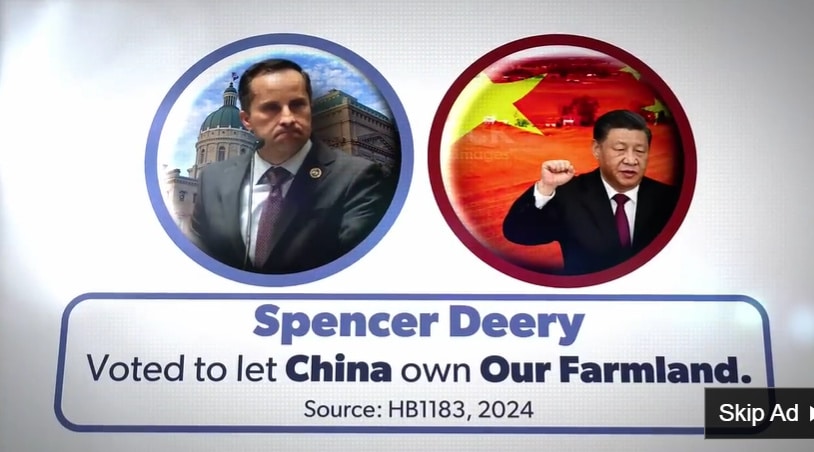
The attacks on Deery’s vote on Chinese ownership are the most misleading. The ads cite his vote supporting House Enrolled Act 1183, which prohibited citizens of certain foreign adversaries, such as China, from owning land within 10 miles of a military site. HEA1183 passed the state senate unanimously in 2024.
Deery said his vote for HEA 1183 is being misconstrued by the ads. The bill banned Chinese ownership of Indiana land within 10 miles of a military site. Now, the ads are pointing to Deery’s vote and accusing him of supporting foreign ownership outside of the 10-miles radius.
“Because of that first bill, they’re saying, ‘Oh well, he voted to let them allow (foreign ownership) well, that’s just an outright lie,’” Deery said.
Deery cast the current effort to unseat him as not just a threat to his career but as a threat to America’s constitutional system.
“It is all about control. You know it is. They’re doing it because they got mad because we refused to mid-cycle gerrymander our maps,” Deery said, referring to “groups affiliated with Washington, D.C., that are able to receive unlimited corporate or other dollars.”
Deery continued that although redistricting is a dead issue, the fight is about showing who is in control.

“Now … it is about sending the message to Indiana and to every other state in the union that they can manipulate your elections, that if your state legislature does not get in line, they can create consequences for you,” Deery said.
Deery said that the retribution campaign was putting the U.S. on the road to authoritarianism.
“It undermines our system of government that was set up with states in a position to be co equal partners with the federal government, and adding a stronger central national government is what authoritarian governments do”
Despite his sharp criticisms, Deery avoided directly criticizing the president, instead attacking Washington as a whole.
“Right now (Trump is) who happens to be in the White House … it’s not just him, though it’s all Congress. There’s no daylight there. It’s all just one entity. That’s why I use the phrase Washington D.C., rather than a particular individual. But that’s what it is right now,” Deery said. “But I think there’s, you know, no reason to assume that it wouldn’t be somebody else next time. And once you prove the concept and make that the norm, that’s a concern.”
Deery started off the campaign avoiding attack ads. Instead he highlighted his record in the Indiana Senate, such as passing a “tougher law to turn over illegal immigrants who’ve committed violent crimes,” helping kill the LEAP pipeline, and how “we kept boys out of girls sports,” which are all issues that have traditionally played well with the GOP base.
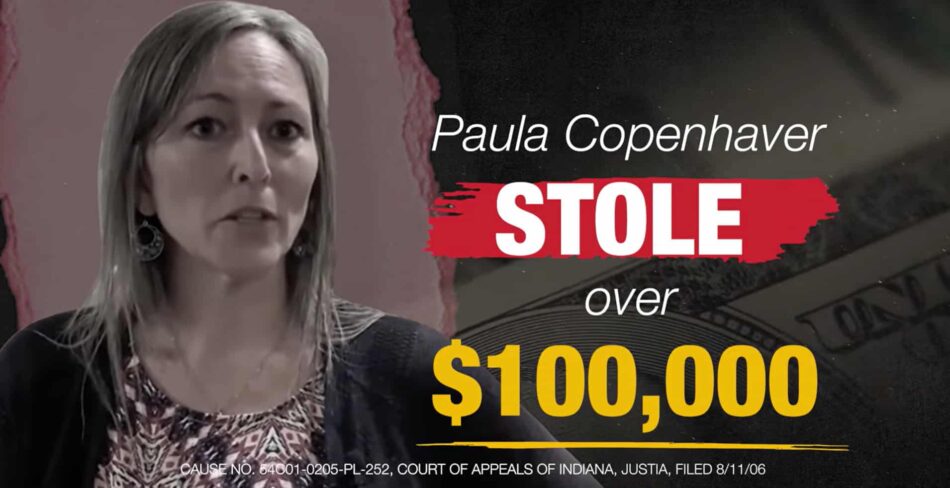
However, as the campaign approached its closing days, Deery pivoted to attack ads sharply criticising Copenhaver, using ads similar to the ones employed against him.
One of those alleges she “stole over $100,000 from the small business she worked for.” The ad refers to a business dispute involving Copenhaver and her husband, Michael, that erupted into the civil case, Coperhaver v. Lister.
Steve Lister, the plaintiff, accused Michael Copenhaver of stealing money from Lister Well Drilling, and then the fight escalated in January 2002 when the Copenhavers reportedly refused to return some equipment to Lister and reimburse the business $28,000, according to court documents.
The trial court found for Lister and awarded him a judgment of $120,107.25. The Court of Appeals of Indiana affirmed the judgment in 2006.
According to a report by Based in Lafayette, Paula Copenhaver called the ads “character assassination” during a rally earlier this month.
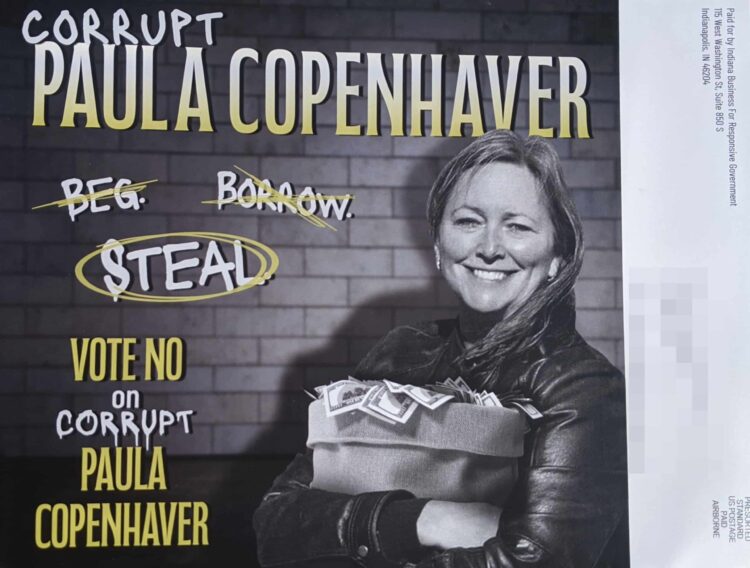
She added that “they’re making it into something that they want to make it into. I always tell my kids, whatever you’re looking for, you’re going to find. If you want to see the bad in something, you’re going to find it. If you want to see the good in something, you’re going to find it,” Based in Lafayette reported.
Deery defended the ads, despite saying that he doesn’t enjoy having attack ads be a part of his campaigns, on the grounds that voters deserved to know about any information that could endanger the GOP in the general election.
“I believe in trying to elevate discourse as much as possible, but that doesn’t mean that I’m going to just sit back and be a punching bag and allow groups to beat on me and not fight back as well too,” Deery said. “I think it’s important for people to remember too, that we didn’t throw the first punch, and we took a lot of punches before we punched back.”
Missing from Deery’s ads though has been his most prominent supporter – former Indiana Gov. and Purdue President Mitch Daniels.
Deery explained that “(Daniels) filmed the kickoff video and attended a fundraiser for me, but we only get a limited amount of ads and we have had other strategic priorities to emphasize.”
Daniels, though, has personally donated $5,000 according to Deery’s most recent campaign finance filings. According to those same filings Deery had slightly over half a million dollars in the bank – which he said were “unprecedented levels” for him.
Copenhaver’s filings show her with $15,620.45 on hand. Copenhaver did not respond to an interview request or answer questions emailed to her.
Those filings showed that Lt. Gov. Micah Beckwith’s campaign – Micah For LT. Governor – donated $7,000 to Copenhaver’s campaign on April 20. Copenhaver is a governmental affairs director on Beckwith’s staff. The campaign finance documents also revealed that Copenhaver loaned $5,000 to her campaign.
Despite millions of advertising dollars that has been poured into the race by outside groups, it’s unclear how engaged the Purdue student body is with the campaign.
Emre Gulec, the current president of the Purdue Political Discourse Club, thought that students have definitely been seeing the ads, especially on YouTube.
“People are aware, even I’m constantly getting ads here on TV. I can only imagine others are as well. I’m seeing a lot of signs around,” Gulec said. “I definitely think it’s pretty prominent, on a lot of students’ minds, even if they’re not normally engaged with politics, it’s become a big deal.”
Gulec acknowledged he is likely part of a more politically engaged circle than most other students..
Kyle Wang, an electrical and computer engineering major from New Jersey, said he had been getting the ads attacking Deery. Despite the ads being the first time he’d heard of Deery he hadn’t really swayed his opinion on the candidates.
“(They’ve) kind of just (been) in the back of my mind a little bit,” Wang said.
As Purdue Political Science Professor Jesse Crosson put it, “at some point you’re like, ‘Okay, I get it, but leave me alone.’”
Even if the ads may come with diminishing returns, Crosson said the campaigns were still spending out of fear of what could happen if they don’t.
“It’s a little bit like the Soviets in the (20th century) and us. Why do we have enough nuclear bombs to blow up the world 26 times over or whatever it is? Mutually assured destruction. You’re afraid,” Crosson said.
One silver lining Crosson saw in the vast sums of money spent? Turnout is likely to jump in this primary.
“I’ll bet you turnout for this primary election will be a record high for the state of Indiana, particularly in districts like ours, because people might not know the local candidates, but they know the national figures — and that’s going to bring them to the polls,” Crosson said.
The Purdue Exponent is the independent student media organization serving the Purdue University community. It is published by the Purdue Student Publishing Foundation, a non-profit educational organization. For questions about the story, contact the editor-in-chief, Olivia Mapes, at editor@purdueexponent.org.
The Indiana Citizen is a nonpartisan, nonprofit platform dedicated to increasing the number of informed and engaged Hoosier citizens. It is operated by the Indiana Citizen Education Foundation, Inc., a 501(c)(3) public charity. For questions about the story, contact the editor, Marilyn Odendahl, at marilyn.odendahl@indianacitizen.org.