By Bill Moreau, publisher
The Indiana Citizen
May 19, 2026
No source I’ve consulted can give me a precise starting date, but during the lifetime of every living Hoosier, we’ve voted for public school board members in nonpartisan elections. Today, however, marks the opening bell of Indiana’s forced membership in the minority of states that permit candidates to run as political partisans. Try to visualize your ballot when you voted in November 2024 and you will recall a category devoted to school board candidates, whose names appeared in alphabetical order, with no other identifier. I’ll bet there were school board elections you skipped over because you didn’t know enough about the candidates to cast an informed vote. There’s always a big dropoff in the number of votes cast for school board candidates compared to the partisan races on the rest of the ballot.
This doesn’t mean Indiana’s nonpartisan school board races have always been polite, civil contests. When the Ku Klux Klan–the White Christian nationalists of that era—launched their hostile takeover of Indiana politics in the 1920s, they ran slates of candidates to control Indiana’s public schools. In 1925, the KKK-supported candidates took over the Indianapolis school board that promptly built an all-Black high school and forced Black students in the other high schools to transfer there.
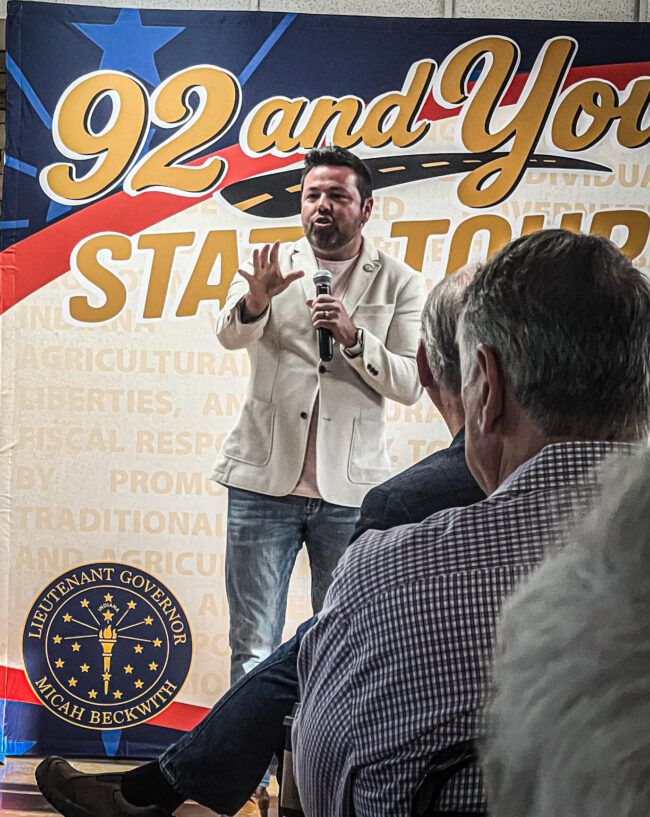
One hundred years later, in 2025, Lt. Gov. Micah Beckwith–today’s most visible Hoosier Christian nationalist–actively lobbied for the enactment of Senate Enrolled Act 287, which transforms the election of Indiana school board members into partisan races. The bill barely made it to Governor Braun’s desk due to bipartisan opposition. Indiana will now be just one of 10 states that permit school board candidates to declare a party preference. A friend of mine from Pennsylvania, one of those states, told me that the 2024 school board elections in his community hinged upon whether the candidates supported Donald Trump’s immigration policies.
With the contentious May 5th primaries behind us, the filing period for school board candidates begins today, May 19. The filing period closes in 30 days, on Thursday, June 18 at noon. Kudos to the Indiana School Boards Association (ISBA) for creating this very helpful resource for school board candidates. The ISBA has determined that these 279 school corporations will elect school board members on Election Day, November 3rd. The total number of school board seats up for election is 805.
If you are thinking about running for school board, click here for an excellent primer recently published by our friends at Chalkbeat. You need to figure out in which school corporation you live. This helpful tool from StatsIndiana permits you to zoom in on a school district to see if you live within its boundary.
Your choices are running as a Democrat, Libertarian or Republican, as a capital “I” Independent, or nothing at all. Whether you’re a Democrat or Republican depends on whether you requested that party’s ballot in the last two primaries in which you voted, although you can go to the county chair of your chosen political party and ask for their signoff. There’s a process for challenging your chosen party affiliation if the powers-that-be disagree with your stated choice.
Anyone can file as a capital “I” Independent or have nothing after their name, and that designation is unchallengeable. A hardcore Democrat or Republican—as shown by their primary voting history—could obscure their party affiliation altogether for purposes of running for school board, a “wolf in sheep’s clothing,” according to some proponents of SEA 287.
Consistent with his record for in-your-face candor, Lt. Gov. Micah Beckwith couldn’t have been clearer in forcefully and frequently voicing his strong support for SEA 287. In some Hoosier communities, unsuspecting voters—the argument went—had apparently elected some wolves in sheep’s clothing, liberals who should have run as Democrats, but were elected because no party label was attached. But SEA 287 didn’t obviate this condescending view of voters’ intelligence: strong partisans can still run as Independents or with no label at all.
The real impetus behind SEA 287 goes to the core functions of a school board. Control of a school board means likeminded members can determine the selection or retention of the superintendent, set the budget, and influence the schools’ curriculum and choice of textbooks.
For the Christian nationalist school board candidates Lt. Gov. Beckwith will likely recruit, support and fund, their first order of business will be to conform American history to their own interpretation: the Founders were devout Christians who intended the United States of America to be an explicitly Christian nation; the idea of separation of church and state is a “myth;” the Three-Fifths Compromise was “a great move” and, the textbook provider of choice will be WallBuilders, “the gold standard for learning the real history of America,” according to Indiana’s second-ranking state official. There will be a Turning Point USA chapter in every high school, a goal vociferously supported by Gov. Mike Braun, whose first elected office was as a nonpartisan member of the Jasper School Board from 2004 to 2014. LifeWise Academy locations, providing religion classes outside the school building but during regular school hours, will be ubiquitous throughout Indiana.
This isn’t hyperbole on my part. These are explicit promises from Lt. Gov. Beckwith and his Hoosier Christian nationalist followers, and evidence of the aggressive implementation of an “anti-woke” master plan concocted last April in a behind-closed-doors session in the Lt. Governor’s Statehouse office, a story we broke.
It will be interesting to see under what label Beckwith-backed school board candidates run, if any. Conventional wisdom would suggest they’d follow LG Beckwith’s example and run as MAGA Republicans, which could set up yet another collision with so-called “Establishment” Republicans. School board races can be characterized as “hyper-local,” so I’ll bet Christian nationalist candidates will be very shrewd when selecting an affiliation to match their communities’ sensibilities; they might run as Republicans, Libertarians, Independents, or with no label.
Do the math. These are essentially 805 separate elections in 279 districts, with no limit to the number of candidates who can file to run for your school board. Say there are four seats up for election; there could be 20 or 30 or 60 candidates.
Statewide, there could be thousands.
Our online, address-driven voter guide—which we call our “virtual ballot”—will prioritize finding out as much as we can about school board candidates. For example, it is likely that many school corporations will ask their voters to approve a referendum seeking an increase in property taxes. Any legitimate school board candidate should have a “for” or “against” position on such a referendum, right?
What about a school board candidate’s positions on important issues such as school choice, vouchers, collective bargaining for teachers, the posting of the 10 Commandments, the teaching of American history, support for LifeWise Academy outposts or Turning Point USA chapters? And who is contributing to a school board candidate’s campaign?
Today also marks the very timely release of Warren Throckmorton’s incisive book The Christian Past That Wasn’t: Debunking the Christian Nationalist Myths that Hijack History. You may remember Prof. Throckmorton’s name from his columns we’ve posted, beginning with this takedown of Lt. Gov. Beckwith’s paean to the Three-Fifths Compromise and WallBuilders.
We’ve all got a stack of gotta-read-next books vying for our eyeballs, but if you only have time for one new book that exposes the falseness of what Christian nationalists are peddling as “American history,” read this meticulously-researched rebuttal. And as you read, keep in the back of your mind that Prof. Throckmorton is a practicing Christian who spent his academic career teaching at Grove City College, a fiercely independent institution that believes in “rigorous Christian learning” and “conservative Judeo-Christian values.”
If you’re not already worried about what Micah Beckwith and his Christian nationalist followers will do to the teaching of American history if they take over Indiana’s public schools, this book spells out the looming threat.
And let me conclude with this pep talk from Steve Bannon:
The views and opinions expressed are those of the author only and do not necessarily reflect the views of The Indiana Citizen or any other affiliated organization.
The Indiana Citizen is a nonpartisan, nonprofit platform dedicated to increasing the number of informed and engaged Hoosier citizens. We are operated by the Indiana Citizen Education Foundation, Inc., a 501(c)(3) public charity. For questions about this commentary, contact Bill Moreau at bill.moreau@indianacitizen.org