By Marilyn Odendahl
The Indiana Citizen
June 5, 2026
Despite reports of increased traffic during the early-voting period, the turnout for Indiana’s May primary could still be described with same word used to characterize other primaries conducted in recent years – abysmal.
Indiana recorded a statewide turnout for the May 5 primary of 17%. That equals the 17% of registered voters who cast a ballot in the May 2024 primary, which was a presidential election year, and is only slightly higher than the 14% turnout in the May 2022 primary.
Linda Hanson, president of the League of Women Voters of Indiana, said she was disappointed but not surprised.
Hanson blamed actions by the state legislature, as well as the Republican and Democrat parties, that she sees as creating barriers to the ballot box. In particular, she noted gerrymandering has drawn such “safe districts” across the state that candidates from the opposing party are discouraged from running for office, so voters have few competitive races on their ballots.
“If voters don’t have choices to make, they don’t feel like their vote will make a difference,” Hanson said in an email. “(Consequently,) they may or may not vote in the primary.”
Indiana Secretary of State Diego Morales’ office released the official 2026 primary results on Wednesday. Three races for the Indiana General Assembly are undergoing recounts, but the Republican and Democratic candidates for the other Statehouse seats, as well as for the nine congressional districts and local municipal offices, are set for the Nov. 3 general election.
Morales touted the work done to conduct the primary, itself, and ensure the registered voters were able to vote.
“Indiana continues to lead with secure, transparent, and well-administered elections,” Morales said in a press release. “As we prepare for the November General Election, our office remains committed to ensuring every eligible Hoosier has access to accurate information and confidence in the integrity of our election process.”
Indiana had a total of 4.71 million registered voters on the rolls for the 2026 primary, of whom 807,055 voted. Comparatively, 4.74 million were registered to vote in the 2022 primary and 664,651 voted in the 2022 primary, while 4.71 million were registered in the 2024 primary and 820,895 cast a ballot.
Although the overall turnout for the May primary was similar to prior primary elections, the number of Hoosiers voting early in-person or by casting an absentee ballot was higher. In fact, the percentage of voters opting to vote prior to the actual primary election has been increasing from 27% in 2022 and 29% in 2024 to 31% in 2026.
The numbers are dwarfed by the 2020 primary. Certainly, Hoosiers were motivated to vote by the presidential race, in which President Donald Trump was vying for a second term, and by the growing uncertainty and frustration brought on by the COVID-19 pandemic.
As a consequence of the health emergency, Indiana relaxed its restrictions on absentee ballots, which allowed more voters to cast their vote by mail. The turnout in the 2020 primary reached 24% of which 51% voted early or by absentee ballot.
Hanson said Indiana could improve its turnout by implementing redistricting reform to establish more competitive districts. Also, she said, the state should make “access to the polls a priority” by allowing same-day voter registration and automatic voter registration as well as removing restrictions so that more Hoosiers can vote by absentee ballot.
“If we are to see a significant increase in primary turnout, we need to give all voters a voice,” Hanson said.
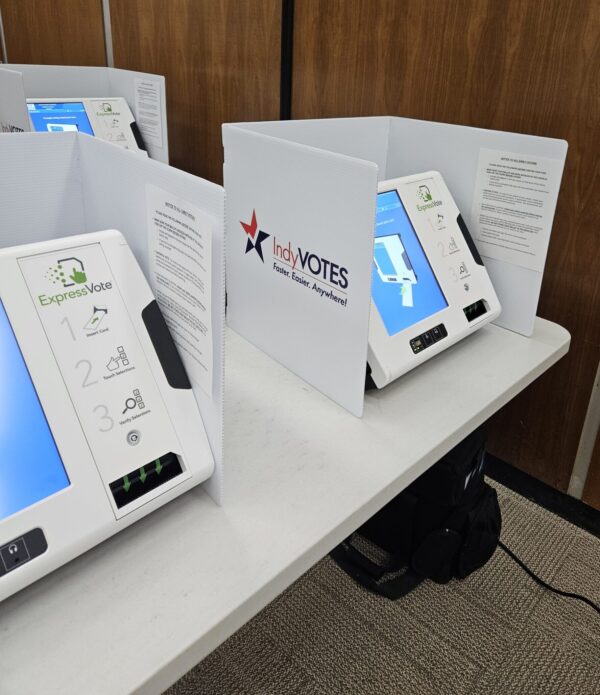
In Fort Wayne, Amy Scrogham, executive director of the Allen County Election Board, was hopeful that turnout in the 2026 primary would be higher because many of the races on the ballot were competitive, giving voters more choices.
Yet, the percentage of voter participation in Allen County barely moved. For the May election, 15% cast a ballot compared to 17% in 2024 and 13% in 2022.
Scrogham linked the low turnout rate to the requirement that voters select either a Republican or Democratic ballot in the primary.
“A lot of people just don’t like to vote in a primary,” Scrogham said. “They don’t like to pick a party.”
In spite of the disappointing turnout, voter behavior may have provided election officials with some good news. This was the first election that Allen County implemented voting centers and the education campaign, signs, QR codes and election-day assistance apparently prevented voters from being confused and possibly missing their chance to get to the polls.
Marion County Circuit Court Clerk Kate Sweeney Bell said a key to boosting voter turnout is for candidates to knock on doors and meet their constituents face-to-face.
As an example, she pointed to Parke County, along the Wabash River, which recorded a turnout rate of 32% for the 2026 primary. Conversely, Marion County posted a 16% turnout rate.
However, Sweeney Bell said Parke County’s higher voter percentage is likely because the candidates for office had an easier time connecting with residents since the number of registered voters is smaller at 9,405. By contrast, Marion County has 632,125 residents who are on the voter rolls, so getting 32%, or 202,280 voters, to the polls would probably require a well-resourced and coordinated effort much like the one that enabled Barack Obama to turn Indiana blue in the 2008 presidential election, she said.
Looking ahead to the midterm election in November, Sweeney Bell believes the Iran war, the price of gas and actions of Trump during his second administration will push more people to use “this awesome, awesome power that they have” of voting.
“Right now, I would say the general election will be one for the record books,” Sweeney Bell said of this November’s contest. “Now, will it compare to a presidential election? You have to take the temperature closer to the election.”
Voter registration is now open and applications for absentee ballots are now being accepted for the November general election.
The deadline for registering to vote is Oct. 5. Hoosiers can register to vote, update their voter registration and check their registration status by visiting IndianaVoters.com.
Indiana residents, deployed military members and overseas voters can start registering to vote in the November election by visiting https://indianavoters.in.gov/MVPHome/PrintDocuments for an application.
Registration and absentee voting assistance for Hoosier military and overseas voters and voters who are unable to mark a ballot because of a sight disability or a physical disability that impairs manual dexterity, should visit https://ev.indianawantsyou.com/ebd/voter/Indiana
Dwight Adams, an editor and writer based in Indianapolis, edited this article. He is a former content editor, copy editor and digital producer at The Indianapolis Star and IndyStar.com, and worked as a planner for other newspapers, including the Louisville Courier Journal.
The Indiana Citizen is a nonpartisan, nonprofit platform dedicated to increasing the number of informed and engaged Hoosier citizens. We are operated by the Indiana Citizen Education Foundation, Inc., a 501(c)(3) public charity. For questions about the story, contact Marilyn Odendahl at marilyn.odendahl@indianacitizen.org