By Marilyn Odendahl
The Indiana Citizen
June 5, 2026
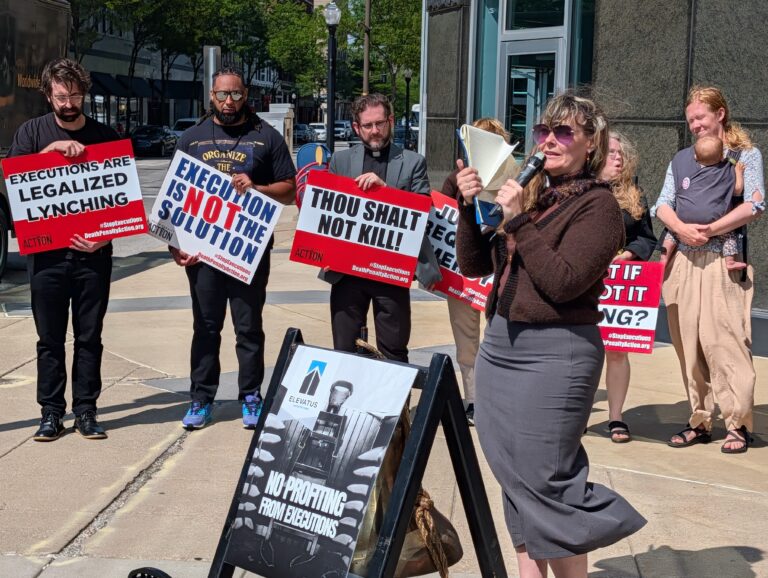
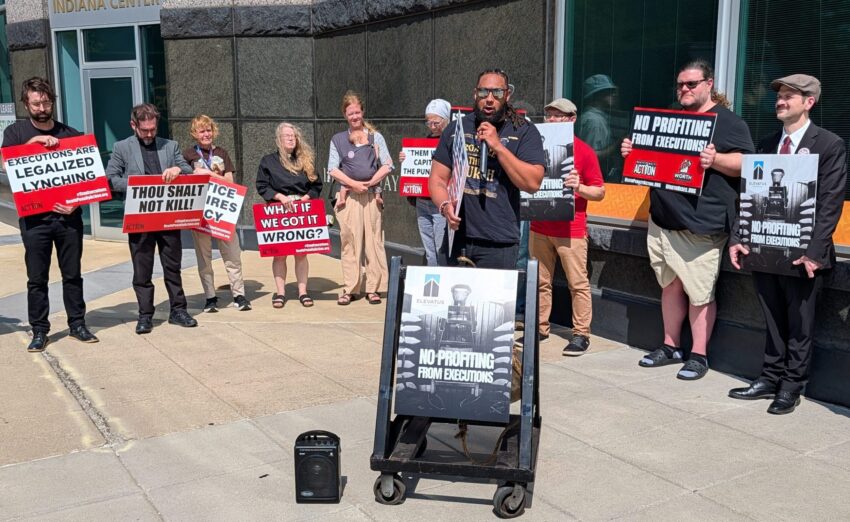
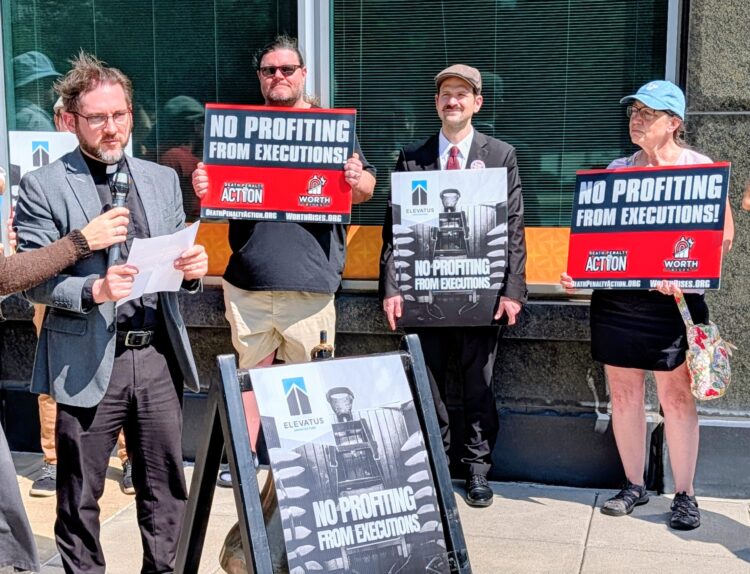
The protesters who recently gathered in front of Elevatus Architecture in Fort Wayne were part of a national effort to stop death penalty executions by firing squads by using the same tactics that have successfully disrupted lethal injections.
Death Penalty Action and Worth Rises joined the Indiana Abolition Coalition, LiveFree Indiana and Hoosier faith leaders and community advocates on May 19 to apply pressure to Elevatus and convince the firm’s leaders to cease their work related to execution chambers. The portfolio of projects done by Elevatus includes designing courthouses and jails, state and federal prisons, sheriffs’ offices and a public safety academy in northeast Indiana.
Elevatus has also been identified as the architectural firm designing a firing squad execution facility for the state of Idaho.
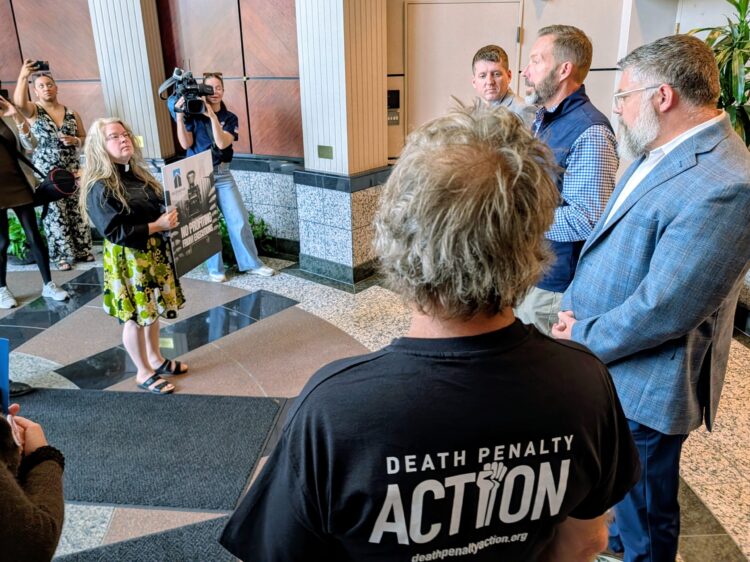
Three Elevatus executives met a handful of the protesters in the lobby of the firm’s building. The advocates gave the company officials a petition with what was said to be thousands of signatures and a letter signed by nearly 200 interfaith leaders, strongly urging the firm to withdraw from all execution-related contracts and make a commitment to stop doing such projects.
One of the leaders of the protest, Rev. Anna Lisa Gross, pastor at Beacon Heights Church of the Brethren in Fort Wayne, said the firm had previously agreed to meet to discuss the criminal-justice projects. However, after she gave them some of her questions in advance, including those about the work in Idaho, and said others would be joining virtually, the executives canceled the meeting.
Gross was part of the group that went into the lobby during the protest and used the opportunity to press for details about the firing squad execution chamber.
“They wouldn’t answer those questions,” Gross said. “Their responses were either, ‘We don’t know,’ or the other response was ‘We are reviewing our practices,’ and ‘We have nothing to tell you.’”
Still the group was able to convey their concerns. Randy Gardner, whose brother, Ronnie Lee Gardner, was executed by firing squad at Utah State Prison in June 2010, shared with the executives how his brother’s “gruesome and painful” death continued to impact him and his family.
Gross said hearing from someone directly affected by the death penalty seemed to have made an impression on the executives.
“We also encouraged them to continue reflecting on the ethics of these choices and … to stop profiting from execution,” Gross said. “One of our suggestions was that whatever they were paid for that work to design Idaho’s death chamber, that they make a donation in that amount to victims’ services in Idaho.”
Elevatus released a statement following the protest, saying it recognized the “seriousness and sensitivity” of its work in the criminal-justice sector. However, the firm asserted its role is not to shape public policy but to provide professional design services.
“We respect the right of individuals to express their views and understand that this project raises deeply held beliefs and strong emotions for many people,” Elevatus said in its statement.
“Our work focuses on creating corrections spaces that prioritize safety, dignity, mental health support, rehabilitation, and operational wellbeing for staff, visitors, and incarcerated individuals alike,” Elevatus continued. “We believe facilities of this nature should be approached thoughtfully, responsibly, and with respect for everyone affected by them.”
Pressing product makers and service providers to turn down contracts and work that will assist states in carrying out the death penalty is the mission of Worth Rises, a nonprofit based in New York, which advocates for dismantling the prison industry. The organization is focused on removing the financial incentives of putting people behind bars by ensuring companies, vendors and retirement funds do not profit from incarceration.
“We’re looking at these corporations and asking if … they should be making money off of other people’s pain and suffering,” Celina Chapin, chief advocacy officer for Worth Rises, said.
That is the first step to pressuring businesses: appealing to their morality, Chapin said. The second step is making clear to the companies that their actions have consequences.
The protest at Elevatus was part of the typical strategy of making residents in the local community aware that their corporate neighbor is participating in the construction of an execution chamber, Chapin said. As a result, communities can then squeeze the firm’s bottom line by taking their business elsewhere and hiring other architects to do the design and build work.
Worth Rises does not want Elevatus to upend its business model or cease to operate, Chapin said. Rather, the advocacy group would like the firm to completely shift its focus to the other parts of its portfolio, such as schools, churches, libraries and YMCA facilities.
“I think that people kind of put off their responsibility and say, ‘Oh, this is just another job, this is just another contract,’ when really that’s not the case,” Chapin said. “You are complicit in something much bigger.”
Public pressure is credited with helping convince pharmaceutical manufacturers to stop selling their products for use in lethal injections, making the cocktail of drugs more difficult and expensive for states to obtain. Last year, Gov. Mike Braun disclosed Indiana had spent nearly $1.2 million on a handful of the controlled substances, which were believed to have come from compounding pharmacies, rather than the drug companies themselves.
Chapin also pointed to Worth Rises’ success in 2022 in persuading Tennessee-based FDR Safety to stop its work on the nitrogen hypoxia execution protocol for Alabama. Worth Rises mounted a pressure campaign that included sending letters from investors, business associations and faith leaders, along with nonprofits and individuals, demanding FDR Safety withdraw from its contract with Alabama.
However, getting one vendor to walk away did not prevent Alabama from moving forward. In January 2024, that state carried out the country’s first execution using nitrogen gas.
“It’s tough,” Chapin said of convincing private companies to turn down government contracts. “I think the first thing that we always do after this kind of action (at Elevatus) is to reach out and try to have a more extensive conversation, and that very much informs what the next steps are going to be. We’re not just blindly trying to go after these corporations. We would really love to be in conversation with them.”
Court documents filed in a 2021 lawsuit brought by Idaho death row inmate Gerald Ross Pizzuto Jr. include copies of emails that confirm Elevatus had been involved in the redesign of the Idaho Department of Corrections’ F Block, which includes modifications to the unit that is intended to be used for firing squad executions.
Pizzuto filed the lawsuit – Pizzuto v. Derrick, et al., 1:21-cv-00359 – in federal court, seeking to have his execution enjoined. The litigation is continuing.
Emails from March 2024 show Elevatus asking about the Idaho Department of Correction’s requirements for the firing squad chamber. In particular, the firm was wanting to know the IDOC’s expectations for the soundproofing and gives the department the options of “complete sound isolation,” so the “gunfire cannot be heard in any adjacent rooms,” or sound suppression “similar to normal speech” or a “motorcycle driving by” or “just enough to ensure no damage to unprotected ears.”
Another March 2024 email from Okland Construction to the other businesses involved in the project, including Elevatus, also discusses the IDOC’s specs for the chamber.
“They would like a floor drain in the execution room,” the email said. “It’s OK if they have to mop/squeegee liquids to the drain. Sloping the floor will not be cost effective.”
Following the protest, Gross, the Fort Wayne pastor, said the next steps will be convincing state lawmakers to not expand Indiana’s death penalty law to include firing squads and to educate the public about that method of execution. She also raised the possibility of trying to convince the leadership of Fort Wayne Community Schools to hold off doing any business with Elevatus, until the firm stops designing death chambers.
Gross did not foresee applying any more direct pressure to Elevatus.
“My inclination will be to sit back a while when it comes to Elevatus and let their own internal processing, their own ethical reflection and their own employees wrestle with that together,” Gross said. The grassroots movement to end the death penalty will “continue to form more cooperation among people who are concerned about how state money is being used, how county money is being used, (and) how city money is being used.”
Additional pressure may come from the American Institute of Architects, which amended its professional code of ethics in December 2020 to prohibit members from designing execution chambers or spaces used for torture.
Indiana does not allow execution by firing squad, but two bills introduced during the 2026 legislative session would have expanded state statute to include that method for carrying out the death penalty.
Restricting the supply of companies to build execution chambers for firing squads still has an urgency for Hoosier activists because of the potential for the failed 2026 bills to return in the 2027 session. House Bill 1119, authored by Rep. Jim Lucas, R-Seymour, which gave the Indiana Department of Correction’s commissioner the authority to choose the execution method of either lethal injection or firing squad, was narrowly defeated on the House floor by a 48-to-47 vote.
A strong supporter of firing squads has been Lt. Gov. Micah Beckwith.
Speaking on the podcast “The Kuyper Files,” during the 2026 legislative session, Beckwith, who has described himself as a Christian nationalist, said the death penalty is a blessing (see the 17:36 minute mark) because it gives the executed the opportunity to be with Jesus. The lieutenant governor and the podcast’s host, John Westercamp, who is also a member of the Indiana Election Commission, referred to several biblical passages, including 13 Romans and 9 Genesis, saying those passages show that God condones capital punishment.
“It’s not unkind and it’s not unloving to carry out the death penalty,” Beckwith said on the podcast. “It can be a blessing to (the executed) too, because they can take their last breath on Earth, open their eyes and be in the presence of Jesus.”
Beckwith also criticized pharmaceutical manufacturers for limiting the availability of the “death penalty serum” used in lethal injections, saying the companies have boosted their prices because of their political bias. A firing squad, he said, is a more practical option.
“Last year when Gov. Braun signed off on the execution of a person convicted of a capital crime and it was a million dollars that we had to spend on the serum, when a firing squad is a couple of bucks,” Beckwith said. “And it’s humane. … It’s a quick end to life.”
The letter from interfaith leaders that was presented to Elevatus noted Catholicism, Protestantism, Islam, Judaism, and Buddhism are all opposed to capital punishment. Those religions, the leaders wrote, see the death penalty as irreconcilable with their belief in the value of human life.
Abraham Bonowitz, co-founder of Death Penalty Action, an Ohio-based nonprofit which helped organize the protest at Elevatus, pointed to the nuance in the Scriptures. He noted in the Christian Bible, Jesus recites the teaching of an eye for an eye but then admonishes that only those without sin can cast the first stone. The Hebrew Bible and the Five Books of Moses allow for someone to be put to death only after completing a long list of preconditions that are impossible to meet.
“There’s supposed to be a separation of church and state, and we’re not basing our laws on whatever your favorite Scripture is,” Bonowitz said. “The death penalty that’s in the Bible, whether it’s in the Hebrew Scriptures or the Gospels, is not the death penalty that’s in the law in Indiana or any other state.”
Dwight Adams, an editor and writer based in Indianapolis, edited this article. He is a former content editor, copy editor and digital producer at The Indianapolis Star and IndyStar.com, and worked as a planner for other newspapers, including the Louisville Courier Journal.
The Indiana Citizen is a nonpartisan, nonprofit platform dedicated to increasing the number of informed and engaged Hoosier citizens. We are operated by the Indiana Citizen Education Foundation, Inc., a 501(c)(3) public charity. For questions about the story, contact Marilyn Odendahl at marilyn.odendahl@indianacitizen.org