By Marilyn Odendahl
The Indiana Citizen
June 18, 2026
With five legislative candidates on Indiana’s November ballot endorsed by President Donald Trump and the recent ruling from the U.S. Supreme Court gutting federal prohibitions against racial gerrymandering, voter-advocacy groups are preparing for another midcycle redistricting battle at the Statehouse.
Common Cause Indiana hosted a webinar Monday to review the fallout from the Supreme Court’s decision earlier this year in Louisiana v. Callais, which upended Section 2 of the Voting Rights Act of 1965, and what could happen next in the Hoosier State. The attendees were told to start talking to neighbors and family members about redistricting and to question candidates, who are running in November, about whether they are for or against redrawing Indiana’s congressional districts ahead of the 2030 U.S. Census.
“Louisiana v. Callais is not simply a Louisiana case,” state Rep. Earl Harris Jr., D-East Chicago, said during the webinar. “It represents a fundamental shift in the balance between voting rights enforcement and legislative authority. The decision gives states greater flexibility in redistricting, makes minority vote dilution claims harder to prove, it strengthens the argument for race-neutral redistricting, and may reshape congressional representation for years to come.”
In 2025, individuals and voting-rights organizations were successful in convincing the Indiana General Assembly to rebuff Trump’s pressure campaign to redistrict. The Trump administration wanted Indiana and other Republican-led states to redraw their congressional maps to give GOP candidates an advantage in the 2026 midterm election so the U.S. House could remain red.
When 21 Republican state senators joined Democrats in voting against redistricting, Indiana became the first red state to reject the president’s scheme. However, the May primary showed the cost of casting those “no” votes with five of those GOP incumbents losing after being pummeled by Trump on social media and a flood of dark-money ads.
Advocacy groups believe that a renewed momentum to reconfigure the congressional districts in Indiana will take hold in the 2027 legislative session if those five Republican state senatorial candidates backed by Trump win their November races.
“I think one of the reasons why we were successful last year in stopping redistricting here in Indiana … was we got started early,” Julia Vaughn, executive director of Common Cause Indiana, said. “The day that (Vice President) JD Vance show up in the Statehouse, it was Aug. 7. It will be seared in my memory forever. We jumped on it and we didn’t let up, so that’s what we’ve got to do now.”
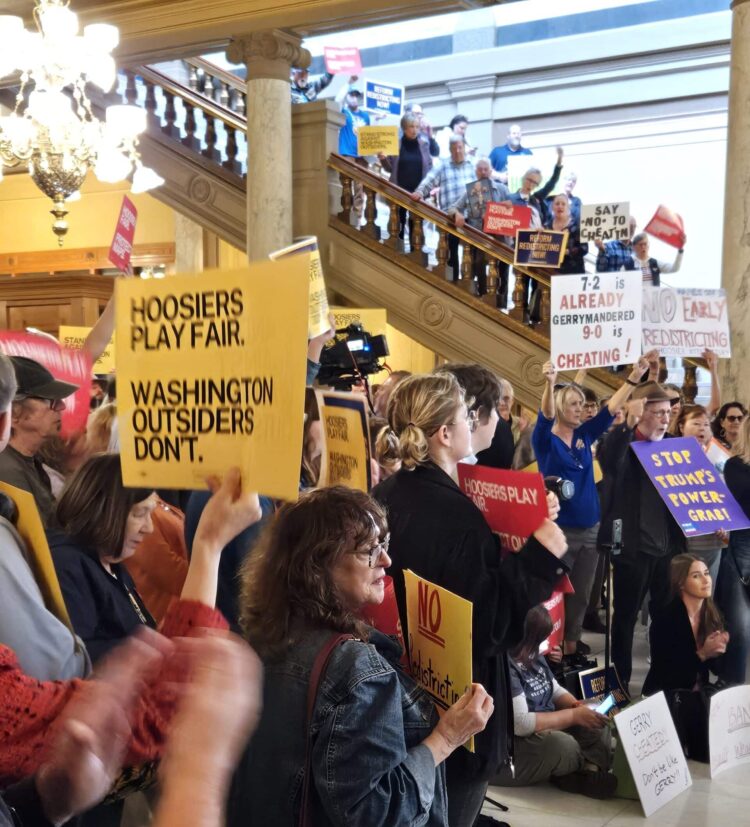
On July 17, just over 11 months since Vance first came to Indiana to discuss midcycle redistricting with Gov. Mike Braun and legislative leaders, the All IN for Democracy Coalition plans to hold an anti-redistricting rally on the steps of the Statehouse. Vaughn said the purpose of the event, which falls on the birthday of 19th-century Massachusetts Gov. Elbridge Gerry, the father of gerrymandering, is to keep the opposition in the public eye and the pressure on lawmakers.
When the Indiana General Assembly started the 2026 session in December primarily to consider redistricting, lawmakers were concerned that the state would be sued over any new congressional map passed by the Republican-led legislature. Likely such a lawsuit would have claimed that Indiana violated Section 2 of the Voting Rights Act, because the 7th Congressional District, which has a large minority population and is represented by Democrat Rep. Andre Carson, the state’s only Black member of Congress, would have been cracked and split among four congressional districts that were largely white and rural. Thus, the proposed map would have diluted the Black vote.
With Callais, the threat of litigation based on racial gerrymandering has been practically eliminated.
The Callais lawsuit originated when a group of self-identified “non-African American” voters challenged Louisiana’s 2024 congressional district map, which was drawn to include two majority-Black districts.
Conner Kozisek, program counsel for the Midwest Voting Rights Program for the Chicago Lawyers’ Committee for Civil Rights, explained during the webinar that the plaintiffs presented a unique argument.
The plaintiffs asserted that in order to satisfy the prohibitions against racial discrimination under Section 2 of the Voting Rights Act, race would have to be considered in drawing Louisiana’s district map. However, the plaintiffs continued, the federal VRA’s use of race to protect minorities from racial discrimination violated the 14th and 15th Amendment protections against racial discrimination.
The U.S. Supreme Court’s 6-3 ruling for the plaintiffs “significantly gutted” Section 2 of the Voting Rights Act, Kozisek said.
“For the past 60 years, the ways you’ve been able to show the problems with the maps is looking at the consequences of them and the impact they have for communities of color to not be able to elect the candidates of their choice,” Kozisek said. “This decision allows for states … to use partisan gerrymandering as a full excuse to deny voters of color a voice in their government and this is something that doesn’t only affect congressional districts. It threatens state and local districts down to city council level.”
In response, CLCCR will be putting a second staff member in Indiana as part of the Midwest Voting Rights Program. The nonprofit said it sees a growing need in the voting rights space in the Hoosier State and wants to add capacity to support the work of its partnering voter-advocacy organizations.
Advocacy groups are going to continue to push for reforming the redistricting process. In particular, they want the map-drawing duties to be given to a nonpartisan citizens’ commission, rather than letting state legislators craft the districts.
Also, Vaughn said, Indiana should fill in the gap created by the Callais ruling and amend state statute to protect communities of color to ensure they have representation and a voice at the ballot box.
“It is time in Indiana that we, as voters, started to demand state protections,” Vaughn said. “If the federal protections are going to be dismantled by the Supreme Court, then the Indiana General Assembly needs to respond and respect these communities and their voting power.”
Dwight Adams, an editor and writer based in Indianapolis, edited this article. He is a former content editor, copy editor and digital producer at The Indianapolis Star and IndyStar.com, and worked as a planner for other newspapers, including the Louisville Courier Journal.
The Indiana Citizen is a nonpartisan, nonprofit platform dedicated to increasing the number of informed and engaged Hoosier citizens. We are operated by the Indiana Citizen Education Foundation, Inc., a 501(c)(3) public charity. For questions about the story, contact Marilyn Odendahl at marilyn.odendahl@indianacitizen.org