By Marilyn Odendahl
The Indiana Citizen
July 17, 2026
Greg Ballard does not expect to get much rest between now and Election Day, as he races to introduce himself to more voters and tries to outrun history.
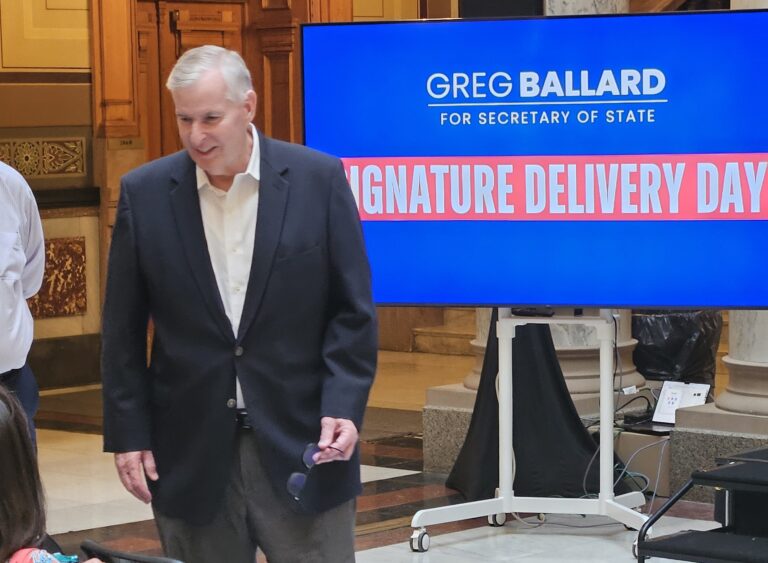
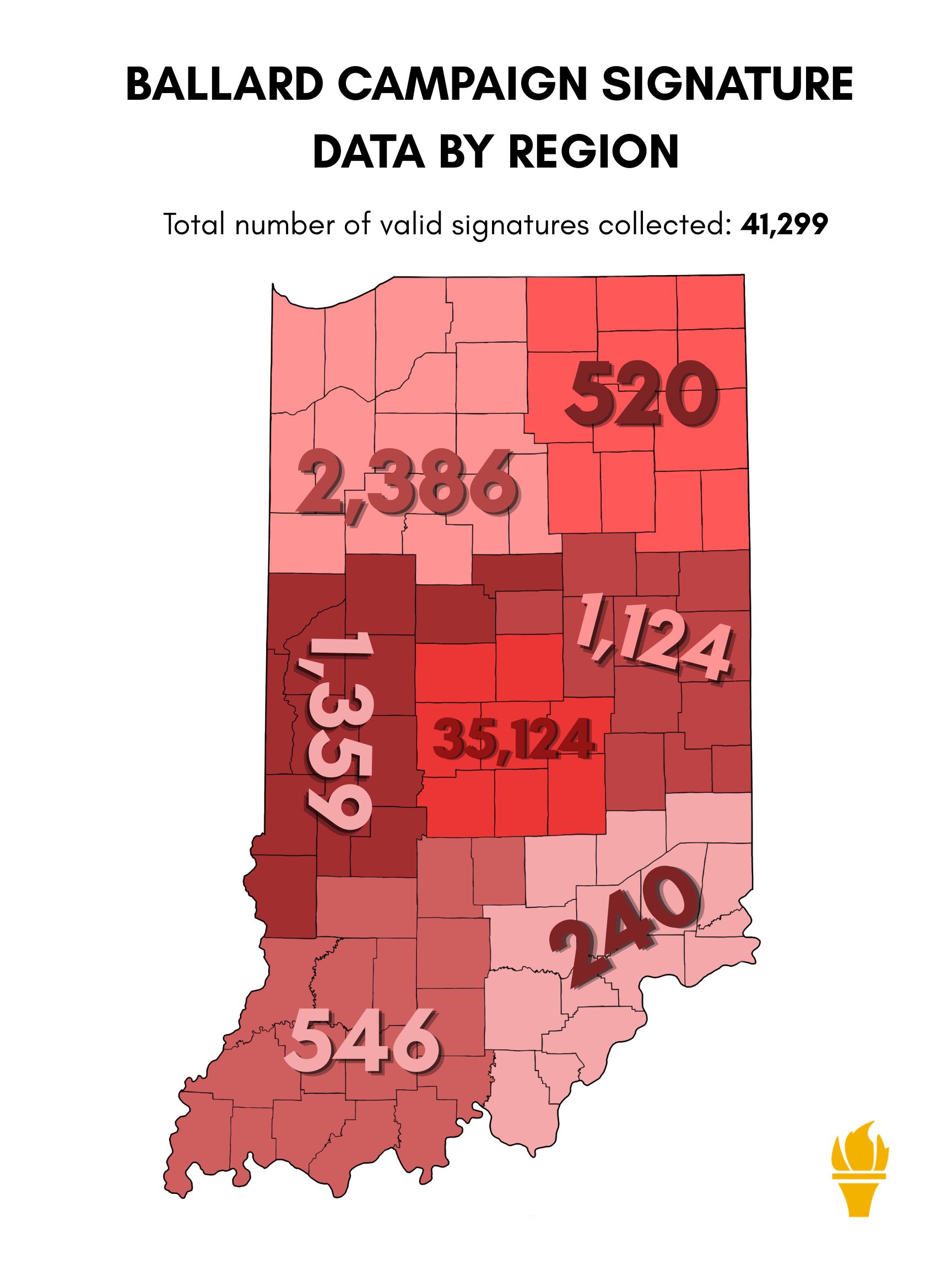
The former mayor of Indianapolis was at the Statehouse on Tuesday with a cadre of supporters and stacks of Bankers Boxes filled with the signed petitions, as he celebrated collecting more than the number of signatures necessary to be on the November ballot as a candidate for Indiana secretary of state. To run in the general election, Ballard and his campaign gathered 41,299 signatures verified by county clerks across the state, exceeding the required 36,943 signatures.
Ballard will be listed on the ballot as a member of the Lincoln Party, the new political faction he is trying to establish. If he garners 2% or more of the total votes cast in the secretary of state’s race, any candidate in the next election, and possibly elections thereafter, will be able to run under the Lincoln Party label and get included on the ballot without having to collect any signatures.
Shortly after declaring his candidacy in March, Ballard announced the creation of the Lincoln Party. He emphasized the opportunity to build a new cohort seemingly more than his outsider status during his remarks on Tuesday.
“The two-party stranglehold on Indiana politics is a relic, a political dinosaur long overdue for extinction,” Ballard told the small crowd gathered for his “signature day” event. “Our campaign is bigger than one candidate. It is bigger than one office.”
Ballard identified the Democratic and Republican parties as his opponents, rather than their respective nominees for secretary of state, Beau Bayh and Max Engling. He referred to Engling and Bayh as “the Republican and Democrat in this race,” and said they were selected by about 1,000 party insiders at closed party conventions, while more than 41,000 Hoosiers signed petitions to get him on the ballot because “they are fed up, frustrated and angry.”
Neither the Bayh nor Engling campaigns responded to a request for comment on how Ballard’s entrance changes the dynamics of the secretary of state race. Lauri Shillings is also running for secretary of state as a Libertarian.
Ballard and his Lincoln Party have already earned a place in the history books. Since 1994, no minor political party besides the Libertarians have been able to meet the signature threshold and put a candidate on the ballot, according to research by the Capitol & Washington blog.
However, Indiana election history shows that actually winning a state office as a third-party candidate is a rarity. A handful of candidates from the People’s Party and the Know-Nothings won a few seats in the legislature prior to the Civil War, but a dry spell appears to have settled in since.
Although to continue making history he will have to overcome history, Ballard is undeterred. He used his “signature day” speech to promote the Lincoln Party by telling supporters the Democrat and Republican parties have ignored the voices of the voters and not given Hoosiers the “accountability, honesty, and results” they want.
“Now we are on the ballot,” Ballard said. “We are not here to whisper. We are here to break open this system and give Indiana back to her people.”
Robert Dion, associate professor of political science at the University of Evansville, is skeptical Ballard will be giving a victory speech on election night.
Among the obstacles to capturing a win is the “myth of the independent voter,” Dion said. Ballard often indicates his base are the Hoosiers who say they do not affiliate with any political party, and while polling can find a relatively high percentage of voters identifying as independent, Dion said a majority of those individuals are “closet partisans,” who will vote for either the Democrat or Republican candidates on the ballot. Moreover, the “true independents” not aligned with either major party are the least informed and the least engaged among the electorate.
“The myth of the independent is that we idealize this notion of independence,” Dion said. “We think that somebody who’s an independent is thoughtful and above politics and doing the right thing. But, man, when you drill down and you find the true independents … those are the people who are the least likely to vote.”
In his speech before submitting the signatures, Ballard did tout himself as the right candidate for the job. He highlighted his eight years of experience as mayor of Indianapolis and, in an apparent swipe at his opponents who may have ambitions for higher office, he said the individual who serves as secretary of state “must protect every voter, every candidate and every ballot,” rather than just marking time until running for governor or Congress.
Also, Ballard said he would not endorse or raise money for, donate to or accept donations from candidates running in Indiana elections.
“This should not be controversial,” Ballard said. “In this race, however, I am the only candidate willing to make this pledge, because I am the only candidate not owned by a political party.”
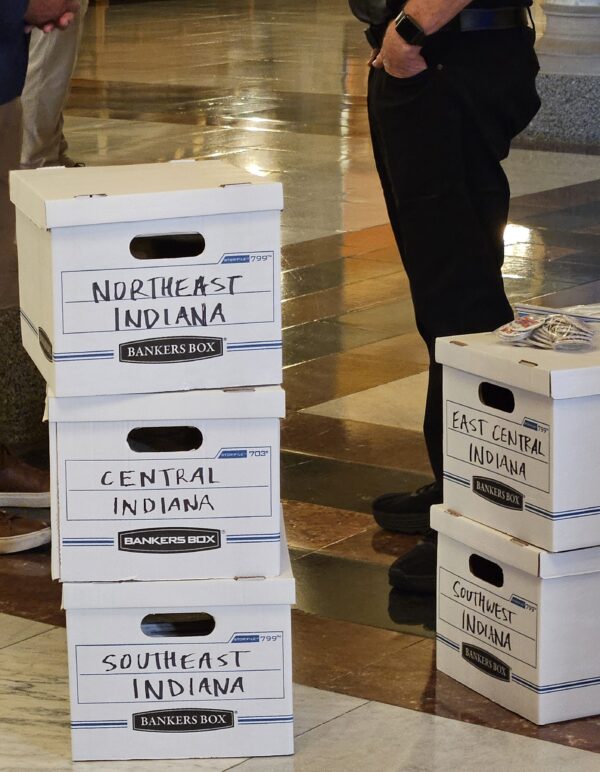
When Ballard finished his speech, volunteers and supporters carried the boxes full of signed petitions, first to the secretary of state’s office and then to the Indiana Election Division. The petitions will undergo another review to ensure the signatures are valid and Ballard has met the threshold to get on the ballot.
Speaking to reporters, Ballard again emphasized how his participation in the November general election will help establish the Lincoln Party.
“Good people have been excluded,” Ballard said. “They can’t run for office. They want to serve the public and they can’t. We’re providing that opportunity.”
Dion is doubtful about the future of the Lincoln Party. He noted forming a third political party and making it a viable option for voters is extremely difficult, because of the “structural incentive” within American democracy to have just two major political parties.
That incentive is explained by Duverger’s law, the theory advanced by the French political scientist Maurice Duverger, Dion said. A democracy that determines election winners by a simple majority after a single ballot will tend toward a system with two major parties, the law states.
Indiana political history has proven the validity of Duverger’s law.
With the exception of the Libertarian Party, minor political parties have appeared on Indiana ballots through the years, but they could not muster any staying power, according to Capitol & Washington’s research. The American Independent Party, which fielded Alabama Gov. George Wallace for the presidency in 1968, was on Hoosier ballots in 1978, 1980 and 1982. Also, the New Alliance Party fielded some candidates in Indiana elections before the mid-1990s.
The last time a major political party was created in the United States, Dion said, was when the Republicans displaced the Whigs in the mid-1800s. Slavery was dividing the country at that time and the Whigs were dithering on the issue, Dion said, so the Republicans stepped forward with a clear message opposing enslavement, which enabled the upstart party to eventually eclipse the Whigs.
Dion said if Ballard can identify and articulate a strong position on an issue that neither the Democrats nor the Republicans are paying attention to, the Lincoln Party might gain a foothold. But, at present, Dion said, the former mayor, who was a Republican during his time leading Indianapolis, has not taken any stance other than “the two major parties are bad.”
“If you want to create a party, that party needs to have a coherent set of ideas that its candidates would then support or promote,” Dion said. “So, you need a platform and that platform has to occupy a space that’s not currently being occupied by the Democrats or Republicans.”
Ballard brushed off the question about the Lincoln Party’s platform, telling reporters his party is seeking “practical, problem-solving people who want to serve the people.” He said he will be transversing the state with a message that goes beyond platforms and focuses on doing the right thing for Indiana.
“It’s the only reason I’m doing this,” Ballard said. “I’m not doing this for me. This is for the state of Indiana and for the people who are kind of fed up with the system right now.”
Dwight Adams, an editor and writer based in Indianapolis, edited this article. He is a former content editor, copy editor and digital producer at The Indianapolis Star and IndyStar.com, and worked as a planner for other newspapers, including the Louisville Courier Journal.
The Indiana Citizen is a nonpartisan, nonprofit platform dedicated to increasing the number of informed and engaged Hoosier citizens. We are operated by the Indiana Citizen Education Foundation, Inc., a 501(c)(3) public charity. For questions about the story, contact Marilyn Odendahl at marilyn.odendahl@indianacitizen.org