By Bill Moreau, publisher
The Indiana Citizen
November 19, 2026
We’ve all heard that turnout in Indiana was “historic” for a mid-term election. While the final numbers have not been posted, I estimate turnout at slightly less than 2 million or about 41% of registered voters. Yes, up slightly over 2022 (1.9 million/39.5%) but not as good as 2018 (2.3 million/51%). Lest Hoosiers break our arms patting ourselves on the back, check out this report from a respected source indicating Indiana might finish 48th for turnout, using a state’s voting eligible population instead of registered voters as the denominator.
But remember that 2026 was a mid-term election that rolls around every 12 years, when there’s no US Senate election at the top of the ballot; that spot is occupied by the Secretary of State’s race. In 2014, turnout was less than 1.4 million, or 30.2%. Yes, you read that correctly.
Using 2014 as the benchmark, turnout this year was certainly heartening — not “historic” — because our modern turnout expectations are so low. Check out this instructive chart by our friend and former board member Trevor Foughty to see how 2026 compared to Hoosier elections going back to 1962.
So what are my takeaways from the Election of 2026?
First, it reinforces a lesson I learned the hard way in 2020, when we launched our non-profit, believing unengaged voters could be inspired to get off the couch in response to our positive, high-minded campaign: There isn’t enough money in the world to motivate a non-voter with a “this is your civic duty” message.
But competition, on the other hand, certainly will.
When these so-called “low propensity voters” feel like their vote actually matters — that it might have an effect on the outcome of an election that wasn’t already predetermined — only then will they get off the couch.
Even in this digital age, our television sets and mail boxes still play a major role in motivating turnout. When infrequent voters get the sense that a ton of money is being spent in the secretary of state’s race, and it looks like the Congressional, Indiana House and Senate, county and school board races where they live are really contested, and ask “Honey, when will the political junk mail stop?” they’re more likely to conclude, “Hey, my vote can make a difference this year.”
And this, after all, was a rationale for the two-party system: competing ideologies represented by strong political parties fielding competent candidates with sufficient resources to communicate with voters, akin to our adversarial legal system.
Second, when the final numbers are crunched, I think Nov. 3, 2026, will be recalled as the year MAGA voters chose the couch. To them, any Democratic candidate was completely anathema, yet there was plenty of objective, real-life evidence their beloved President had screwed things up royally. So when many MAGA adherents heard the President’s exhortation, “Vote like I’m on the ballot” their reaction was, “Yeah, you’re not, so I’m staying home.”
On this point, I agree with former Vice President Mike Pence: GOP voters didn’t “turn left,” they were “turned off.”
But millions of American voters did respond to “Vote like I’m on the ballot,” causing a surprising number of Democrats to be swept into office nationwide, including in the Hoosier State. This is what happens when highly-motivated, anti-incumbent voters go to the polls and dispirited supporters of the status quo choose the couch.
One of the first indicators of a Democratic wave election came from a new, “purple blue” Hamilton County. State Sen. J.D. Ford needed—and received—a big margin from his home county to unseat three-term incumbent Victoria Spartz in the 5th congressional district race. He flipped a district President Donald Trump carried by 17% in 2024 with a winning margin of more than 3%.
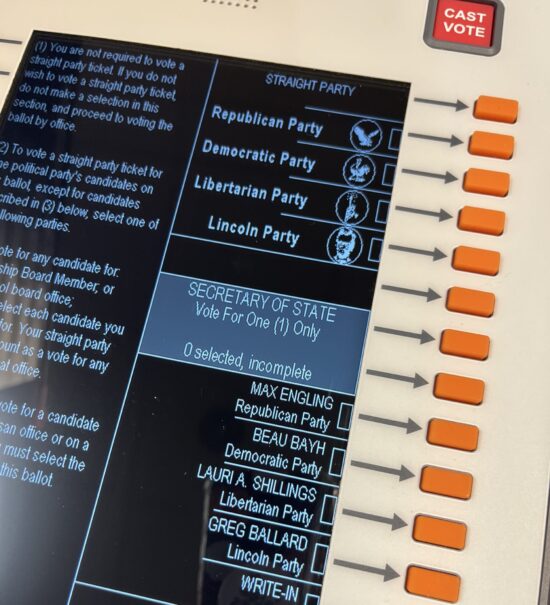
Beau Bayh — in a hotly-contested, four-candidate race — won 52% of the vote for secretary of state and carried 19 counties, when even his supporters hoped he’d win with a plurality of perhaps 46%. There will be a new comptroller, Jessica Bailey, who received just less than 50% in a race that included a Libertarian who received 3%. The comptroller is state government’s “paymaster,” so those two Democratic officeholders will undoubtedly collaborate in exposing what they consider wasteful spending.
The only head-to-head statewide race — state treasurer — was won by incumbent Republican Daniel Elliott, re-elected with 51% over Democrat Coumba Kebe, who will be heard from in coming years. For political junkies, the treasurer’s race revealed what’s called a party’s “baseline vote.” It’s the notion that a voter chooses a candidate knowing nothing more than their party affiliation. By that measure, Hoosier Democrats are elated. Ms. Kebe received 49% in her statewide race, compared to Democrats’ baseline vote of just 36% in 2022.
Indiana House Democrats entered 2025 with the goal of breaking the Republicans’ 70-30 supermajority by picking up just four seats. They flipped 16. Their ambitious recruiting efforts yielded 97 candidates; only three House Republicans got a free pass, compared to 20 House Democrats packed by the GOP gerrymander of 2021 into safe seats. Compare this to two years ago, when 26 Republican House candidates—believed to be in safely gerrymandered seats—ran without Democratic opposition. If you’re looking for proof of the political adage “You can’t beat somebody with nobody” this is it.
Senate Democrats didn’t break the Republicans’ supermajority but still increased their ranks by at least five seats. Pending the outcome of one incomplete final tally—significantly, the unresolved election of Chris Garten, of Charlestown, Republicans’ choice for Senate President Pro Tem—the Senate split will be either 35-15 or 34-16.
Statewide – due to straight party voting – “down ballot” Democrats were elected to county and even township offices they hadn’t held in years, if ever. Here in Marion County, 48% of voters voted straight party Democrat.
Nationally, Republicans had a bad night and Indiana wasn’t spared. The Indiana GOP’s “trifecta” — control of the governorship and both houses of the legislature — still stands, but one bad election means someone has to fall on her sword; predictably, the Republican Party chair has resigned. Will the choice of her successor touch off an internecine fight between the Braun and Banks factions of the Indiana GOP?
Gov. Mike Braun announced he’ll run for re-election in 2028. The odds are with him. Since the Indiana Constitution was amended in 1972 to permit two terms, no incumbent, elected governor who sought re-election has lost.
But no incumbent governor has ever had to win a serious challenge in his party’s primary first.
Braun’s re-election announcement was initially closed to the press. When several outlets pushed back, the media was admitted, but no questions were permitted. Thus, no reporter could ask whether he plans to run again with Lt. Gov. Micah Beckwith, who was conspicuously absent from the announcement.
It certainly appears Braun and Attorney General Todd Rokita are on a collision course for the May 2028 gubernatorial primary. Notwithstanding his statements to the contrary, Rokita has all but announced he’s running, as shown by his most recent attacks on Braun. In one of those broadsides, Rokita blisters the governor for not pursuing the revocation of 25 public school educators’ licenses for their callous remarks following the murder of Charlie Kirk.
Apparently, Ball State University’s acknowledgement in May they’d improvidently fired an administrator on the very same grounds wasn’t sufficiently precedential for our learned attorney general. Our friend and colleague John Krull surgically skewers Rokita’s latest, unlawyerly diatribe as only John can: “For almost any other lawyer in the state, offering such advice would come close to being malpractice.” Absolutely true. The reason Braun hasn’t gone after those 25 licenses is because he has better lawyers advising the Department of Education and him.
Consider this: Say Braun caves and orders the Department of Education to revoke the licenses, who will represent the Department when those teachers and administrators fight back? Yep, Rokita.
As if Rokita doesn’t stir up enough heartburn, Braun has to stomach Beckwith, a lieutenant governor he didn’t want and barely goes a week without causing him more indigestion. I’m sure it’s just a rumor that Pepto Bismol is delivered to the governor’s residence by the truckload.
Now it appears Beckwith is playing hard-to-get with Braun about being his running-mate? Thanks to our intrepid Sydney Byerly, we have Beckwith coyly saying he’s not ready to commit to running for #2 again with Braun. Or perhaps Braun doesn’t want to commit this far in advance of the June 2028 GOP convention, when delegates choose the LG candidate? Now that’s a strong partnership!
U.S. Sen. Todd Young, R-Indiana, will run for a third term in 2028. Will he attract a primary opponent? Will Gov. Braun encourage LG Beckwith to run against Sen. Young?
For both Rokita and Beckwith, they can lose a May primary and still get renominated to run for their current positions at the GOP’s June convention. Imagine that. (No, seriously, imagine that.)
Will the House and Senate GOP leaders recruit candidates for every race on the 2028 ballot? Imagine an election in which there are 100 House and 25 Senate candidates of both major parties. (No, seriously, imagine what that would do for turnout,)
Congratulations to the founders of the new Lincoln Party, which emerged from a bet that non-MAGA Indiana Republicans needed a home. And kudos to its intrepid standard-bearer, former Indianapolis mayor Greg Ballard, for running a very laudable race for secretary of state that was substantive and positive. Mr. Ballard received 3.6% of the vote, clearing the 2% threshold for securing automatic ballot access for the next four years.
But the Libertarian Party of Indiana — which has been on Indiana ballots since 1994 by exceeding the 2% mark in eight consecutive Secretary of State elections — might have been hip-checked by the Lincolnites. (Okay, it’s a word I just made up, but try pronouncing “Lincolnians.”) At this writing, it looks like Lauri Shilling, the Libertarian’s highly credible candidate for secretary of state, might finish with less than 2% and thereby return her party to ground zero under Indiana law.
Hoosier voters will be the losers if the Libertarian option disappears from our ballots. Libertarians are more than a home for “none of the above” voters. They have a consistent, coherent philosophy that has contributed to our civic discourse.
It will be interesting to watch how the Lincoln Party evolves to take its place as Indiana’s new Third Party – or “Second Party” as they prefer, according to our Marilyn Odendahl’s post-election story.
Will the Lincoln Party replace its “Statement of Principles” with something closer to a party platform? If so, will such a platform take positions on divisive issues like abortion, gun control or marriage equality? I’ll bet they don’t make up a list of policy positions that, by definition, create litmus tests. I’m old enough to remember when there were pro-life Democrats and pro-choice Republicans. My hunch — my hope — is that the nascent Lincoln Party will be a welcoming place for anyone who feels unwelcome in the two major parties and their litmus tests.
Last month I worried 2026 might be an historic election for the wrong reason, the interference of an unprecedented number of DOJ observers deployed to all 50 states. Happily, I was wrong. No less an impartial authority than Governing magazine reported “a smooth Election Day.”
Another ancient political adage is “timing is everything.” Hoosier Democrats haven’t had an election like this since 1974. In that “Watergate election,” U.S. Sen. Birch Bayh, D-Indiana, won reelection over Indianapolis Mayor Richard Lugar. Larry Conrad was reelected as secretary of state. The Indiana House of Representatives went from 52R-48D to 56D-44R. Two years later, former mayor Lugar crushed U.S. Sen. Vance Hartke, D-Indiana. The Indiana House of Representatives went back to 52R-48D and Gov, Otis Bowen, a Republican, cruised to reelection over Democrat Larry Conrad.
Just sayin’.
The views and opinions expressed are those of the author only and do not necessarily reflect the views of The Indiana Citizen or any other affiliated organization.
The Indiana Citizen is a nonpartisan, nonprofit platform dedicated to increasing the number of informed and engaged Hoosier citizens. We are operated by the Indiana Citizen Education Foundation, Inc., a 501(c)(3) public charity. For questions about this commentary, contact Bill Moreau at bill.moreau@indianacitizen.org