This story was originally published by Chalkbeat. Sign up for their newsletters at ckbe.at/newsletters
By Amelia Pak-Harvey
Chalkbeat
Sign up for Chalkbeat Indiana’s free daily newsletter to keep up with Indianapolis Public Schools, Marion County’s township districts, and statewide education news.
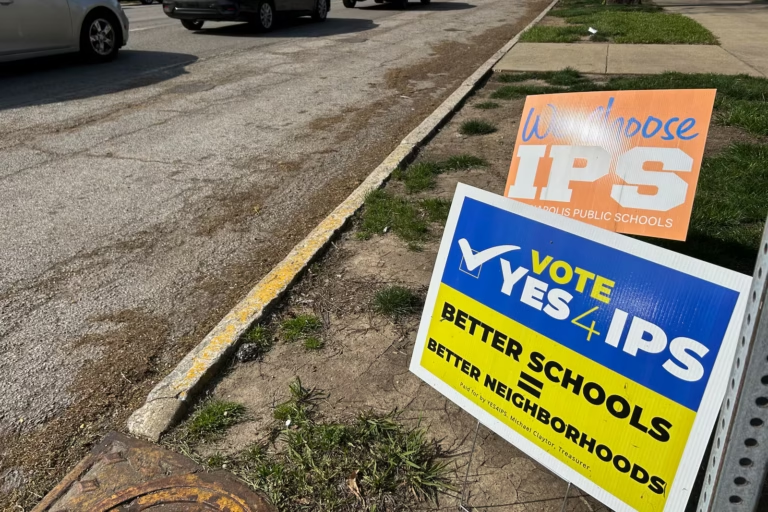
A record number of Indiana school districts are asking voters to increase property taxes for various expenses this fall as reforms passed by state lawmakers last year take effect.
At least 38 districts are requesting to place a referendum question on the ballot in November for one of three reasons allowed by state law: to pay for operating expenses, capital needs, or security projects. The majority of districts are requesting an operating referendum, which covers everyday expenses such as transportation and curriculum.
The surge in ballot questions seeking property tax increases reflects the rising financial pressure on school districts due to recent changes in state law. Last year, lawmakers changed state law so that districts may only place referendum questions on the ballot during general elections, which fall in November of even-numbered years, instead of every year. Plus, lawmakers passed a sweeping property tax relief bill that by one estimate would cost school districts millions of dollars in lost revenue.
A final list of all ballot questions won’t be available until at least Aug. 1. But the number of districts listed on the department’s website just a few weeks before the Department of Local Government Finance finalizes the questions already represents a record for districts seeking tax increases in a single election and calendar year.
Half of the 38 districts are requesting to renew their operating referendums, even though their existing voter-approved tax increases do not expire this year. Five others are seeking an operating referendum for the first time, according to an analysis of historical referendums from the Indiana University Center for Evaluation and Education Policy. Many districts cite the recent property tax reform legislation as a major factor in asking voters for more funding.
Several expenses covered by operating dollars, including transportation and utilities, are growing far faster than the rate of inflation, said Indiana School Board Association Executive Director Terry Spradlin.
The 2025 changes, combined with the state’s 2008 property tax reforms — which capped property taxes for homeowners at 1% of gross assessed value —will end up costing school districts across the state about $5 billion in tax revenue over roughly two decades, he said.
“For the 38 districts pursuing the referendum, it’s not really for program expansions — new programs, new expenses,” said Spradlin, who expects about a dozen more districts to file ballot questions ahead of the deadline. “It’s really to maintain status quo.”
So far, just one district is requesting a capital referendum, and one is requesting a safety referendum.
Although the number of ballot questions has reached a record high, it is not extraordinary given that two years’ worth of ballot questions are now being squeezed into one, experts say.
Historically, school districts that have successfully passed a referendum have a greater chance of winning another one, said Larry DeBoer, a professor emeritus at Purdue University who has extensively studied tax referendums.
And districts that have tried but failed to pass a ballot question still have a higher success rate on subsequent attempts than districts asking voters for the first time, he said. Of the 38 listed so far on the department’s website, seven have previously floated a referendum that voters have rejected.
“Even if you’ve lost before, your chances of winning this time are better,” DeBoer said. “And I suppose that’s experience.”
Some districts may be asking voters to renew a referendum years before an existing one expires so they have multiple opportunities to try and pass a ballot question, Spradlin said.
Others are seeking a referendum early because their current operating referendum no longer generates enough revenue due to property tax reforms, he said.
The property tax caps first implemented in 2008 — known as “circuit breakers” — have collectively cost school districts statewide over $4 billion in lost revenue since their inception, according to historical figures from the Legislative Services Agency. The latest tax reforms will cost school districts statewide roughly $744 million from 2026 through 2028, according to a state analysis last year.
Still, 88 of the 144 school corporations that have floated a referendum have succeeded in passing one, according to Spradlin.
“It might be (that) the publicity will cause voters to say, ‘I guess this is a normal thing now,’” DeBoer said. “But it’s still the case that more than half the school districts have never tried a referendum. On the whole, it’s not that common.”
Amelia Pak-Harvey covers schools for Chalkbeat Indiana. Contact Amelia at apak-harvey@chalkbeat.org.
Chalkbeat is a nonprofit news site covering educational change in public schools.