By Marilyn Odendahl
The Indiana Citizen
March 19, 2026
BRAZIL, Indiana – Just as county clerks have absentee ballots printed and scheduled to be mailed for the May primary, a state court judge has ordered Clay, Vigo and Sullivan counties to halt the process while a dispute continues over a candidate’s eligibility to run in the Republican primary for state Senate District 38.
Clay County Circuit Court Judge David Thomas issued the stay Wednesday afternoon after a nearly two-hour hearing on the matter that morning. Also on Thursday, Thomas granted the change-of-judge motion filed Alexandra Wilson, the candidate fighting to stay on the ballot. Vigo County Superior Court Judge Lakshmi Reddy appointed Putnam County Superior Court Judge Charles D. Bridges to preside over the case.
Bridges has served on the bench since 2009. Currently, he is listed on the Indiana Roll of Attorneys as “active and in good standing,” but in 2025, he was reprimanded by the Indiana Supreme Court for violating three provisions in the Indiana Code of Judicial Conduct.
In his order, Thomas granted the motion to stay the Indiana Election Commission’s February ruling that Alexandra Wilson could remain on the Republican primary ballot. He then directed Vigo and Clay counties to “immediately cease sending, mailing or otherwise distributing absentee ballots” for the GOP primary election in May until the court case is settled. Sullivan County was ordered to stop sending the absentee ballots only to those voters within Senate District 38.
Unlike the order granting the change-of-judge motion, Thomas did not explain his reasoning or cite any Indiana trial rules or statutes. He wrote that he had reviewed the filings in the case and heard the arguments of all the parties during the March 18 hearing and determined a stay should be granted.
The ruling came a few hours after the hearing had concluded, but Thomas told the litigants and their attorneys what he was going to do, and he invited them to submit their proposed orders by 3 p.m. for him to consider. At the conclusion of the hearing, he seemed to acknowledge no one was satisfied with the outcome.
“I know people are not getting what they want here today,” Thomas said. “I do think this is a fair thing to do.”
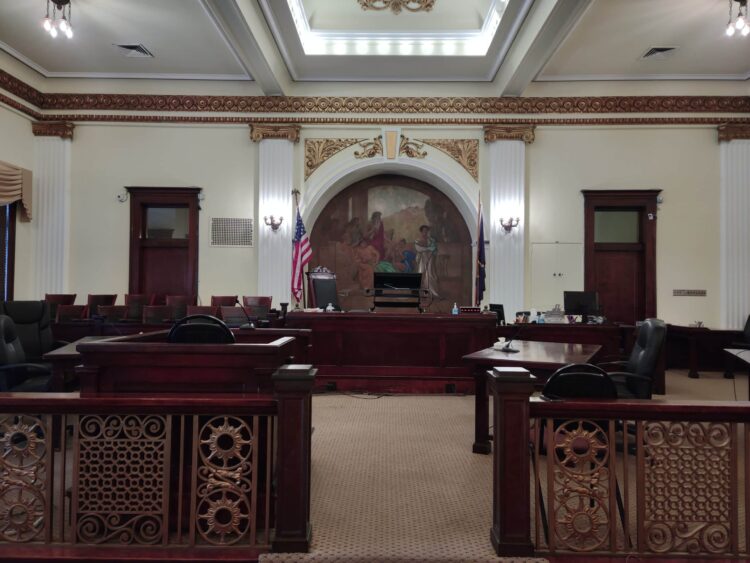
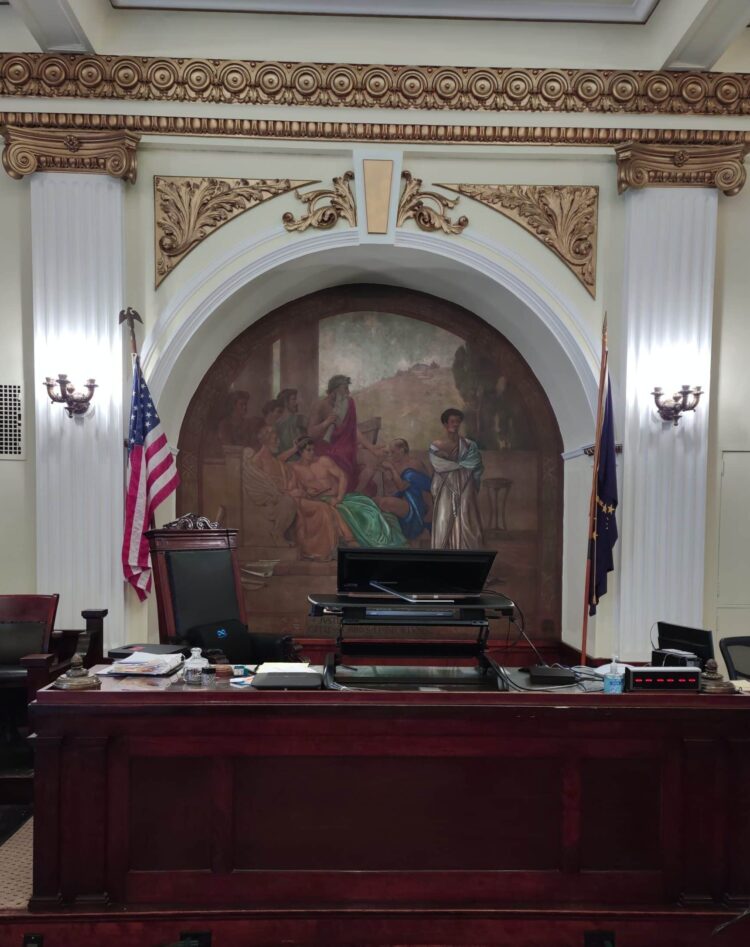
Thomas conducted the hearing in his cavernous courtroom in the 112-year-old Clay County Courthouse. Ornate molding capped the walls, a stained glass skylight perched in the ceiling, and a large mural sat recessed in the wall behind the judge’s bench. The attorneys and their clients occupied the long wooden tables on opposite sides of the judge while the few people sprinkled in the gallery sat on benches that resembled church pews.
Standing behind the bench, Thomas wore a suit and tie rather than a black judge’s robe and did not bang a gavel, instead telling everyone they could remain seated when he entered and exited the courtroom. He kept the hearing civil and focused on the issues, addressing each party individually and giving them all time to fully respond to his questions.
The court case was a continuation of a dispute that started after Terre Haute resident Alexandra Wilson filed to run against state Sen. Greg Goode for Senate District 38 in the Republican primary election. She is the second Wilson to enter the race, and her name is poised to appear on the ballot ahead of Brenda Wilson, a Vigo County Council member who has been endorsed by President Donald Trump.
Jeffrey Gallant, a Vigo County voter, challenged Alexandra Wilson’s eligibility to be a candidate on the basis of her 2010 arrest for resisting law enforcement. After the Election Commission denied his challenge, Gallant filed the petition for judicial review. His attorney, James Bopp, has alleged she is part of a political ploy to confuse voters and ensure that Goode retains the Republican nomination.
Thomas had planned to hear arguments on the merits of the case, but the request for a new judge filed by Samantha DeWester, Alexandra Wilson’s attorney, upended the agenda. Also taking part in the hearing were John Oberdorf and Drew Green of the Indiana Attorney General’s office, which is representing the Election Commission.
Bopp argued against switching judges, saying any delay in getting to a resolution would harm the voters and Brenda Wilson. He said voters will be confused by seeing two candidates with the same last name on the ballot and possibly not vote for the Wilson they want. In addition, Brenda Wilson would suffer collateral damage, he said, because her rights would be violated if her supporters mistakenly cast a ballot for her opponent.
DeWester scoffed, saying the argument that voters would not be smart enough to differentiate between candidates with the same last name was absurd. She said her client was the one at risk of being disenfranchised by having her name removed from the ballot before she could present her case.
The attorney general’s office did not take a side in the change-of-judge argument. Oberdorf said the office would defer to the court.
Bopp proposed placing a stay on the commission’s ruling in the emergency motion that he filed with the court on March 12. He asserted the stay was necessary to prevent “irreparable harm” if the case could not be settled before the absentee ballots had to be mailed.
This election cycle, the absentee ballots must be in the mail by March 21.
Oberdorf of the attorney general’s office questioned the court’s purview. He noted Clay, Vigo and Sullivan counties were not named parties in the case and he questioned whether the court could legally prevent the counties from mailing the absentee ballots.
Thomas asked Oberdorf to cite case law to support his argument.
DeWester said holding the ballots would be “horrific.” Voters who were voting absentee would not be getting a ballot because, she said, one person thinks they will be confused by having two Wilsons running for the same office. “It’s absurd,” she said.
During the hearing, Bopp brushed aside the impact the stay would have on the county clerks and local election boards. He said the ballots were usually printed from computers in the clerks’ offices so removing a candidate’s name would not be overly burdensome.
However, the three counties have already had their ballots designed and printed. Any change in candidates would require the clerk to get the Republican ballots completely redone with the extra cost borne by their local taxpayers.
Sullivan County is scheduled to start mailing ballots to absentee voters on Friday, while Clay County has reportedly been sending ballots since March 13. Vigo County has posted sample ballots for the May primary online and is scheduled to start sending out the absentee ballots on Saturday.
Contacted after the hearing, Sullivan County Circuit Court Clerk Tonya Bedwell said a change in the Senate District 38 candidates would burden the county’s already tight budget. She estimated the cost of materials and stamps needed to mail the ballots is already between $3 and $4 dollars each.
Another snag in the process is the federal Military & Overseas Voter Empowerment (MOVE) Act.
Under this law, absentee ballots must be sent at least 45 days in advance of the election to military and overseas voters who filed a Federal Post Card Application that was reviewed and approved by county election officials. If an Indiana county anticipates it will miss the 45-day requirement, the Indiana Election Division notifies the U.S. Department of Justice and the Federal Voting Assistance Program about the potential delay and then works with the federal officials to resolve the problem.
The Election Division has already alerted the Justice Department about the trial court ordering Clay, Vigo and Sullivan counties to not distribute any ballots requested by Republican primary voters in Senate District 38.
Also, the Vigo County Election Board has scheduled an emergency meeting on Friday to discuss Thomas’ order to hold the ballots.

Thomas repeatedly pointed out, during the hearing and in his change-of-judge order, that Alexandra Wilson entered the case 14 days after the petition for judicial review had been filed. He said Wilson waited until “eve of the trial” to intervene in the case and request a new judge.
The delay, Thomas asserted in his order, benefits Wilson. A pause in the court proceedings, he said, “has the effect of (Wilson) staying on the ballot without a judicial opinion on the ultimate issue of (her) alleged disqualification.”
Thomas made the same point during the hearing. “If I disqualify myself, you’ve won, haven’t you?” he asked.
DeWester, Wilson’s attorney, responded, “It’s not about winning.” She said it was about following proper procedure.
DeWester told the court that Bopp had never served her client. He had copied DeWester on emails with his filing attached but, after the commission meeting, DeWester was technically no longer Wilson’s attorney and there was nothing to indicate DeWester was still providing representation. Consequently, DeWester argued, Wilson should have been served the court filings, personally.
Moreover, DeWester asserted, Wilson has the right to file a brief in response to the petition for judicial review and to have the time to argue her side in court.
Bopp filed the petition for judicial review on March 3 and the next day, filed a motion to add Wilson to the case. The attorney general’s office and Bopp submitted some additional documents and notices in the subsequent days, but the court did not issue any rulings until Bopp filed an emergency motion requesting a hearing on March 12.
That same day, Thomas responded by setting the hearing for March 18. Dewester filed a motion to intervene on March 13, a Friday. The court did not grant the motion until March 16, at which time DeWester filed for a change of judge.
Even Bopp sounded exasperated at the pace of the journey the case has taken through the court. As he argued for the commission’s ruling to be overturned and for the court to order Wilson’s name removed from the May ballot, he pressed the urgency to move quickly because of the approaching primary election.
“This is the best we can do,” Bopp said during the hearing. “I’ve done everything I can do to expedite this case and have filed multiple requests for an expedited hearing.”
In his order, Thomas said Alexandra Wilson’s right to a new judge overrode the “emergency circumstances” in this case and the need for a “quick decision on the merits.” Also, Thomas motion to add Wilsonhe could have continued to preside over this matter and tried the case on its merits. However, he said the appeal that likely would be filed if he did that would “cause a distraction to the merits of the case.” So, he said he opted to err on the side of caution.
The case is Jeffrey Gallant v. Indiana Election Commission and Alexandra Wilson, 11C01-2603-RA-185.
Colleen Steffen, executive editor of TheStatehouseFile.com, edited this article. She worked as a newspaper reporter and editor for more than 13 years and is now in her 10th year teaching college journalists.
The Indiana Citizen is a nonpartisan, nonprofit platform dedicated to increasing the number of informed and engaged Hoosier citizens. We are operated by the Indiana Citizen Education Foundation, Inc., a 501(c)(3) public charity. For questions about the story, contact Marilyn Odendahl at marilyn.odendahl@indianacitizen.org.