This story was originally published by Capital B Gary.
By Calvin Davis
Capital B Gary
March 17, 2026
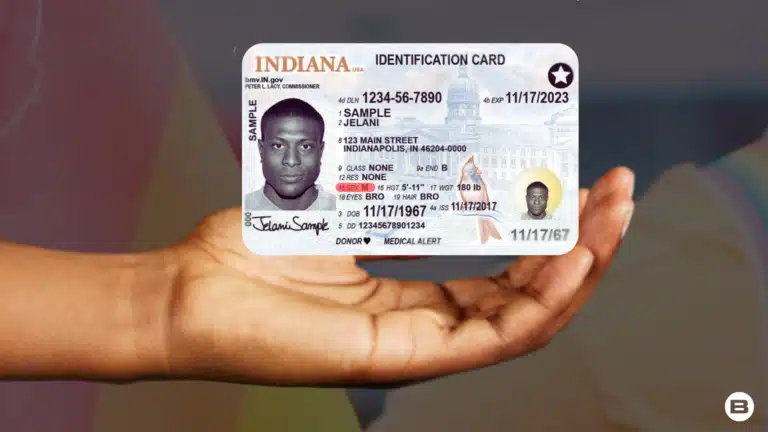
Indiana residents can no longer change the gender on their driver’s licenses under an executive order from Gov. Mike Braun that requires state-issued identification to reflect a person’s assigned sex at birth. The policy, which went into effect Feb. 12, applies to all gender changes on Indiana-issued credentials, ending a long-standing Bureau of Motor Vehicles process that allowed residents to update identification to align with their gender identity.
The order is the latest in a series of efforts by Indiana Republicans to crack down on support for gender transitions, a policy that has divided voters in Indiana. It underscores how strong the backlash has been statewide against transgender rights in recent years.
Gary has also faced division over transgender rights.
In 2007, Kevin Logan, a gay and transgender student at West Side Senior High School, sued the Gary Community School Corporation, claiming his First and Fourth Amendment rights were violated when he was denied entry into the school’s 2006 prom for wearing a dress, according to the Post-Tribune. In 2011, the Gary Community School Corporation settled the lawsuit, issued an apology, and agreed to policies preventing future discrimination based on gender identity or expression.
For decades, Hoosiers were able to update the gender on their licenses. The Braun administration, however, has stated its official position is that “gender ideology falsely asserts the false claim that men can identify as and thus become women and vice versa and it would require all institutions of society to regard this false claim as true.” He has declared that state funds shall not be used to support it.
But at public hearings held at Bureau of Motor Vehicles locations across the state, speakers largely opposed the change.
“The people of Indiana spoke clearly and repeatedly against this policy, and the BMV chose to ignore them,” said Chris Paulsen, CEO of Indiana Youth Group, an advocacy organization for LGBTQ+ youth and young adults, in a news release. “Quietly implementing a rule that puts transgender Hoosiers at risk is not governance. It’s cruelty.”
Gary native Belinda Drake, the executive director of the Community Research and Resource Center in Indianapolis, which empowers disenfranchised communities by providing access to comprehensive health and social services, said identification that does not match a person’s gender identity can create daily risks.
“What that means is that not allowing folks’ IDs to match their preferred gender puts them in harm’s way,” Drake said. “It allows them to be discriminated against. It allows them to be targeted, but it ultimately makes it hard for them to get access to vital resources.”
“It creates unnecessary opportunities for transgender and gender-diverse people to be discriminated against and targeted,” she added.
The Human Rights Campaign Foundation reported that 34 transgender and gender-nonconforming people were killed in the United States in 2022. Of those, 26 were people of color and 19 were Black, according to the group’s annual report.
Drake said she saw Indiana residents rush to update their identification before the order took effect.
“I saw community members literally scramble to hurry up and get their IDs updated before the law took place,” she said. “It was just fear; fear of feeling unsafe when your ID doesn’t match how you identify. That just creates all kinds of challenges for your mental health and access to vital resources.”
The executive order comes amid a broader wave of state legislation cracking down on gender transitions. In 2023, lawmakers passed Senate Bill 480, prohibiting physicians from providing gender transition procedures to minors. Lawmakers also restricted the Department of Correction from using state or federally administered funds to provide sexual reassignment surgery for incarcerated individuals.
At the state and federal levels, policymakers have also proposed eliminating Medicaid coverage for gender-affirming care and cutting federal funding to hospitals and clinics that provide it. The proposal would apply not only to surgical procedures but also to hormone prescriptions such as testosterone and estrogen and to mental health services for transgender patients.
Victoria Kirby York, director of public policy and programs at the National Black Justice Collective, said the potential loss of federal funding would have sweeping consequences.
“These attacks have been incredibly harmful, especially to Black people and low‑income people,” she said. “One of the first things they’ve done is try to get rid of gender‑affirming care coverage under Medicaid.”
Kirby said Black transgender residents are more likely to rely on Medicaid and safety-net clinics, meaning cuts to public coverage and hospital funding would hit them hardest.
“Unfortunately, the people most impacted are Black folks, particularly Black trans folks, who are more likely to receive care from these kinds of clinics, and also Medicaid, which is also being targeted,” she said.
Under the Biden administration, the U.S. Department of Justice and partner agencies hosted trainings for law enforcement on interacting appropriately with transgender people and identifying transgender victims and suspects.
“In 2021, we saw 60 transgender people, mostly Black, murdered,” Kirby said. “After those trainings, we went from that high‑water mark of 60 … to last year, we were just under 30 murders. And so I took that as a sign that law enforcement had been doing better.”
While national violence data and policy debates shape the broader climate, advocates say local leadership often determines what support looks like on the ground.
In Gary and other majority-Black communities, LGBTQ residents remain present and active, but sustained and visible organizing has often struggled to take root. Gary has not held a Pride parade since 2008. The city’s first parade, held that year, marked a milestone moment for LGBTQ visibility, but large-scale celebrations have not returned in the years since.
“Gary has the people. What it needs is sustained leadership, funding, and people willing to put ego aside to build year after year,” Kirby said. “The support is often there, but people are usually waiting for someone to make the first move.”
Calvin Davis is Capital B Gary’s government and politics reporter. You can reach Calvin at calvin.davis@capitalbnews.org. More by Calvin Davis