By Sheila Suess Kennedy
October 6, 2026
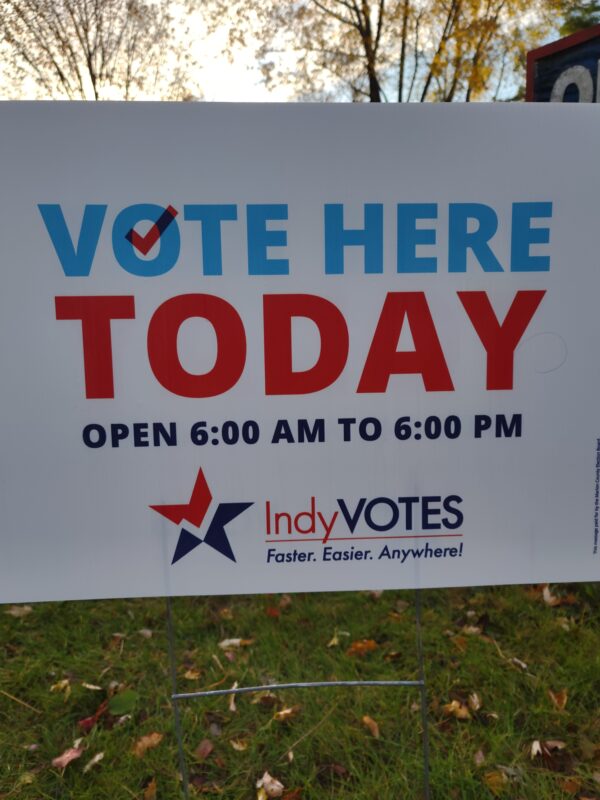
Early voting starts today in Indiana. Later today, my husband and I intend to cast our ballots, and I encourage every registered voter reading this in Indiana–or in any state where early voting has begun– to do the same. I’ve previously explained why early voting, preferably in person, is so important this year; a massive early turnout will make it far more difficult for Trump to play games with the midterm results.
Here in Red Indiana, I intend to vote Blue, and I have high hopes that Hoosiers can rid ourselves of the GOP’s culture-war super-majority in our dreadful state legislature. But Indiana’s ballot also asks us to approve two changes to the state constitution. I intend to vote NO on both, and I hope those of you in the Hoosier state will join me in rejecting them.
The first proposed measure is the most pernicious. It would amend Article I, Section 17 of the state constitution. It reads as follows:
Currently, under the Constitution of the State of Indiana, a person charged with murder or treason is not entitled to be released on bail if the proof is evident or the presumption strong. Shall the Constitution of the State of Indiana be amended to provide that a person charged with an offense other than murder or treason is not entitled to bail if: (1) the proof is evident or the presumption strong; and (2) the state proves by clear and convincing evidence that no release conditions will reasonably protect the safety of any other person or the community.
There are all kinds of reasons why this is a bad idea. Courts already have ample tools to protect public safety while accused folks (who are, remember, innocent until proven guilty) are out on bail: supervision, money bail, electronic monitoring, no-contact orders, treatment, testing, and travel restrictions come to mind. Furthermore, available data shows that 98.6% of those deemed high risk do not commit violent crimes while they are out on bail.
It seems unfair to keep people who have yet to be convicted from earning a living during the months between being charged and being tried, but it’s Indiana jails that will face the real problem if this unnecessary measure passes. For more years than I can count, the state’s jails have been so stretched, so over-crowded and under-resourced that they have frequently been targets of successful lawsuits requiring them to expand. When those lawsuits succeed–and most do– we taxpayers shell out a lot of money. In 2024, thirty-one of Indiana’s jails were operating above above the state’s recommended capacity threshold, and eight were above 100% capacity.
Most of the judges I know are thoughtful and fair-minded, but there is no reason to give the occasional MAGA rogue additional authority to “lock ’em up.” This ballot question is a solution in search of a problem, and I hope voters recognize that and vote NO.
The second ballot question is less pernicious, and you may disagree with my conclusion that it, too, should garner a NO vote. it would amend Article 6, Section 6, of the state’s constitution. It reads:
Shall the Constitution of the State of Indiana be amended to permit the judge of a city or town court to reside in: (1) the county in which the court is located; or (2) the bordering county closest to the city or town in which the court is located?
I think there are good reasons for judges to reside in the counties inhabited by the people their decisions affect. There are undoubtedly highly competent lawyers in the fancier suburbs of Indiana’s urban counties, but I see no persuasive reason why they shouldn’t confine their desire for judicial status to the counties within which they have chosen to live. Granted, a judgeship in a more highly populated city is likely to produce more publicity and attention, but I personally see no reason to change Indiana’s constitution simply to allow ambitious lawyers to occupy more prominent benches.
Whatever my fellow Hoosiers decide when faced with these ballot measures, I urge you–plead with you– to VOTE EARLY. As I’ve previously argued, early voting allows campaigns to improve their Get-Out-The-Vote efforts. Every night, campaigns get a list of people who voted that day, allowing them to focus their efforts only on the people who haven’t yet voted. The larger the number of voters who vote early–preferably on Day 1–the easier it is to increase turnout for one’s candidate. And in this midterm election, massive turnout is essential.
Sheila Suess Kennedy is Emerita Professor of Law and Public Policy at the School of Public and Environmental Affairs at Indiana University Purdue University Indianapolis. As an attorney, she practiced real estate, administrative and business law in Indianapolis before becoming corporation counsel for the City of Indianapolis in 1977. In 1980, she was the Republican candidate for Indiana’s then 11th Congressional District and in 1992, she became executive director of the American Civil Liberties Union of Indiana. She joined the faculty of the School of Public and Environment al Affairs in 1998.
This column was originally published by Sheila Kennedy on her blog, “A Jaundiced Look at the World We Live In.” The views and opinions expressed are those of the author only and do not necessarily reflect the views of The Indiana Citizen or any other affiliated organization.