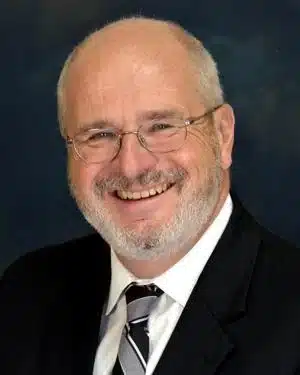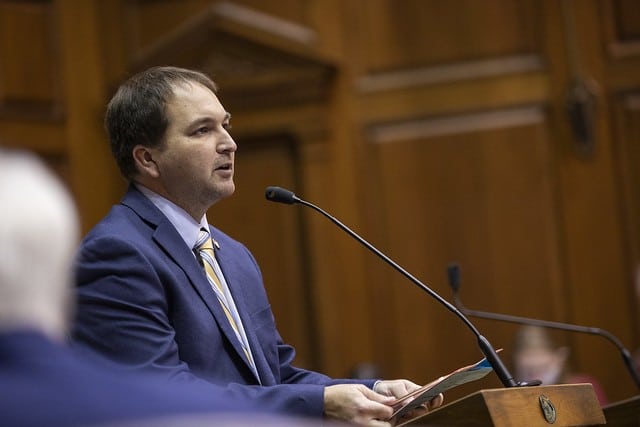
The House Committee on Government and Regulatory Reform passed a bill by Rep. J.D. Prescott, R-Union City, giving municipalities the ability to adopt rules for decorum at public meetings. (Photo/J.D. Prescott’s Flickr)
By Whitney Downard
Indiana Capital Chronicle
January 16, 2024
The city of Winchester, Indiana, has less than 5,000 residents but one glaring problem in the eyes of local elected officials: people purposefully disrupting government meetings and deliberately disregarding decorum.
Mayor Bob McCoy detailed a December 5, 2022, meeting in which attendees were “so out of hand” that he adjourned the meeting early and chaos ensued.
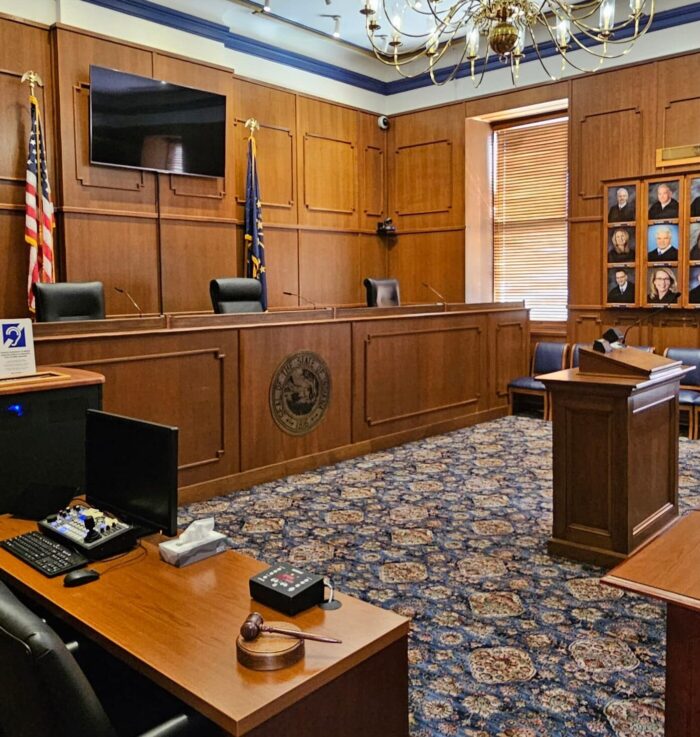
“The crowd just took over the council chambers, got up on the bench and (were) slamming the gavel. It’s just, it’s just been so crazy,” McCoy said. “Our residents do not want to come to our meetings. We’ve got two or three people that have pretty much monopolized our meetings since May of 2022.”
McCoy said he filed a protective order on behalf of himself, his family and various city officials after an individual started filming clients coming and leaving the city attorney’s office. And, for the first time, he started carrying a firearm.
Some residents have told him they don’t want to sign-in and testify before the council for fear of retaliation. Ongoing actions include repeated interruptions, ignoring three-minute time limits or raising hands to say someone on the council is “out of order,” according to McCoy.
The content ends up on YouTube, a platform which Rep. J.D. Prescott said encouraged the group to be more disruptive to get more views and subsequently monetize the videos. In response to events in Winchester, which is in his district, he introduced House Bill 1338 to let municipalities define decorum and protect intervening law enforcement.
“The thing that I keep trying to balance is when person A’s First Amendment rights start to violate person B’s First Amendment rights,” Prescott said. “And when you have people that are uncomfortable coming to city council meetings, coming to county council meetings because of a small group of individuals (who are) being disruptive. I think it’s a clear violation of the average, everyday citizen’s First Amendment rights.”
Prescott, R-Union City, said the language doesn’t impact school board meetings, which the General Assembly regulated recently, and utilizes a “three strikes” approach. After two verbal warnings, the local presiding officer can ask the disruptive attendee to leave and, if they refuse, law enforcement can intervene.
Decorum rules determined by local units of government must be posted in a public place and law enforcement can immediately remove someone if necessary to maintain public order or if a crime is committed. The bill also clarifies that the state’s qualified immunity legal language protects public employees and law enforcement from being held personally liable for enforcement.
Additionally, the bill expands the definition of trespass to include restricted property with appropriate signage. Previously, trespass only counted if an owner or operator asked an alleged trespasser to leave and signs didn’t count as notice.
Luke Britt, Indiana’s Public Access Counselor charged with rulings related to the state’s public access laws, spoke in support of the bill, saying the issues aren’t unique to Winchester.
“The bill itself mirrors a lot of guidance that I’ve issued from my office in the form of advisory opinions. But this codifies those and gives them more weight,” he said. “And I think that gives more confidence to local officials to keep that decorum, to keep civility (and) to keep those business meetings professional.”
Britt opined that such rules wouldn’t infringe on the freedom of residents to protest, beyond the already acceptable and constitutional limits on time, place and manner.
The bill passed out of the House Government and Regulatory Reform Committee unanimously and now moves to the full House.
Indiana Capital Chronicle is part of States Newsroom, a network of news bureaus supported by grants and a coalition of donors as a 501c(3) public charity. Indiana Capital Chronicle maintains editorial independence. Contact Editor Niki Kelly for questions: info@indianacapitalchronicle.com.