By Marilyn Odendahl
The Indiana Citizen
September 1, 2026
During last week’s debate among the secretary of state candidates, Lincoln Party candidate Greg Ballard was able to show what he would do to improve Indiana’s voter turnout – he held up a copy of his proposed voter’s guide.
His opponents – Republican Max Engling, Democrat Beau Bayh and Libertarian Lauri Shillings – offered differing ideas for getting more Hoosiers to the polls during elections, but they were pretty much in agreement that Ballard’s guide was not the answer.
“I think $2.5 million dollars for a piece of paper that’s going to be mailed to every house is not the best idea,” Engling said, referring to the estimated average cost of Ballard’s voting guide.
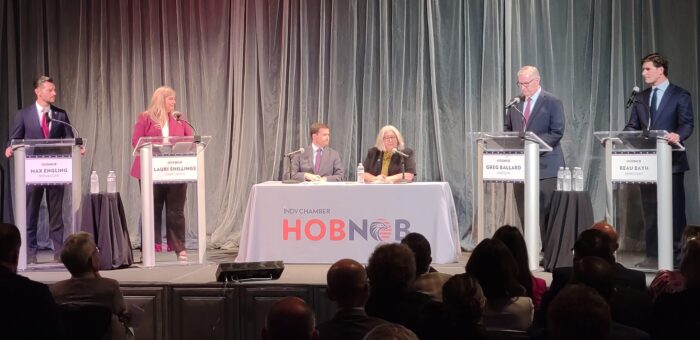
The four hopefuls for Indiana secretary of state faced off on Aug. 26 as part of Indy Chamber’s HobNob event. Over the course of roughly an hour, they fielded a range of questions about their plans for carrying out the duties of the office, including the administration of elections and oversight of business services.
Boosting the state’s bottom-dwelling voter-turnout rate inspired an animated discussion among the four candidates.
Two days before the debate, Ballard unveiled his voter’s guide at a news conference held in the Statehouse, a few feet from the entrance to the office he hopes to occupy after the Nov. 3 general election.
Ballard said if elected secretary of state, he would create a voter’s guide for every registered Hoosier voter before every general election. He touted the guide as helping voters become better informed and improving turnout at the polls.
“No Hoosier should ever walk into the voting booth feeling unprepared to cast their ballot. And no one should stay home because they didn’t have time to learn who or what would be on that ballot,” Ballard said during the news conference. “When I’m secretary of state, that won’t happen.”
During the Indy Chamber debate, Bayh and Shillings saw a deeper problem behind Indiana’s lagging voter turnout.
Bayh dismissed the notion that Hoosier voters are staying home on Election Day because they do not know anything about the candidates on the ballot. He attributed the low turnout to anger at the behavior of some of the state’s leaders.
“The largest problem that we have is apathy,” Bayh said. “And apathy is driven in large part by some of our elected officials, the current secretary of state included, looking out for the interests of their donors and their political party, not the people of our state.”
Shillings, likewise, linked the abysmal voting rate to current officeholders. In particular, she said Hoosiers were not going to the polls because their trust in the election process has declined as national leaders have been “spouting off information about voter fraud,” without offering any supportive evidence. Moreover, she said, Hoosiers are not happy with the candidates.
“The reason we have low voter turnout is people are absolutely exhausted by bad options on their ballot,” Shillings said. “I’ve been campaigning for 18 months and every single community that I’ve talked to have the same response: ‘I’m tired of bad options.’”
Indiana’s voter turnout rate has consistently lagged way behind the national average despite some recent upticks in both the number of Hoosiers registering to vote and those going to the polls.
According to the 2025 Indiana Civic Health Index, Indiana’s voter registration rank rose from 40th in the nation during the 2022 midterms to 33rd during the 2024 presidential election. Meanwhile, its voter-turnout ranking climbed from 50th in the 2022 midterms to 41st in the 2024 election.
The state’s voter turnout has stayed close to 60% over the past decade during presidential election years, but its national ranking dipped, according to the Civic Health Index. Even though Indiana’s turnout rate climbed 9 percentage points from 2016 to 2020, its ranking fell from 41st to 46th in the country, because nationally voter turnout rose almost 15 points. In 2024, the state’s ranking returned to the 41st position.
The midterm elections have drawn even fewer Hoosiers to the polls, the index reported. In 2018, Indiana hit 49.3% turnout, its best midterm showing in decades. However, four years later, that rate dropped 7.4 percentage points to 41.9% and the state’s ranking sagged to 50th out of 51 jurisdictions (50 states plus Washington, D.C.).
Voting-rights organizations have long advocated for the secretary of state to provide Hoosiers with a voter’s guide.
In a review of voter education efforts, Indianapolis Public Editor Tracey Compton found many news organizations and nonprofits were offering their own directories to provide information about the candidates and the mechanics of voting. Still, some advocates were worried the space is becoming too cluttered with all the groups trying to do the same thing.
That situation creates a space for state-produced election materials.
“It’s certainly helpful,” Julia Vaughn, executive director of Common Cause Indiana, told Compton about the news outlets’ voter’s guides, “but I think the state has a role to play because they have the ability to reach every registered voter, if they really wanted to.”
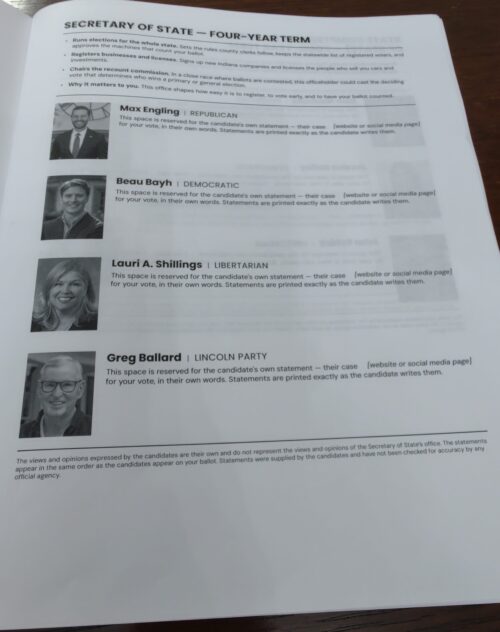
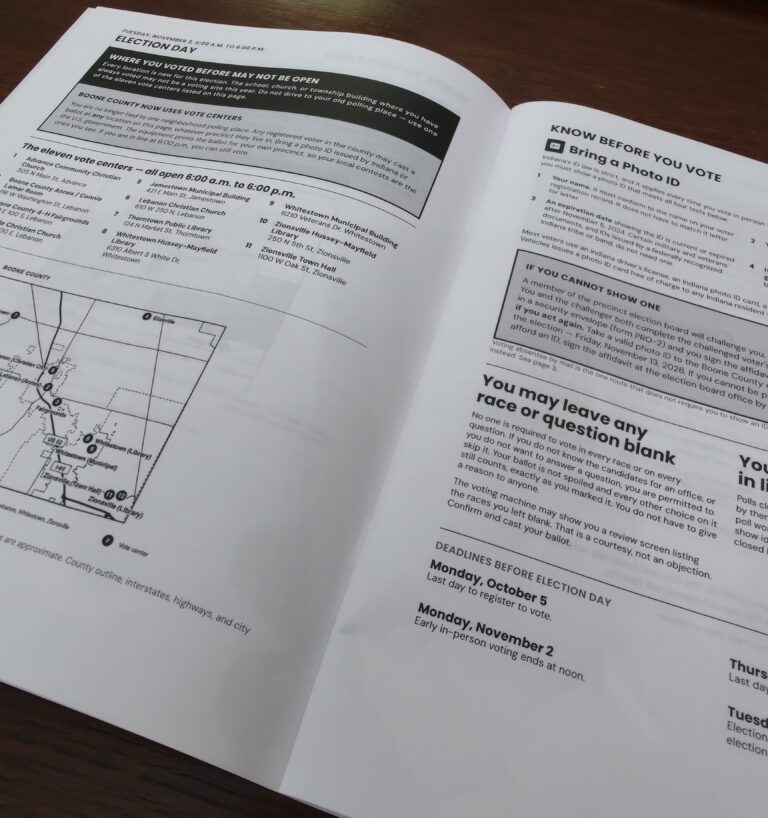
The voter’s guide proposed by Ballard would be available in a digital format as an app as well as in a print copy, which would be mailed to every registered voter in Indiana before each general election. At the news conference, Ballard emphasized the guide would be nonpartisan.
Information in Ballard’s proposed guide would include deadlines for registering to vote and for applying for a mail-in ballot, poll locations and hours for voting early in-person or on Election Day, and a list of voters’ rights plus tips on what voters can do if they are turned away at the polls.
Also, the guide would contain the candidates in every race from statewide offices to the local school board. Along with a picture and party affiliation, each individual entry would include the candidates’ statements about themselves and their candidacies.
In keeping with the objective nature of the guide, Ballard said those candidate statements would be reviewed by “nonpartisan people” and could not be used to disparage any opponents.
During the debate, Engling and Bayh were especially critical of the cost to produce and mail the voter’s guide.
The estimated cost of printing and mailing the guides across a four-year secretary of state term would average out to $2.5 million per year, Ballard said at his news conference. Seeking to put the cost in context, he said the expense equated to roughly eight days of interest income earned from the state’s $2.5 billion in reserves or about one cent out of every $100 the state collects in taxes from Hoosiers.
A press release from the Ballard campaign provided a more detailed cost analysis.
In a presidential or mid-term election year, the printed guides would be 28 pages and mailed to every registered voter in Indiana, which currently numbers 4.7 million persons. It would cost from $3.6 million to $4.3 million. In municipal election years, the printed guides would shrink to 14 pages, because they would cover local races and be mailed only to voters in cities and towns. Consequently, that cost would drop to $2.0 million to $2.3 million.
Ballard said he believed the cost could be absorbed by the secretary of state’s budget, instead of asking the General Assembly for an additional appropriation. However, he said getting money from the legislature to cover the expense “would be helpful.”
Defending the expenditure, Ballard said Hoosier voters needed to be better informed in order to practice self-governance and cast a ballot, which is the “most sacred right in the U.S. government.”
“We don’t inform the voters enough to choose their leaders,” Ballard said. “We just don’t do that as well as we could, and we should do that from the secretary of state’s office.”
However, at the debate, Bayh said the cost of producing a voter guide “doesn’t make sense.” He maintained the $2.5 million would be eating into the secretary of state’s annual budget of approximately $8 million and siphoning money that “needs to be spent elsewhere.”
In addition, Bayh remained skeptical the guide would provide an answer to the problem of low voter turnout. “More importantly perhaps than the cost, I don’t think it’s a good way to actually solve this,” he said.
Engling also pointed to the estimated impact on the secretary of state’s budget and indicated that the information should be sent to voters via social media or email.
“Get this information to folks in a way that they actually digest it,” Engling said. “We don’t need a $2.5 million document that someone is going to throw away.”
Ballard responded to the criticism by noting the Republican and Democratic candidates “seem to not want the voters to have the information” in which to vote. He then rebutted their complaints about the costs by claiming the state already pays $10 million every election cycle for the parties’ primaries.
“Make them pay for the primaries,” Ballard said of the Republican and Democratic parties. “We’ll do the voter turnout.”
Dwight Adams, an editor and writer based in Indianapolis, edited this article. He is a former content editor, copy editor and digital producer at The Indianapolis Star and IndyStar.com, and worked as a planner for other newspapers, including the Louisville Courier Journal.
The Indiana Citizen is a nonpartisan, nonprofit platform dedicated to increasing the number of informed and engaged Hoosier citizens. We are operated by the Indiana Citizen Education Foundation, Inc., a 501(c)(3) public charity. For questions about the story, contact Marilyn Odendahl at marilyn.odendahl@indianacitizen.org.