By Steve Hinnefeld
The Indiana Citizen
November 23, 2026
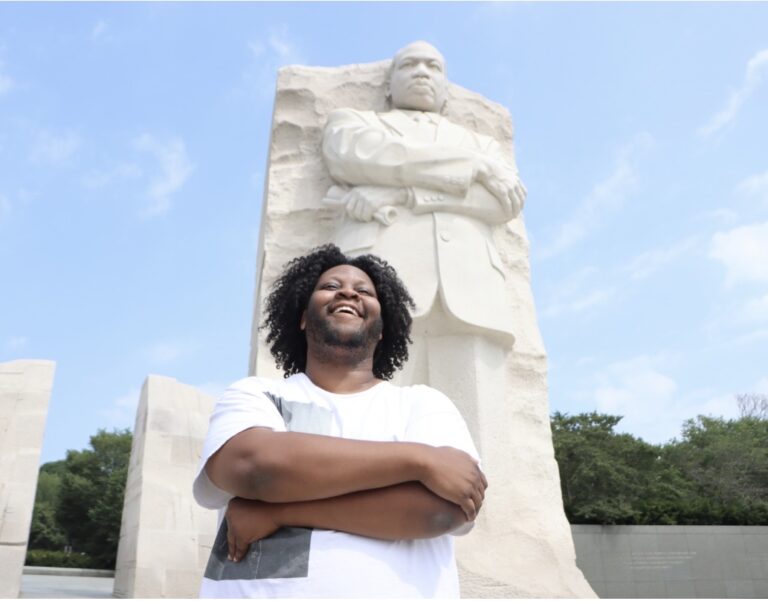
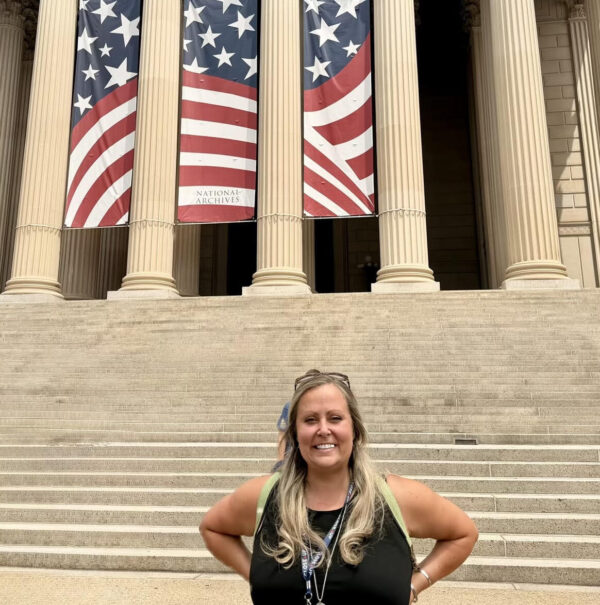
Kristin Kleinert and Keshawn Coleman teach in different kinds of schools at opposite ends of Indiana, but they share a passion for social studies as a subject and citizenship as a practice.
When they learned about an opportunity to sharpen their civic education skills, they said yes.
Together with 100 other educators from around the state, Kleinert and Coleman have become part of a “community of practice” focused on teaching civics with an emphasis on original documents and projects that engage students. They have shared resources, met for discussions and seminars, and traveled to Washington, D.C., for a four-day immersion in American history.
“It’s changed a lot of what I do,” said Kleinert, a veteran educator who teaches fifth grade at Henryville Elementary School in rural southern Indiana. “I feel like I’m a better teacher.”
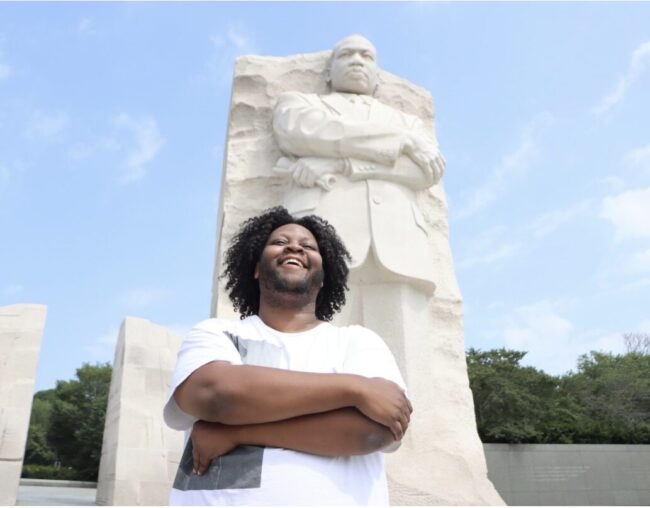
Coleman teaches English/language arts and social studies for sixth grade at East Chicago Lighthouse Charter School, where 55% of the students are Black, 40% are Hispanic and all qualify for free or reduced-price school meals. A second-year teacher, he said the civic education program is helping him find his footing
“I really am excited for what this could do for my students,” Coleman said. “It’s definitely something that’s benefiting the kids right now.”
The three-year program, called CREATE250, is part of a series of professional development programs for teachers designed and carried out by Ball State’s Center for Economic and Civic Learning. Launched last year, it pairs close study of key foundational documents, such as the Declaration of Independence, Constitution and Bill of Rights, with teacher-led civics-learning exercises and is intended to provide sustained support for civic education.
But, while nearly everyone agrees that civic education is important, there’s disagreement about what it should include. Should schools focus on teaching the facts about American history and government? How should they interpret the facts? Should they encourage critical thinking?
Complicating the debate, the Trump administration is using civic education to promote its own take on history and American values. In 2025, it revised criteria for the grant program that funds Ball State’s civic education initiatives to prioritize patriotic education. Its efforts have received pushback from scholars, who worry students will get an inaccurate view of U.S. history.

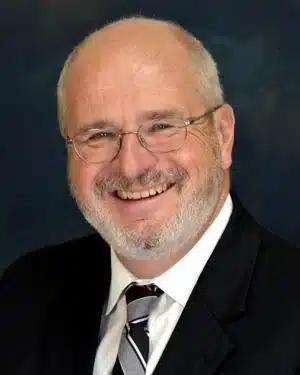
David Roof, a professor of educational studies in the Ball State Teachers College and the leader of CREATE250, said the program is giving teachers the tools to learn and share the American story in all its fullness. He said the response from Indiana teachers shows they are hungry for such support.
“There’s a lot of excitement from the teachers and a lot of positive energy,” he said.
As for the need for civic education, Roof pointed to the 2025 Indiana Civic Health Index led by the Indiana Bar Foundation. The index found that Indiana’s voter turnout rate was among the worst in the nation, especially among young voters; it also found a decline for Hoosiers in social connectedness and political involvement. Across the country, the National Assessment of Educational Progress recorded a drop in eighth-grade students’ scores in U.S. history and civics in 2022, the most recent year for the assessments.
Indiana legislators voted to require schools to provide a civics course in the second semester of sixth grade, beginning in 2023-24. They also created programs to recognize schools and students for excellence in civic engagement.
“The middle school legislation was a big step,” Roof said. “Indiana became one of nine states to require an actual civics class.”
Others hope that civic education can help bridge partisan divisions among grown-ups that have become deep-seated and often angry. “I think a lot of the disagreements we have as adults are because we’re not informed,” Coleman said. “And that’s on all sides of the spectrum.”
As with so much in American education, civic education has become a front in the culture wars over race, gender, religion and other matters. While President Donald Trump has insisted he wants to abolish the U.S. Department of Education, he has also used the department to search out and eliminate diversity programs in schools and eliminate “woke” policies.
Last year, the department declared that applications for civic education grants should promote “patriotic education” by emphasizing “a unifying and uplifting portrayal of the nation’s founding ideals.” Grant criteria emphasized the “role of faith” and the “cultural history” of Western civilization and its influence on the “American political tradition.”
The move sparked an outcry, with historians and free-speech advocates arguing it promoted a narrow and distorted interpretation of America’s founding and development.
“Students deserve an honest and full account of U.S. history,” the Organization of American Historians, the American Historical Association and the National Council for the Social Studies said in a statement. “The founding generation of the United States did not have a shared understanding of their history, their symbols, or their heroes; nor have subsequent generations.”
For critics, the grant language aligns with other recent efforts by the federal government to promote partisanship in education:

In Indiana, Gov. Mike Braun ordered an end to diversity, equity and inclusion efforts in state government. State universities have shut down DEI programs. A law enacted in 2025 requires college instructors to teach diverse views on controversial topics. Indiana University fired an instructor, after a student complained about a presentation on white supremacy. Attorney General Todd Rokita called for teachers to lose their licenses over social-media posts.
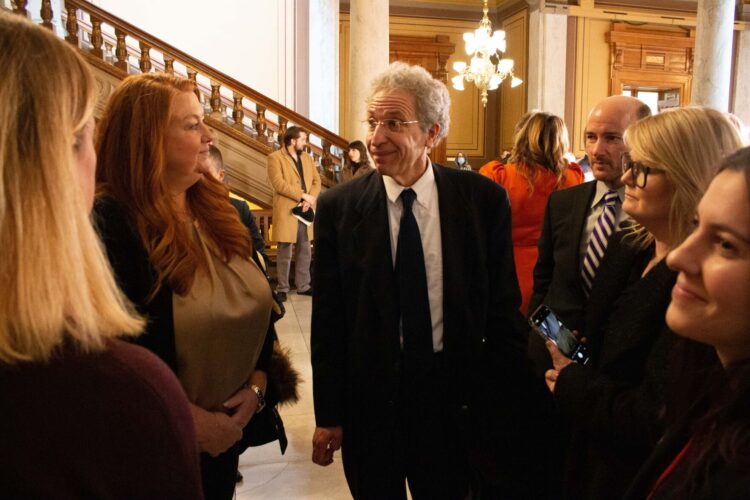
Teachers have gotten a message that they need to be cautious, said Alexander Cuenca, a social studies education professor at Indiana University Bloomington.
“It’s had a chilling effect on what is possible to teach and on how careful teachers should be when they speak about certain topics that they’ve spoken about for years,” he said.
Schools and citizenship have been linked throughout U.S. history, going back to Horace Mann, credited as the father of American public education in the mid-1800s. But the emphasis has ebbed and flowed.
Roof, the Ball State professor, said civics fell out of fashion when the Vietnam War increased Americans’ skepticism about government. More recently, the 2002 No Child Left Behind Act caused schools to focus on math and reading, crowding out time for civics.
With Indiana’s sixth-grade civics mandate, the pendulum is swinging back. But the state has left it to schools and teachers to find resources. Civic education has been “inconsistently funded, unevenly implemented, and politically vulnerable,” Roof wrote in a journal article.
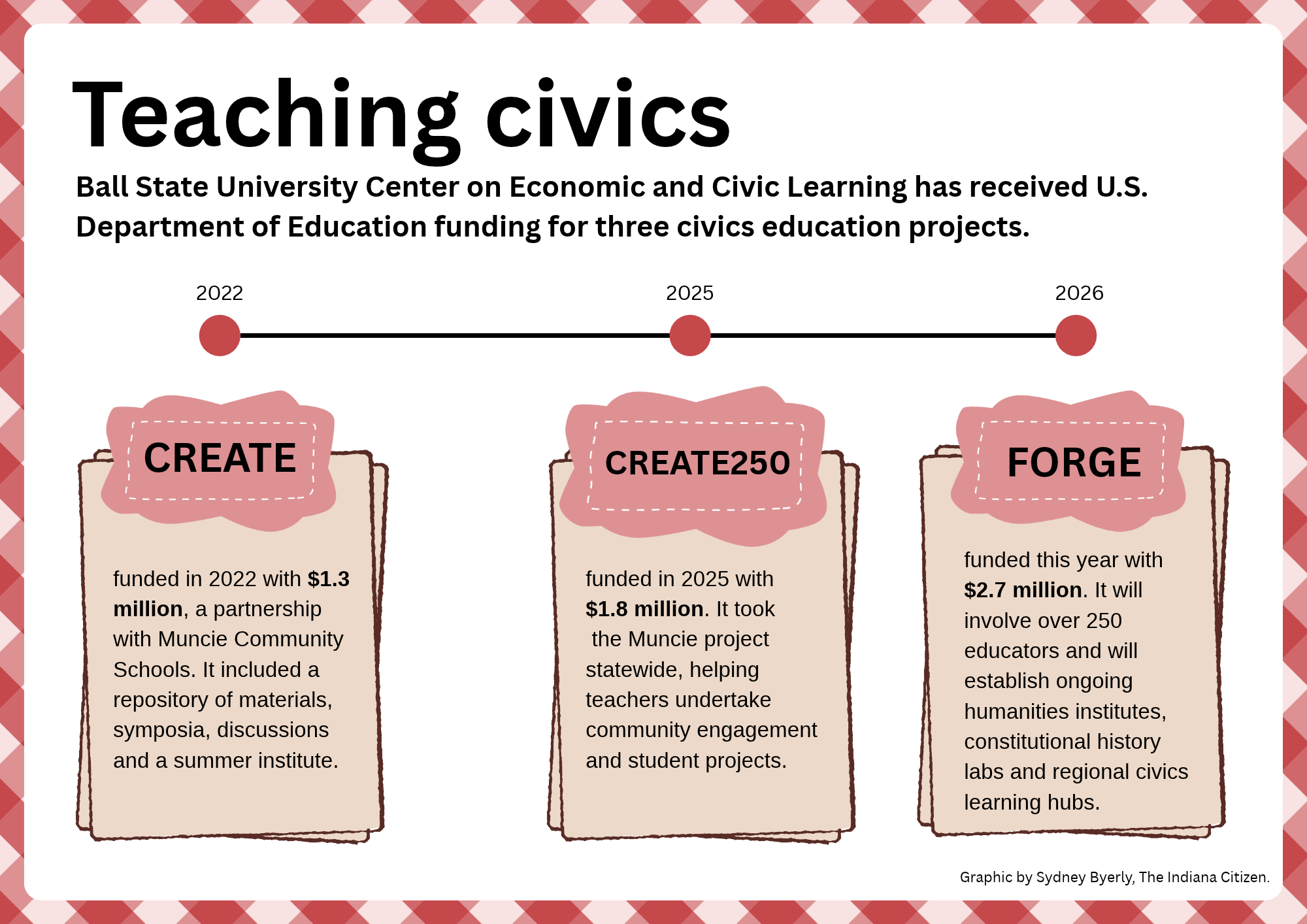
Ball State stepped up with a series of three-year projects funded by a U.S. Department of Education program called American History and Civics – National Activities. The projects have been awarded a total of $5.8 million.
The first, CREATE, an acronym for Civic Renewal through Education for Agency, funded in 2022, was a partnership with Muncie Community Schools. It included a repository of materials, symposia, discussions and a summer institute. CREATE250, funded in 2025, took the Muncie project statewide and includes about 100 teachers. FORGE, for Foundations of Representative Government and Engagement, funded this year, will involve 250 educators and will establish ongoing humanities institutes, constitutional history labs and regional civics learning hubs.
Roof said the initial CREATE program produced impressive gains in student learning, encouraging Ball State to continue and broaden its efforts. Over three years, students’ scores in the Muncie district nearly doubled on assessments based on the NAEP civics exam, he wrote.
All three projects maintain an “equity-centered” approach, according to Ball State. Schools involved in the program are designated by the federal government as Title I schools because they serve large numbers of students from low-income families.
“That was intentional,” Roof said. “The national data is very clear: More-well-funded schools tend to have more robust access to civics.”
In keeping with Trump administration grant criteria, the current projects are expected to promote patriotic education.The definition is straightforward: “accurate and honest study of American history grounded in primary sources of the American founding, the principles that shaped the nation, and the continuing influence of those ideals on American civic life.”
Ball State’s grant proposal for FORGE aligns with what’s expected. The phrase “patriotic education” appears 15 times in a 48-page description of the project. It says the project will focus on “underserved populations” but doesn’t mention diversity or equity.
Roof said he understands that some people worry that federal expectations could promote a narrow understanding of civics. “It’s important to have that concern, and I share that perspective,” he said. “But I don’t think that’s what’s happening in practice.”
He said there has been no real difference in implementation between the initial CREATE project, funded by former President Joe Biden, and the current projects. “There has been a stronger focus on patriotism, on America’s founding ideals,” he said. “But, from my perspective, those things are pretty consistent with the way the program ran previously.”
Kleinert, the Henryville teacher, said CREATE250 has emphasized “opening the classroom to inquiry.” In a unit on the American Revolution, for example, students might explore the experiences of the colonists and how they found meaning in the nation’s founding documents.
“We want our youth to be learners,” she said. “We want them to think for themselves.”
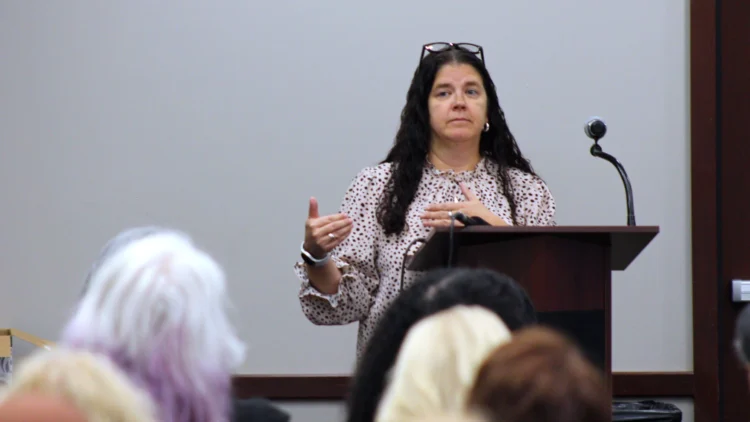
Janine Giordano Drake, a history professor at IU Bloomington, said that’s the approach that effective social studies and civics teachers will take. “Social studies education is about teaching the debate, helping students form their own educated perspectives and debate them within their classrooms,” she said.
Drake said disputes over civic education are nothing new. They go back at least to the 1890s, when rising immigration challenged ideas about what it meant to be an American. They flared with the anti-socialism campaigns of World War I and with McCarthyism in the 1950s.
“It’s an interesting resurgence of a very old debate: Who gets to tell the story of the United States?” she said.
Drake, who works with high school teachers in IU’s Advance College Project, questioned whether government mandates will have much impact in the classroom.
She pointed to Indiana’s academic standards for 11th-grade U.S. history as an example. The 2020 version, which she helped write, said students should be able to “analyze the foreign and domestic consequences of U.S. involvement in Vietnam.” In 2023, the standards were “streamlined” by the Indiana Department of Education and references to Vietnam were removed.
“Which is ludicrous,” Drake said. “But the thing is I don’t know a single high school history teacher who skips the Vietnam War.”
But that doesn’t mean teachers won’t face pressure over controversial topics. Warren Throckmorton, a retired professor of psychology at Grove City College who writes about Christian nationalism, said problems could surface if a student or parent complains. Those complaints could influence the programs developed by teachers.
“Here’s what makes it worrisome,” he said. “The (Trump) administration has laid down the outline for what they’d like to see as part of civic education. It would, I think, make a university think twice about deviating too far from that.”
Some university faculty also worry that civic education can be a code phrase for efforts to prop up conservative teaching. They point to the proliferation of university centers and schools of “civic thought,” often launched by state officials in Republican-led states, which can hire conservative scholars to counter the perceived liberal bias of college professors. The Heterodox Academy, a faculty advocacy group, says there are 41 such centers, and half have opened since 2021. It lists one in Indiana, at Notre Dame.
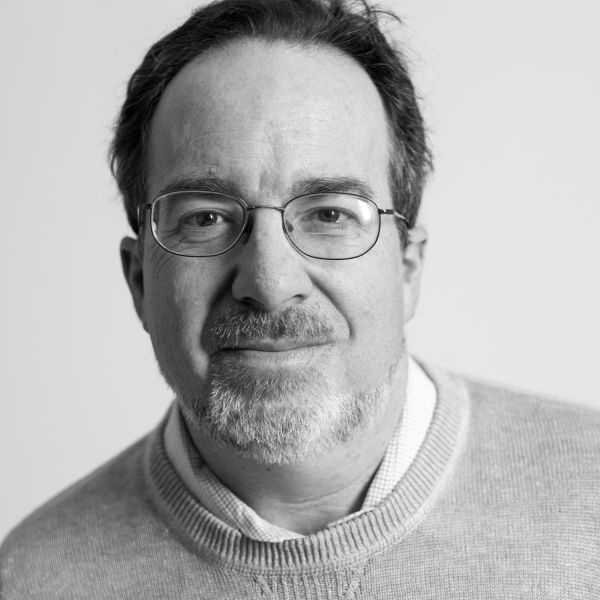
“This is the flavor of the month for right-wing and Christian nationalist legislators in conservative states,” said Alex Lichtenstein, a history professor at IU Bloomington.
Lichtenstein, a scholar of African American history and slavery, said he supports helping teachers use original documents in the classroom. But there are deep divisions over how to interpret those documents, especially ones involving topics like slavery, religion, the Civil War and Reconstruction. Lt. Gov. Micah Beckwith has drawn the ire of scholars, Black legislators, faith leaders and others with his praise for the Three-Fifths Compromise and claims that the U.S. is a Christian nation.
“When I teach, I make the history of slavery central to American history,” Lichtenstein said. “That’s patriotic education. You’ve got to know your nation’s history to improve the future.”
Cuenca, the IU social studies education professor, noted that using grants to promote policies didn’t start with Trump. The Eisenhower administration funded math and science education to compete with the Soviet Union. The Obama administration favored education grants that aligned with the Common Core state standards for K-12 schools.
What’s worrisome, he said, is the current administration’s narrow view of patriotism, the idea that an uplifting view of America’s founding and founders should be beyond criticism. When combined with state-level policies, he said, it can impact education.
“My fear for a very long time has been that we’re going to have some version of red social studies and blue social studies, and those will inevitably collide,” Cuenca said.
Meanwhile, students arrive at school with different experiences and expectations. At Henryville, where over 40% of students qualify for free or reduced-price school meals, many students consider themselves patriotic, Kleinert said. But their understanding of patriotism involves simple love of country.
“They don’t realize it also has to do with having a sense of community and everyone working together for the greater good,” she said.
In East Chicago, students’ contact with the government may come from ICE raids and the deportation of immigrant neighbors. When it comes to civic knowledge, Coleman said, students have often been “spoon-fed” information from social media. They get the impression that Trump is all powerful. Studying the Constitution, they’re surprised to learn about checks and balances.
For the teachers, CREATE250 provides a chance to meet and interact with other educators and to discuss what works and what doesn’t – an opportunity that can be rare for teachers, especially those who focus on social studies and civics. “When it comes to any subject matter, if you’re not constantly learning, you get stagnant,” Kleinert said.
Both teachers said high points of CREATE250 came from the trip to Washington, D.C. For Kleinert, it was visiting the National Archives and discussing how to use original documents to teach. For Coleman, it included watching Congress in action and talking about education with U.S. Rep. Frank Mrvan, who represents northwestern Indiana. Next summer, CREATE250 organizers will take teachers on a tour of civil rights history sites in the South.
Coleman said sharing the Washington experience with his students will help them explore questions like “why did the founders set the country up the way they did? Why is it important to uphold the ideals they had? Why do these ideals help make our country successful today?”
The teachers understand the government may be promoting its own version of civics and patriotism, but they take that with a grain of salt. They say that nothing they are learning suggests they should whitewash American history.
Cuenca, of IU Bloomington, said what ultimately matters is what happens in the classroom, not what politicians say should happen.
“I trust the teachers,” he said. “They have navigated this, they will continue to navigate it.”
Steve Hinnefeld is a freelance writer based in Bloomington. He formerly was an adjunct instructor at the Media School at Indiana University, a media specialist at Indiana University and reporter for the Bloomington Herald-Times. He has had no affiliation with the Media School since spring 2022.
Dwight Adams, an editor and writer based in Indianapolis, edited this article. He is a former content editor, copy editor and digital producer at The Indianapolis Star and IndyStar.com, and worked as a planner for other newspapers, including the Louisville Courier Journal.
The Indiana Citizen is a nonpartisan, nonprofit platform dedicated to increasing the number of informed and engaged Hoosier citizens. We are operated by the Indiana Citizen Education Foundation, Inc., a 501(c)(3) public charity. For questions about the story, contact Marilyn Odendahl at marilyn.odendahl@indianacitizen.org.