By Sydney Byerly
The Indiana Citizen
October 29, 2026
Gov. Mike Braun and Lt. Gov. Micah Beckwith are taking different approaches to a ballot measure that will go before Indiana voters Tuesday, with Beckwith urging voters to reject an amendment to the state’s constitution that would expand judges’ authority to deny bail. Braun has released a video explaining the measure but does not explicitly recommend a yes or no vote.
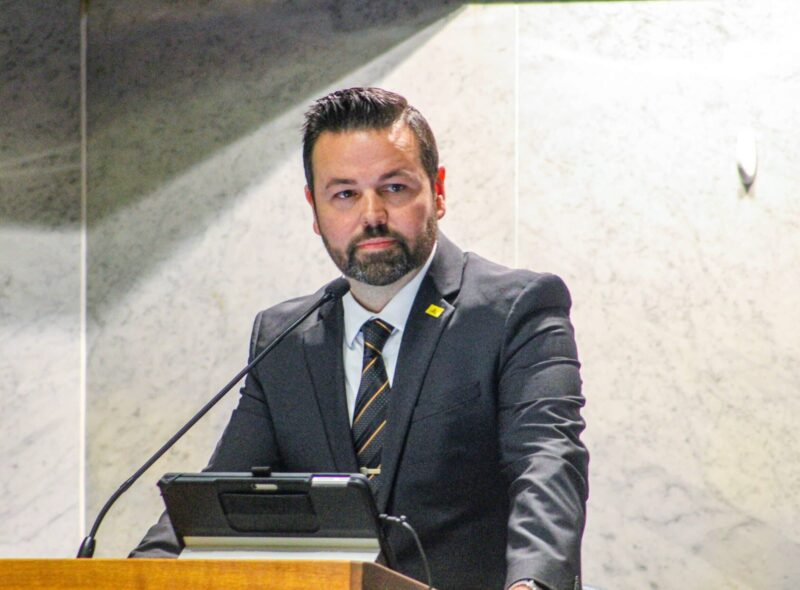
In a video about the proposed amendment, Braun discusses the legislation he signed and thanks lawmakers involved in its passage. The video encourages voters to consider the question carefully but does not explicitly state how they should vote. Sen. Aaron Freeman, R-Indianapolis, is among the Republican lawmakers who support the amendment, saying judges need the option to detain people who pose a serious danger to others.
Beckwith, a strident conservative who has called himself a Christian nationalist, is siding with the American Civil Liberties Union of Indiana, with both raising concerns that allowing judges to jail people who have not yet been convicted could violate due-process rights.
“Our justice system rests on the presumption of innocence until proven guilty,” Beckwith said in a social-media post. “While public safety matters and violent offenders must be held accountable, expanding government authority to deny liberty before conviction raises serious due-process concerns.”
This year two measures will be featured at the end of Indiana’s 2026 midterm election ballots. They represent the ninth and 10th times Hoosier voters have been asked to decide statewide ballot measures since 2000, and the first since 2018. To reach the ballot, each amendment first had to win the approval of two separately elected General Assemblies.
Here’s a look at what these amendments would do and the stances Indiana political leaders have taken on them:
Public Question 1 would allow judges to deny bail beyond the existing constitutional exceptions for murder and treason if the state meets specified legal standards, including proving by clear and convincing evidence that no release conditions could reasonably protect public safety. The proposed amendment, Senate Joint Resolution 1, passed the General Assembly in 2023 and again in 2026, as required for a constitutional amendment to reach voters. It cleared its final Senate vote 43-2 and the House 75-11 earlier this year.
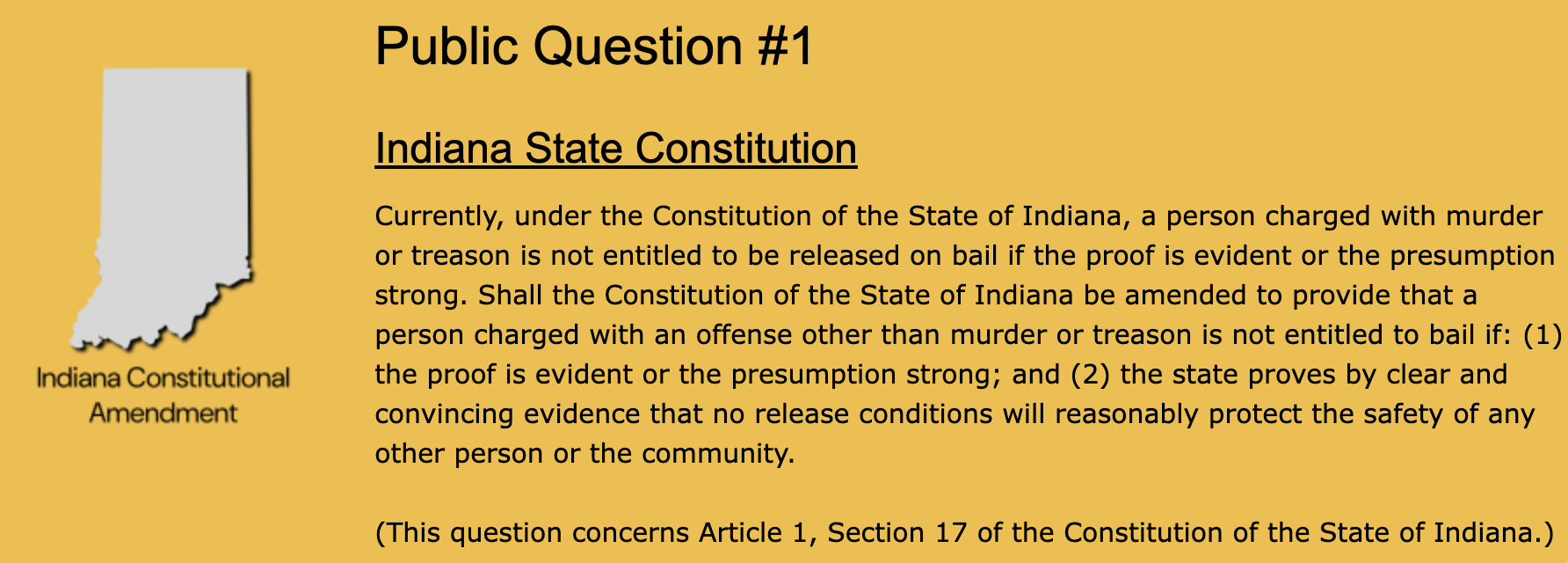
Under the amendment, a judge could deny bail if the person poses a substantial risk to another person or the community, the state proves by clear and convincing evidence that no release conditions could reasonably protect others, and the evidence of guilt is strong.
Freeman, who co-authored the amendment, said in an interview with The Indiana Citizen that this would give judges another option in rare cases involving people they believe pose a serious danger.
“We’re in essence giving the judges another tool that they could use to deny bail to somebody,” Freeman said, describing the intended cases as “the most rare and the most egregious.”
Freeman said the proposal is intended to address dangerous offenders, including people accused of repeat violent acts. The amendment itself, however, does not limit eligibility to a specific list of crimes.
Rep. Chris Jeter, R-Fishers, who sponsored the resolution in the House, said the amendment would give judges another option when releasing a suspect could endanger others.
“When someone poses a serious threat to others, judges should have the authority to consider that danger when deciding whether to grant bail,” Jeter said in a statement.
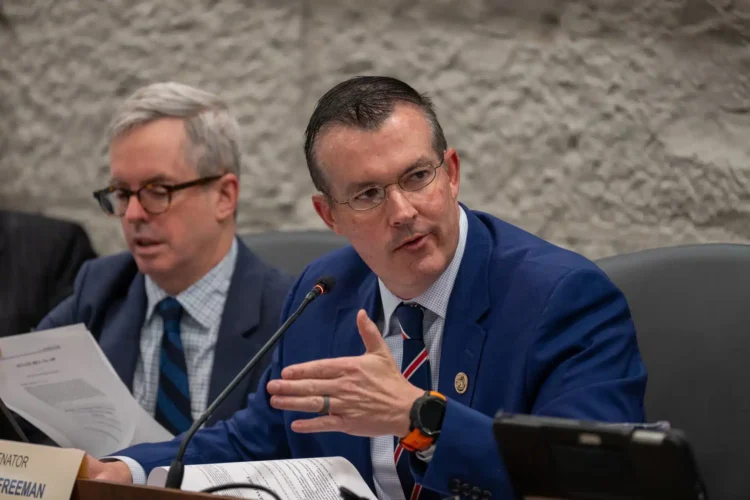
Freeman said the proposal followed work by the Bail and Release Review Commission, a temporary panel established by the legislature in 2024, which met twice and issued a report in 2025. The commission brought together judges, prosecutors, public defenders, private attorneys, sheriffs and others to consider pretrial release practices, Freeman said. He said the group considered concerns including jail overcrowding and that defendants denied bail would have the right to appeal a decision while their criminal cases remained pending.
“They still are presumed innocent until proven guilty,” Freeman said. “There’s just some folks that are so dangerous that I don’t—we should be able to give the judges the option to withhold bail there.”
Danielle Drake, advocacy manager for the ACLU of Indiana, said the amendment does not identify specific offenses that could qualify, raising concerns about how broadly judges might apply it.
Drake said Indiana judges already have options for managing pretrial risk, including electronic monitoring, no-contact orders, release conditions and supervision. She said changing the state constitution could allow people to be held without bail in circumstances that are not clearly defined by the ballot question.
During legislative debate, Sen. Greg Taylor, D-Indianapolis, questioned whether a dangerousness assessment could affect people charged with less serious offenses. Sen. Rodney Pol, D-Chesterton, raised concerns about the amendment’s breadth and the potential consequences for defendants held before trial. Other lawmakers questioned whether a constitutional amendment was necessary.
Freeman rejected concerns that the measure would lead to arbitrary detention, saying judges would have to meet the amendment’s legal requirements.
Drake said pretrial detention can have serious consequences for people who may lose jobs, housing or access to family while their cases are pending. She also said the existing cash-bail system produces unequal outcomes for people who cannot afford release.
“These are already inequitable systems, and we would just be perpetuating the same inequities,” Drake said.
Braun released a video discussing the measure and thanking lawmakers involved in its passage. Although he encouraged voters to consider the question carefully, he did not explicitly tell them how to vote. A spokesperson for Braun’s office told 13News that the governor supports the amendment. Braun’s office did not respond to multiple requests for comment.
Public Question 2 would amend the Indiana Constitution to allow city and town court judges to live in the county where their court is located or in a qualifying neighboring Indiana county, rather than requiring them to reside within the municipality. Supporters say the change would give communities more flexibility to recruit judges, particularly where few local attorneys are available.
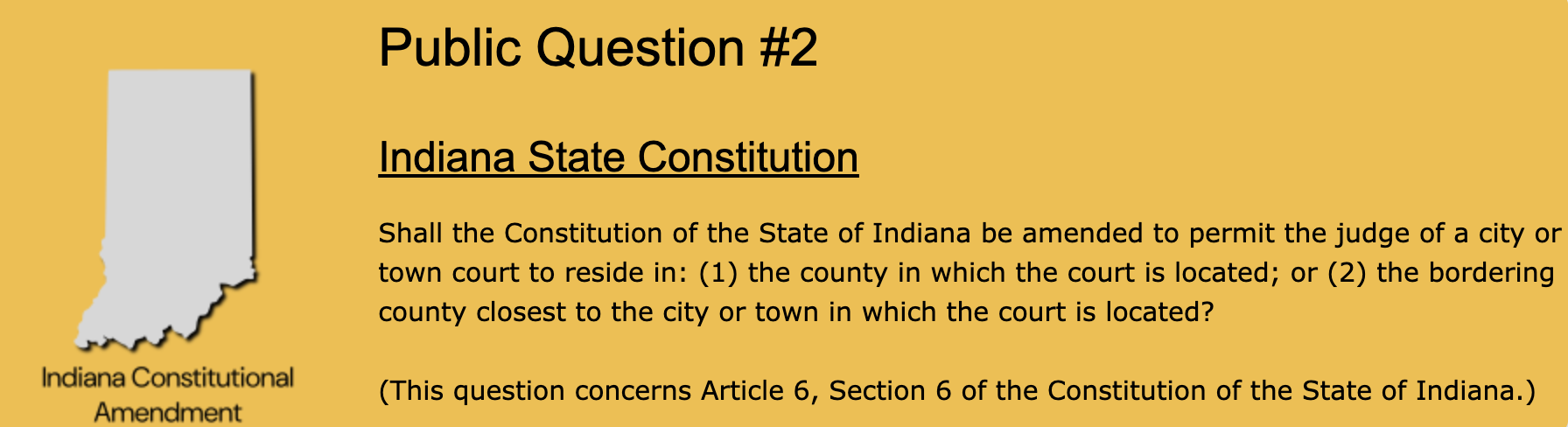
The proposal advanced through House Joint Resolution 6 in 2023 and House Joint Resolution 1 in 2025. The 2025 resolution passed the House 81-7 and the Senate 43-3. The Legislature also approved House Bill 1019 during this year’s legislative session, which sets out the language of the ballot question voters will consider.
Freeman supports the amendment, saying some smaller communities struggle to find enough local attorneys to serve as judges. He said the change would give local officials more flexibility to fill vacancies, particularly in rural areas where the pool of potential candidates is limited.
Freeman acknowledged that residents may want judges to live in the communities they serve, saying he respects that perspective. He argued that allowing judges to live in a neighboring county could help communities fill positions when no qualified local candidate is available.
Beckwith opposes the amendment, arguing that it could set a dangerous precedent.
“Judges should live in and remain connected to the communities they serve, understanding local people and circumstances,” Beckwith wrote in his post. “At a time when I believe the judiciary already exercises too much power, we should strengthen local accountability, not weaken it.”
The American Civil Liberties Union of Indiana said it does not have an official position on Public Question 2. The Indiana Democratic Party has not taken an official position on either amendment, a spokesperson said. The Indiana Republican Party has not issued a statement in support or opposition of either ballot question.
Braun’s video about the bail amendment did not address Public Question 2. His office did not respond to The Indiana Citizen’s request for comment on the governor’s position on the ballot questions.
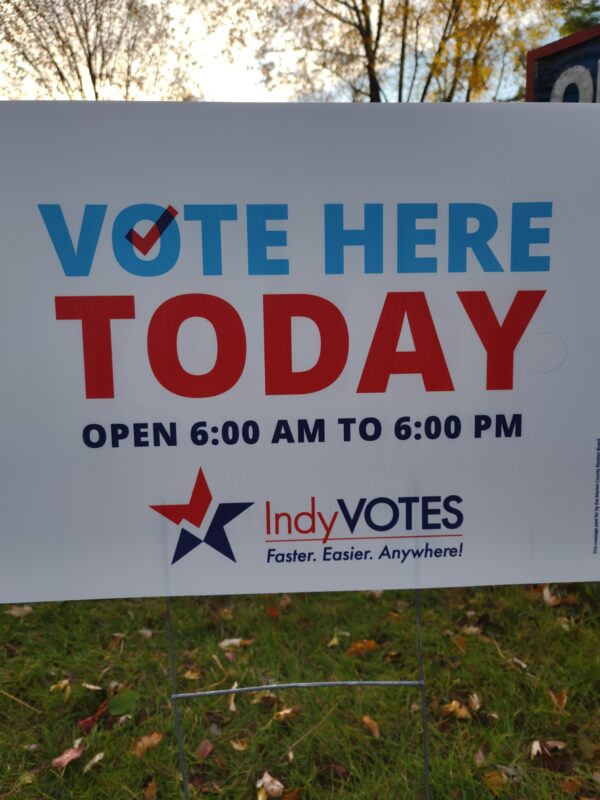
Voters will decide each amendment separately on Nov. 3.
Sydney Byerly is a political reporter who grew up in New Albany, Indiana. Before joining The Citizen, Sydney reported news for TheStatehouseFile.com and most recently managed and edited The Corydon Democrat & Clarion News in southern Indiana. She earned her bachelor’s in journalism at Franklin College’s Pulliam School of Journalism (‘Sco Griz!).
The Indiana Citizen is a nonpartisan, nonprofit platform dedicated to increasing the number of informed and engaged Hoosier citizens. We are operated by the Indiana Citizen Education Foundation, Inc., a 501(c)(3) public charity. For questions about the story, contact Marilyn Odendahl at marilyn.odendahl@indianacitizen.org.