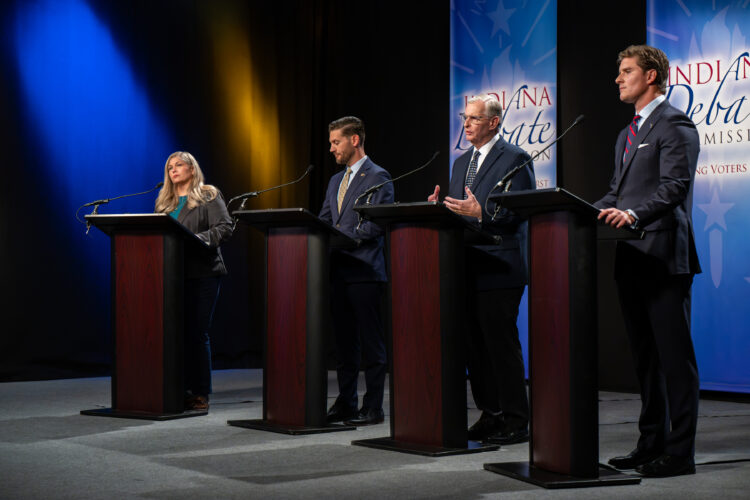
Democrat Beau Bayh had to fight on at least two fronts. He had to convince progressives who are wary about the centrist tendencies that he and his famous father, former U.S. Sen. Evan Bayh, D-Indiana, exhibit that he’s worthy of their trust.
At the same time, the younger Bayh also had to persuade middle-of-the-road Hoosiers who grew distrustful of all Democrats more than a decade ago and began voting Republican by rote that his candidacy merited a look.
Bayh walked that tightrope dutifully, but without much flair—avoiding miscues and gaffes while coming across as an earnest young man who studied his script a little too closely.
If anything, Republican Max Engling’s task was even more difficult.
Engling tried to take credit for many of the things Hoosiers like—low taxes, etc.—while distancing himself from the many things they don’t care for, such as using public office for one’s personal benefit, as current Indiana Secretary of State Diego Morales and Indiana Attorney General Todd Rokita, both Republicans, have been accused of doing.
Stuck with an impossible choice, Engling chose not to make any choice at all and spent the entire hour flailing like a guppy caught in a tidal wave. He tried, repeatedly, to condemn corruption and present himself as a model of moral rectitude.
That only left him open to rejoinders from his opponents that often were savage. More on that in a moment.
Libertarian Lauri Shillings, like all members of her party, has about as much chance of prevailing on Election Day as a snail does winning the Kentucky Derby.
But the very hopelessness of her candidacy in traditional political terms allows her to perform the role Libertarians historically have filled—that being the teller of uncomfortable truths.
The most basic of those truths was her reminder to both the audience and her fellow candidates, however grandiose their rhetoric might be, that the office the four seek is an “administrative” position, not a policymaking one.
Basically, she was saying, Hoosiers should realize that the next secretary of state won’t get to remake the world in his or her image. Her or his job will be to make certain trains run on time and be sure that all the checks clear.
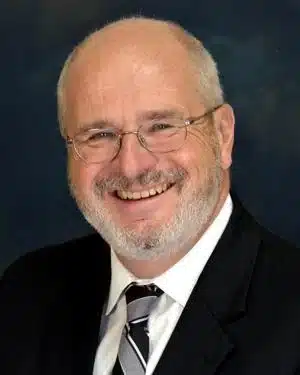
Then there was Ballard, who until recently was a Republican—the last Republican mayor of Indianapolis, in fact.
Ballard, with the backing of political veterans from the Richard Lugar/Mitch Daniels wing of the GOP, has formed a new party, the Lincoln Party. His chances of winning on Nov. 3 are only slightly better than Shillings’, but, as in her case, the slimmer-than-slim likelihood that he’ll claim victory liberates him.
He spent his time in front of the cameras presenting himself as the adult in the room, the one who could be trusted to remain steady and sober when things get rough.
He said the motivation for forming his new party sprang from a sense of discouragement with the intransigence of both Democrats and Republicans.
In practice, though, he focused all his fire during the debate on his Republican opponent.
The most telling moment came when Engling foolishly said he was the only candidate who cared about preventing ineligible voters from casting ballots.
Ballard snapped back that Engling’s statement was “a ludicrous assertion.”
In the wide shot that followed Ballard’s smackdown, Engling winced like a second grader who had just found out that he was being sent to the principal’s office.
As hours of television go, this one wasn’t particularly edifying.
Both the nature of the office—administrative, not policymaking, as Shillings said—and the format demanding short, bumper-sticker-like answers to questions made watching it a less than life-altering experience.
Still, the hour had impact.
Engling had the most to lose and he managed to do just that. He persuaded anyone who is not a MAGA minion that no original thought ever will find its way into his brain.
Ballard came off the best, reveling in his newfound role as lovable political curmudgeon.
Shillings, like a Greek chorus, stayed apart from the main action and had her moments by delivering telling comments on the action.
And Bayh got through the night without incurring any wounds.
The next act belongs to the voters.