By Marilyn Odendahl
The Indiana Citizen
September 18, 2026
To mark this year’s Constitution Day, Indiana University Robert H. McKinney School of Law examined the founding document in action by reviewing a handful cases that started with disputes in the Hoosier State, before traveling all the way to the U.S. Supreme Court, sometimes resulting in landmark rulings.
“Constitutional law is not just something that happens in a marble temple in Washington, D.C., IU McKinney Professor Frank Sullivan said at the start of the program, “but is part of the standard fare of the work of Indiana judges and lawyers.”
Students, professors, lawyers and judges packed the IU McKinney Wynne Courtroom for the Thursday event, entitled, “My Constitutional Law Case from Indiana that was Decided by the U.S. Supreme Court.” Three attorneys, including a former Indiana solicitor general, Thomas Fisher, and three retired judges presented the cases. They detailed the circumstances of the disputes and the constitutional questions the legal arguments raised.
The discussion was led by Sullivan, a retired Indiana Supreme Court justice who served 19 years on the bench and wrote roughly 500 majority opinions, and Clinical Professor Joel Schumm, who created the law school’s Appellate Clinic in 2008 and has personally represented more than 120 indigent clients on appeal.
Two of the Indiana cases examined helped establish Supreme Court precedent.
In 2008, Crawford v. Marion County Election Board, the highest court’s ruling upheld Indiana’s voter photo ID law and is still cited in election and voting law cases today. Similarly, Hammon v. Indiana from 2006, defined when an individual’s statement to law enforcement becomes a “testimonial” that is barred from being admitted at trial by the Sixth Amendment’s Confrontation Clause.
Indianapolis Attorney William Groth, who represented the Indiana Democratic Party challenging the government-issued photo ID law in Crawford, told the audience that deciding to ask the U.S. Supreme Court to hear the case was difficult. He and his colleagues had already lost in the Southern Indiana District Court as well as at the 7th U.S. Circuit Court of Appeals, and they feared another adverse ruling could have negative consequences nationwide. Many of the election law experts they consulted encouraged them to file a writ of certiorari with the Supreme Court, because few seriously believed the justices would take the case.
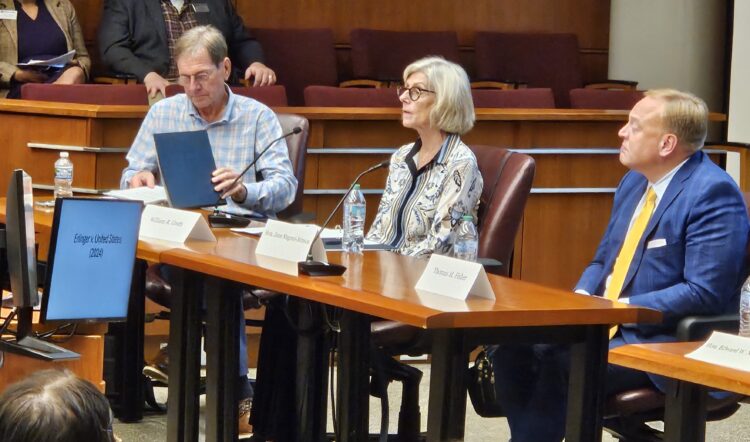
However, the Supreme Court did take the case and in April 2008 issued a 6-3 decision in favor of the photo ID law. Justice John Paul Stevens wrote the controlling opinion and Justice Antonin Scalia wrote the concurring opinion. In upholding the state law, the justices gave legitimacy to Indiana’s claims the photo ID requirement was needed to prevent voter fraud, even though, Groth said, the state has no record of such an incident happening in its history.
Justice David Souter wrote a blistering dissent. “Indiana’s “Voter ID Law” threatens to impose nontrivial burdens on the voting right of tens of thousands of the State’s citizens, and a significant percentage of those individuals are likely to be deterred from voting,” Souter asserted.
Groth pointed out the case is still consequential today, most recently being cited in Count US IN, et al. v. Diego Morales, 1:25-cv-00864, which upheld Indiana’s 2025 law that prohibited students at state colleges and universities from using their school-issued IDs to vote.
“It remains a landmark case in voting rights jurisprudence,” Groth said.
At one point in the Hammon case, Kimberly Jackson, then a public defender representing Hershel Hammon, remembers a trial judge questioning why this misdemeanor case was requiring so much effort.
Hammon had been convicted of misdemeanor domestic battery, after police were called to his home in Miami County following an argument he had with his wife. The prosecution relied on statements Hammon’s wife, Amy, made to police, which said she had been shoved and punched in the chest. She did not appear for Hammon’s trial but the court admitted into evidence the testimonial statements she made to law enforcement.
Previously, the U.S. Supreme Court had ruled in Crawford v. Washington in 2004 that the Sixth Amendment’s Confrontation Clause prohibited testimonial statements made outside of court from being used against a criminal defendant, unless the defendant had an opportunity to cross-examine the witness.
However, the Supreme Court had not defined “testimonial statement” and Hammon presented the chance to do so. The decision to seek transfer to the U.S. Supreme Court came after the Indiana Supreme Court had found Amy Hammon’s oral statements were non-testimonial utterances and, therefore, could be admitted.
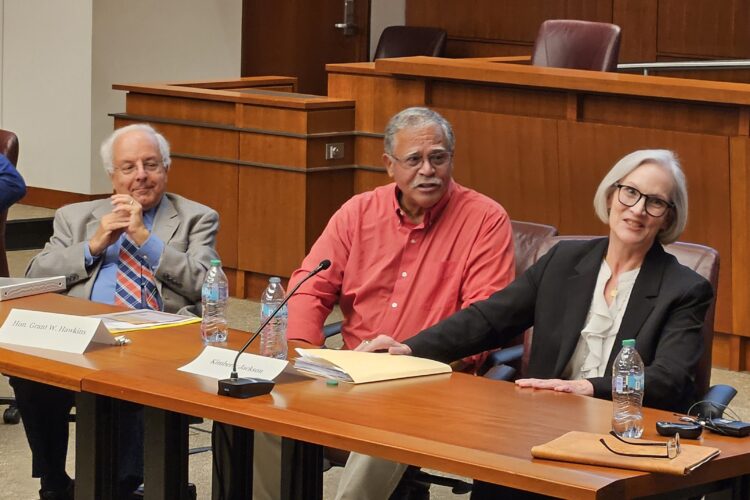
Jackson said the stars aligned at key points that propelled this case to the U.S. Supreme Court. In particular, the ruling in Crawford came while Hammon was being litigated before the Court of Appeals of Indiana. Also, Richard Friedman, a University of Michigan Law School professor and an authority on the Confrontation Clause, argued the case before the nine justices who found for Hammon.
“I like to refer to the case as a small case that made significant law,” Jackson said of Hammon.
Fisher, who served as Indiana’s first solicitor general from 2005-2023, made several trips to Washington, D.C., to argue for the state in Indiana cases that went before the U.S. Supreme Court. He told the audience, as he gained experience, he became less nervous and thought more strategically.
He said after he first appeared before the Supreme Court in 2006, he left the courtroom in a daze.
“I had no idea what had just happened. I was grateful I hadn’t thrown up on my shoes,” Fisher said.
Sixteen years later, when he exited the courtroom after an argument, he was reviewing the hearing and trying to determine whether he had made progress with the justices he thought would be key to deciding the case. “I was thinking much more critically and analytically,” Fisher said.
After the event, former Senior Judges Grant Hawkins and John Hanley of the Marion County Superior Court and Senior Judge Edward Najam of the Court of Appeals of Indiana pointed out very few cases from the Hoosier State arrive at the U.S. Supreme Court and, generally, they said, having a case they initially heard go to the highest court in the country is “no biggie.”
Even so, when the homeowners in Armour v. city of Indianapolis were asking the U.S. Supreme Court to hear their case, Najam checked the docket every day to see if the justices had accepted. Once the court did add the case to its 2011 term, the appellate judge immediately made travel plans.
The dispute arose when the Indianapolis Board of Public Works decided not to reimburse homeowners who had paid a special assessment in one lump sum, even though those homeowners who were paying the tax in installments received a full refund. In June 2012, a U.S. Supreme Court majority allowed Indianapolis to keep the lump sum payments. The 6-3 majority ruled that the city had a rational basis for treating the two groups of homeowners differently and, therefore, did not violate the Equal Protection Clause.
Najam was in the front row of the Supreme Court’s courtroom, sitting across from Justice Scalia, during the oral arguments. He described the case as a David versus Goliath situation and noted through the end of Armour, 18 jurists had adjudicated the case with nine finding for the homeowners and nine finding for the city.
Najam said a key difference between the Indiana Court of Appeals and the U.S. Supreme Court is the caseload. The appellate court has to take whatever case is appealed, but both the U.S. Supreme Court and the Indiana Supreme Court can choose the cases they want to hear.
“The higher courts have discretionary review and that’s the joker in the deck,” Najam said. “You never know what will catch the eye of a Supreme Court justice or U.S. Supreme Court justice.”
Purdue University celebrated Constitution Day by hosting American legal scholar Richard Pildes. He delivered a lecture to a capacity crowd in Pfendler Hall, offering a series of solutions to reduce the political polarization in the United States.
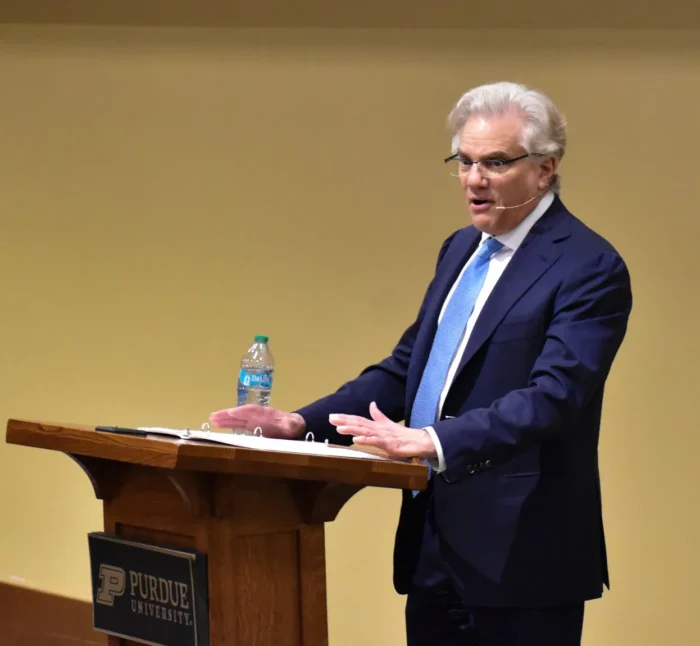
“It’s very important for people to participate, and if they want the system to change, they have to participate,” Pildes, a professor of constitutional law at New York University School of Law, said. “They have to avoid a disillusionment that leads them to withdraw.”
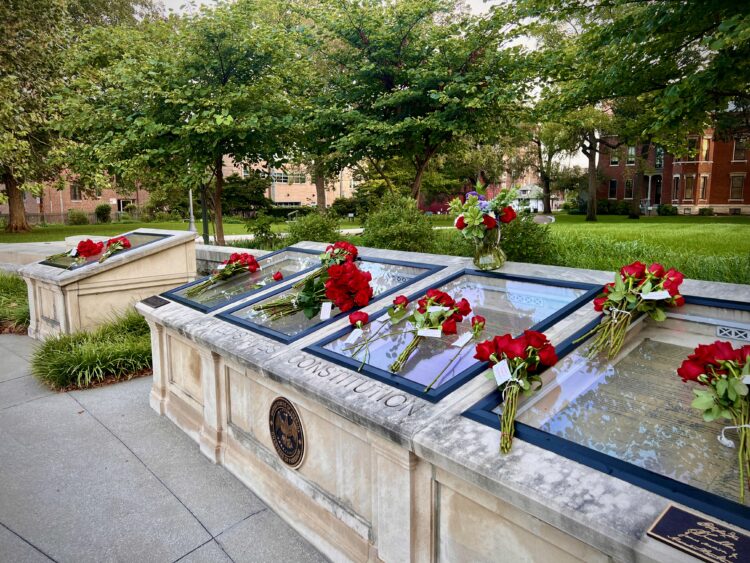
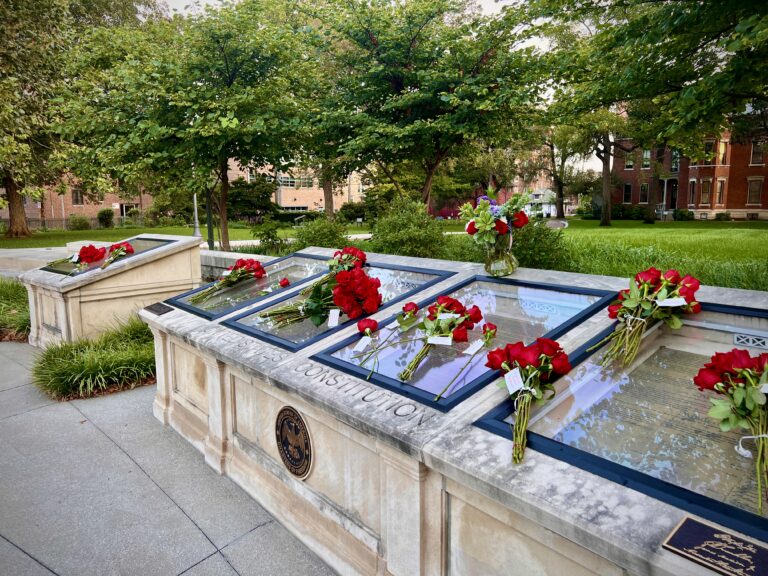
Also, the Benjamin Harrison Presidential Site continued its Constitution Day tradition of placing roses on the Charters of Freedom display located on the Sarah Evans Barker Citizenship Plaza on the grounds of the Harrison home in Indianapolis. The display features engraved replicas of the founding documents, including the Declaration of Independence and the U.S. Constitution, encased in Indiana limestone.
Each rose was dedicated to the Americans who helped shape and preserve democracy. The honorees included the Founding Fathers, civil rights leaders, veterans, teachers and ordinary citizens who made a difference in their communities.
Dwight Adams, an editor and writer based in Indianapolis, edited this article. He is a former content editor, copy editor and digital producer at The Indianapolis Star and IndyStar.com, and worked as a planner for other newspapers, including the Louisville Courier Journal.
The Indiana Citizen is a nonpartisan, nonprofit platform dedicated to increasing the number of informed and engaged Hoosier citizens. We are operated by the Indiana Citizen Education Foundation, Inc., a 501(c)(3) public charity. For questions about the story, contact Marilyn Odendahl at marilyn.odendahl@indianacitizen.org.