By Steve Hinnefeld
The Indiana Citizen
September 9, 2026
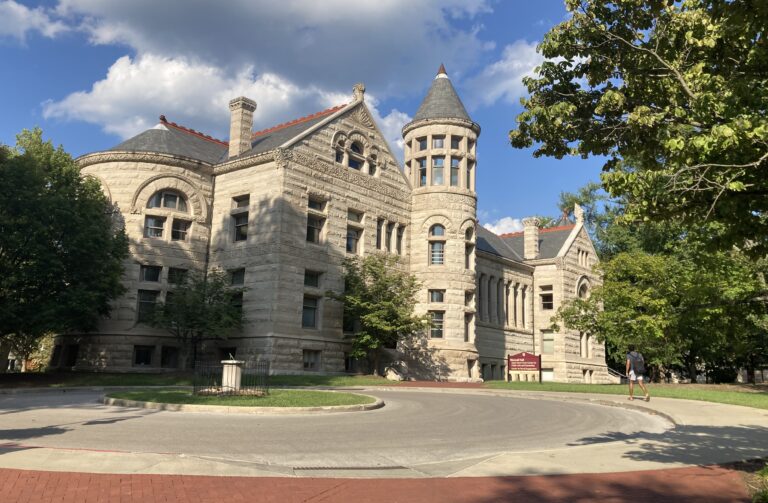
Indiana University Bloomington remains one of the nation’s worst colleges and universities when it comes to free speech on campus, according to a report released this week.
IU Bloomington ranked 256th out of 261 institutions in the seventh-annual 2027 College Free Speech Rankings produced by the Foundation for Individual Rights and Expression, known as FIRE. It received a score of 51 on a 100-point scale and a grade of F on the annual report.
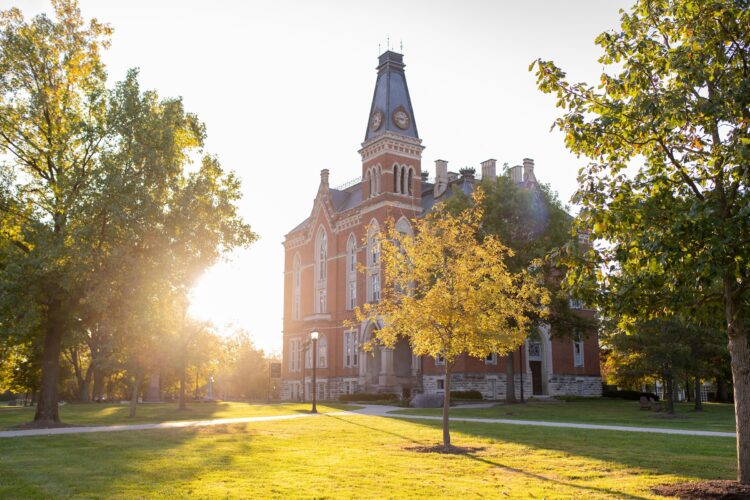
The University of Notre Dame also ranked low: 232nd with a score of 54 and grade of F. At the other end, Purdue University’s West Lafayette campus ranked seventh overall and third among public universities with its score of 77 and a grade of C-plus. DePauw University in Greencastle, with a score of 72 (a C-minus), was ranked 25th. No other Indiana schools are included in the report.
The FIRE report, begun in 2020, evaluates the campus climate for free speech and expression on the basis of student surveys, conducted by the marketing firm College Pulse, as well as an analysis of policies concerning speech.
In the 2027 report, the University of Chicago ranked first for the third time in seven years, and Claremont McKenna College ranked second. New York University ranked last; also ranked below IU were the University of Washington, Texas State, Northeastern and Rutgers. Washington, Texas State and Rutgers are public institutions.
FIRE President and CEO Greg Lukianoff said in a news release that the state of campus speech remains “grim,” despite some improvement from previous years.
“Too many college administrators wield their power to cancel controversial speakers, cave to government or student calls for censorship, and limit academic freedom,” he said. “This report emphasizes the need for colleges to embrace their constitutional obligations wholeheartedly.”
The average score for all schools in the report was 61.4 (with a corresponding grade of D-minus), the highest recorded in seven years, and the number of F schools fell from 166 to 121. But the report says the past year has been “jarring” for free speech with universities grappling with commentary after the assassination of conservative activist Charlie Kirk, President Donald Trump’s attacks on higher education and the divisive Israeli-Palestinian conflict. It notes that Indiana Attorney General Todd Rokita’s “Eyes on Education,” site, which invites reporting by the public of perceived liberal bias in public schools and universities, publicized multiple complaints about teachers and other staff allegedly making light of Kirk’s death.
Each school’s score is the sum of 12 components. Six rely on surveys to measure student perceptions, three assess campus speech policies, and three evaluate the universities’ responses to speech controversies. The higher the score, the better the climate for free speech and expression, FIRE says.
IU Bloomington improved from last year’s report, when it had a score of 44 and was the lowest-ranked public university and the third-lowest ranked overall. It got a boost from adopting the Chicago Principles, a set of guidelines for protecting free speech, in February 2026. Notre Dame’s score and grade remained the same, while its ranking rose from No. 238 to 232.
IU spokesperson Mark Bode declined to provide a comment on the report but directed a reporter to university policies concerning free speech.
A spokesperson for Notre Dame said the university values open discussion. However, the school has to provide a climate that fosters learning and inquiry.
“Grounded in our Catholic intellectual tradition, the University of Notre Dame is dedicated to the pursuit and sharing of truth for its own sake, and to providing a forum where, through free inquiry and open discussion, the various lines of Catholic thought can intersect with all forms of knowledge and creativity,” Erin Blasko, spokeswoman said in an email. “As such, our commitment to academic freedom and freedom of expression is unwavering. At the same time, we maintain reasonable guidelines to protect the safety of all members of the University community and ensure the critical work of the University—the teaching, learning, research and intellectual exchange core to our mission—can continue uninterrupted. At Notre Dame, we seek to be a model of vigorous but respectful dialogue for a society greatly in need.”
Purdue and DePauw improved their scores in the latest survey but saw their rankings decline, Purdue from second to seventh and DePauw from 18th to 25th. Purdue received a C-plus and DePauw a C-minus. The report singles out DePauw as a “riser” over the years; it ranked last in the report’s first two years, but the university president reformed speech policies and it is now near the top.
“A DePauw education is strengthened when we engage difficult questions with intellectual curiosity, mutual respect, and a willingness to consider perspectives different from our own,” DePauw President Lori S. White said in a statement. “In our classrooms, student organizations, and throughout campus life, we undertake this work together, grounded in a shared commitment to both free expression and to one another. Through these experiences, we prepare students to lead with discernment, empathy, and courage.”

Steve Schultz, Purdue senior vice president and general counsel, said the 2027 FIRE report affirms the university’s commitment to free speech and open inquiry and debate. “We think it’s central to the mission of a university,” he said in a phone interview. “We have a truth-seeking and knowledge-expanding mission. Free thought and free speech are essential to advance that.”
In 2015, Purdue became the first public university to adopt the Chicago Principles. Schultz said Purdue immediately began to think about preparing students to encounter speech and ideas that might make them uncomfortable. It developed a required seminar on free speech for all incoming students, which is now part of Purdue’s freshman orientation programming.
The FIRE report lists zero speech controversies at Purdue in the past three years. Schultz said there are sometimes disputes about campus speakers and events, but Purdue is committed to allowing controversial speech, subject to “time, place and manner” restrictions.
“When in doubt, we find a way for the expressive activity to occur,” he said.
Steve Sanders, a professor in the Indiana University Maurer School of Law in Bloomington and an expert on First Amendment law, said IU is moving in the right direction by embracing the Chicago Principles. But he said the report suggests the campus has work to do in persuading students that the administration supports free speech.
“It appears the perceptions of students are what’s really dragging us down,” he said.
Sanders said he’s been struck by how many faculty members believe Indiana’s Senate Enrolled Act 202, an “intellectual diversity” mandate adopted by the legislature in 2024, prevents them from addressing controversial topics, even within areas of their expertise. That may create a perception among students that IU doesn’t support free speech, he said.
“A lot of it is misunderstanding and misinformation,” Sanders said. “It’s something the university needs to work on, clarifying to faculty what SEA 202 does and doesn’t do.”
IU may also need to revise and clarify policies, he said. For example, it would help if the university stopped accepting and investigating anonymous complaints against faculty under SEA 202, something the law doesn’t require.
Aurelian Craiutu, a political science professor, was appointed this month to serve as IU Bloomington campus lead for implementing the Chicago Principles. He said he will work with faculty, students and others to promote understanding of the principles. Activities could include speakers, seminars, shared reading lists and an annual seminar on free speech.
“This is something that, at the level of principles, everyone can agree with,” he said. “Implementing a plan is a quite difficult process. It can take some time. It requires campuswide and universitywide collaboration and working with different groups.”
Craiutu said adopting the Chicago Principles and developing a program to implement them is a step in the right direction for IU that will, hopefully, lead to buy-in from the university community. “Nobody has a monopoly on truth, and I think we can all stand to learn from others,” he said.
FIRE, founded in 1999, has a reputation as a critic of political correctness and restrictions on campus speech, often those imposed by the left. The report, for example, is punctuated with comments from students who say they are uncomfortable expressing support for Trump or opposition to abortion. But FIRE has also supported progressive educators who have been targeted by conservative government officials. In April, a FIRE official told the Indiana Citizen that an Indiana “intellectual diversity” law was well intended but could chill campus speech.
In the campus speech ratings, FIRE relies on surveys to measure how comfortable students are expressing controversial ideas, how often they “self-censor” or withhold their views in class or conversations, and whether they accept shouting down or using violence against offensive speakers. The surveys also gauge students’ perceptions of administrators’ support for free speech, how open they are to discussing difficult topics and their “political tolerance” for allowing controversial speakers on campus.
Some of those questions, Sanders said, seem “squishy” and appear to overlap. For example, what’s the difference between self-censoring and not being comfortable sharing ideas?
FIRE’s 2027 report gives IU Bloomington an F for administrative support and for political tolerance, based on surveys of 341 students. Its highest survey mark, a C-plus, is for disruptive conduct: 32% of students say it’s never acceptable to shout down a speaker and 69% say it’s never permissible to use violence to stop someone from speaking on campus. IU gets a D-plus for openness and a D-minus for self-censorship and comfort expressing controversial ideas. IU also is cited in six speech controversies.
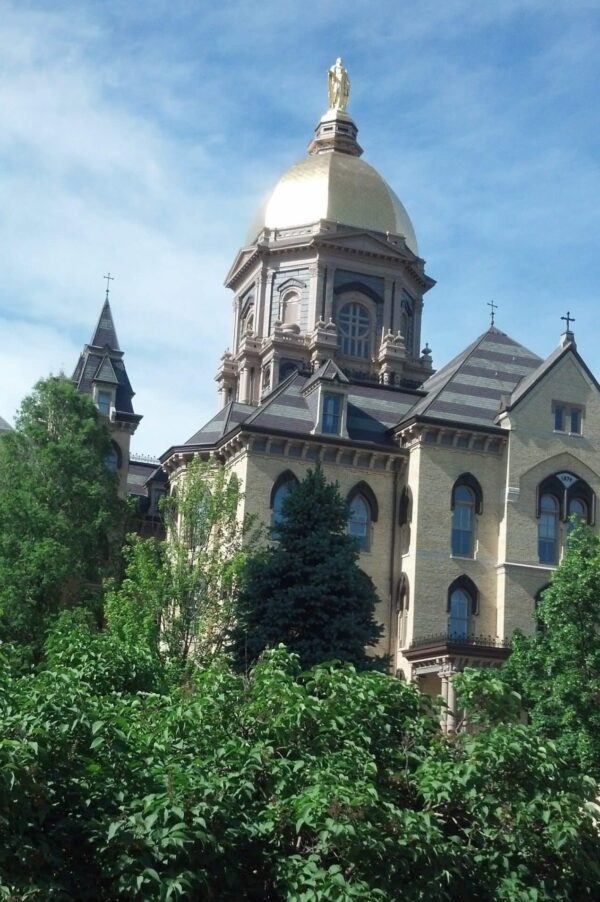
Notre Dame, where 243 students were surveyed, gets an F for political tolerance and a D-minus for administrative support. Its highest survey grade, a B, is for disruptive conduct. The report lists one speech controversy: In 2025, the university rescinded an invitation for a keynote address on the Israeli–Palestinian conflict. No recent speech controversies were cited at Purdue or DePauw.
In the area of policies, the report credits IU and DePauw with adopting the Chicago Principles but said neither has adopted a statement of institutional neutrality.
The IU Board of Trustees did adopt a neutrality policy in September 2024 to comply with state law. But Sean Stevens, FIRE’s chief researcher, said the policy doesn’t meet his organization’s requirements; it focuses on barring employees from speaking for the university and “isn’t clear enough on the point that the institution itself can’t put out political statements.”
IU also has an “expressive activity policy” that sets parameters for certain protests and public speech on campus. The Board of Trustees adopted it in June 2025, after restrictions in a previous version of the policy were blocked by a federal judge.
Author and free speech advocate John K. Wilson, in a guest column in the IU Bloomington student newspaper, writes that IU’s institutional neutrality policy “absurdly declares that ‘University Community Members’ — which includes students and alumni — should assume that they are representing the University’ whenever they use a university email address.” Wilson argues, “Saving free speech at IU requires a radical shift in policies, practices and values.”
The FIRE report identifies IU speech controversies in 2024 and 2025 that include the suspension of the Palestine Solidarity Committee and cancellation of a pro-Israel speaker and an art exhibit by a Palestinian-American alumna. It doesn’t mention a recent controversy: the termination of an instructor who showed a slide that referred to the political slogan “Make America Great Again” as covert racism. Stevens said that occurred too late for FIRE’s current report but is likely to be cited next year.
It also doesn’t cite a recent incident involving a part-time lecturer at the IU McKinney School of Law who posted a controversial video following the death of Sen. Lindsey Graham. The McKinney School is on IU’s Indianapolis campus, which is not included in the report. The report also doesn’t include Ball State University, which recently agreed to pay $225,000 to settle a lawsuit by an employee who was fired for online comments about Kirk.
In another controversy, Valparaiso University, a private institution in northwestern Indiana, came under fire from politicians when its student senate rejected an application to restart a chapter of Turning Point USA, the organization that Kirk led. Student leaders said the organization’s alliance with the Republican Party made it partisan and inappropriate for a campus group. Valparaiso is not included in the FIRE report and rankings.
This story has been updated to include the statement from the University of Notre Dame.
Steve Hinnefeld is a freelance writer based in Bloomington. He formerly was an adjunct instructor at the Media School at Indiana University, a media specialist at Indiana University and reporter for the Bloomington Herald-Times. He has had no affiliation with the Media School since spring 2022.
Dwight Adams, an editor and writer based in Indianapolis, edited this article. He is a former content editor, copy editor and digital producer at The Indianapolis Star and IndyStar.com, and worked as a planner for other newspapers, including the Louisville Courier Journal.
The Indiana Citizen is a nonpartisan, nonprofit platform dedicated to increasing the number of informed and engaged Hoosier citizens. We are operated by the Indiana Citizen Education Foundation, Inc., a 501(c)(3) public charity. For questions about the story, contact Marilyn Odendahl at marilyn.odendahl@indianacitizen.org.