By Marilyn Odendahl
The Indiana Citizen
October 23, 2026
Lincoln Party candidate Greg Ballard was in Marion County Superior Court on Friday for a hearing on his lawsuit against the Indiana Election Commission.
Ballard, who is running for Indiana secretary of state, filed his lawsuit on Oct. 14 to push the Election Commission to meet and consider campaign finance complaints filed against his opponents, Republican Max Engling and Democrat Beau Bayh. During Friday’s hourlong hearing, Ballard’s attorney, Michelle Harter, urged the court to grant a motion for preliminary injunction to force the commission members to meet before Election Day, while the Election Commission’s legal counsel, Deputy Attorney General E. Marie Queen, asked the court to deny Ballard’s motion and dismiss the case altogether.
Marion Superior Court Judge Jennifer Prinz Harrison did not ask any questions or challenge any conclusions as Harter and Queen presented their arguments. At the end of the hearing, Harrison told the attorneys to submit their proposed orders by noon on Monday and said she would issue her ruling no later than 4:30 p.m. that same day.
Harter reiterated several times that Ballard is not seeking a specific finding from the Election Commission on any of the complaints. Rather, he just wants the governmental body to meet and review the allegations to determine whether a further investigation is warranted.
“Today, my client, Greg Ballard, is not asking this court to tell the Indiana Election Commission how to do their job,” Harter said. “He’s only asking the court to order them to do it.”
Among the four known complaints pending before the commission is the one Knox County Circuit Court Clerk Dave Shelton filed against Engling in July. Shelton alleges Engling accepted an illegal $60,000 campaign contribution from Hoosier Leadership for America Inc. shortly after winning the GOP nomination for secretary of state. Engling has said his campaign discovered the error and returned the donation in mid-July.
Harter pointed out the Election Commission Chair Beth Boyce and Gov. Mike Braun, who both have the authority to call the commission into a meeting, were Republicans, but she said neither is motivated to take any action because they are politically aligned with Engling.
Also, Harter noted that both major party candidates in the secretary of state race are facing complaints and speculated that the two Republicans and two Democrats who comprise the commission may be reluctant to investigate their own party’s nominees.
“There’s definitely at least the appearance of impropriety here,” Harter said. “It looks like the chair (of the commission) is protecting her own. Holding the meeting will demonstrate to the public that the commission is operating not out of partisan gamesmanship, but in accord with their nonpartisan statutory duties.”
Queen, the deputy attorney general, argued Ballard is the candidate engaging in partisan politics. She said Ballard could have compelled the commission to meet by asking the governor to call the members together or by getting at least one voter from each of the state’s nine congressional districts to sign a petition, but instead, she asserted, he is trying to use the Election Commission to garner votes.
“The public has an interest also in a political candidate for office not being able to weaponize meetings of the commission against their opponents to influence voter opinion,” Queen said.
Harter countered that Ballard had not engaged in any self-serving act, such as filing a “bunch of frivolous complaints” and then trying to “ram those through” by forcing the Election Commission to meet. He just wants the commission members to decide whether campaign finance laws were violated, she said.
“It’s sort of curious and alarming that the commission is accusing my client of weaponizing the commission by asking the commission to hear complaints that were filed,” Harter said. “As (the Election Commission and attorney general) note in their own briefing, my client didn’t file any of those complaints.”
The Indiana Election Commission has posted a notice to its website that a public meeting will be held at 10 a.m. on Nov. 20, more than two weeks after the election. No agenda has been released.
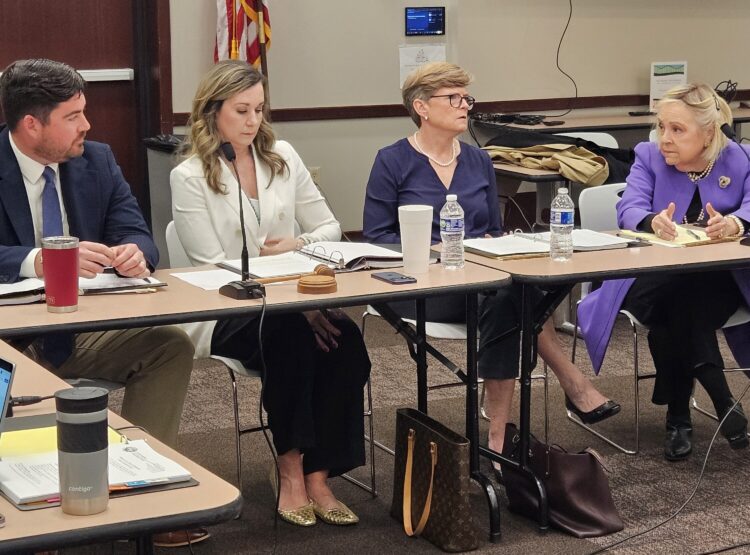
Queen disputed Ballard’s contention that the commission must act before the general election, so Hoosiers can know more about the candidates before they vote. She said forcing the members to meet and discuss the complaints does not guarantee any violations will be found or dismissed or that any penalty will be imposed.
Moreover, Queen said any decision made at a meeting would be “speculative and minimal at best,” because the only penalty the commission could impose would be a fine. If the members saw a potential criminal liability, they could refer the case to a prosecutor, but that prosecutor would not be obligated to pursue the matter, she said.
“There is no evidence that the commission would find violations after an investigation into the allegations,” Queen said. “Even if they did, and those findings were made prior to the election, it would not and cannot change who’s on the ballot, and no one can guess how voters would receive the information.”
Harter asserted waiting until after the election for the commission to meet would render any decision meaningless, because some voters might cast their ballots differently if they had more information about the pending complaints.
Also, Harter pushed back on the claim that the commission has too little time to take any action before the general election on Nov. 3. The problem with timing, she said, was one the commission had created itself by not holding a meeting, noting that during previous election cycles, the members had convened in September and reviewed campaign finance complaints.
“(Ballard is) not asking for a specific outcome or to control the manner in which the commission performs its duties,” Harter said. “But they have to meet prior to the election and decide if an investigation into those campaign finance violations is warranted, because, otherwise, they are not executing their duties in a meaningful manner consistent with the goal and purpose of all election law, which is to benefit and protect voters.”
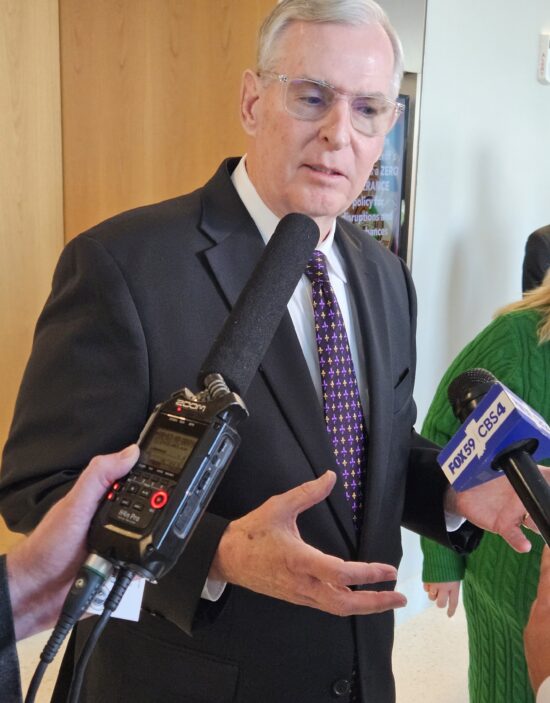
After the hearing adjourned, Ballard said he filed the lawsuit on behalf of Hoosier voters. Having the commission meet before Election Day and decide whether any of the complaints need further review will be relevant to voters, he said, even though the result of any subsequent investigation would likely come well after the election.
“In this case, just meeting and saying, ‘We need further investigation,’ I think, will be important to voters,” Ballard said. “They deserve that information. They absolutely deserve that information.”
Asked if there would be any value in the Election Commission not meeting until Nov. 20, Ballard said, “Not really. They’ll just gloss over it.”
On Tuesday, Knox County Circuit Court Clerk David Shelton filed an amicus curiae brief with the trial court in support of Ballard’s request that the Election Commission meet before Nov. 3.
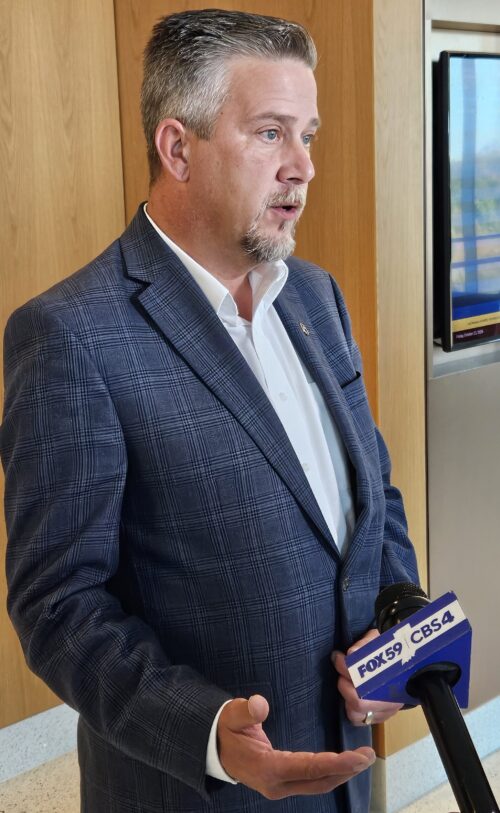
Shelton, who Engling defeated this summer in the race for the Republican Party’s nomination for secretary of state, filed the complaint alleging Engling accepted a $60,000 campaign contribution in violation of Indiana’s campaign finance laws. In joining Ballard in asking the court to order the Election Commission to meet, Shelton said his complaint “presents a substantial question that only the commission can answer.”
In his complaint, Shelton said Engling accepted the $60,000 donation on June 30 from Hoosier Leadership for America Inc., an Indiana-based nonprofit corporation. Not only did the donation exceed the $5,000 limit state law has placed on annual corporate contributions, but Engling also reported the money as coming from a noncorporate source, according to the complaint.
Shelton said in his complaint that any contention made by Engling about Hoosier Leadership for America not being subject to the state’s corporate contribution cap is “an admission that it operated as an unregistered political action committee – a status that would require it to register with the (Indiana) Election Division and publicly disclose all of its donors, past and present.”
Also in his complaint, Shelton cited state statute, which allows the Election Commission to impose a civil penalty of up to three times the excess contribution. In the case of the alleged $60,000 contribution, the excess would be $55,000 and any civil penalty could reach $165,000, according to Shelton’s amicus brief.
Under state statute, any corporate that “recklessly exceeds the limit” on campaign contributions, commits a Class B misdemeanor, Shelton said in his complaint.
The relief Shelton is requesting from the commission includes ordering a refund of the excess contribution amount of $55,000 and issuing a subpoena to Engling to compel him to appear before the commission and answer questions about the campaign contribution filings. Also, Shelton wants the matter referred to a prosecuting attorney.
Shelton attended Friday’s hearing in Marion County Superior Court. Speaking to reporters afterwards, he expressed doubt that Englng actually did return the contribution to Hoosier Leadership for America.
“That fact that he says he refunded that money, it’d be easily proved if he’d just provide bank records,” Shelton said.
In addition to two complaints filed against Engling, Bayh also faces two campaign finance complaints. They allege that Bayh received in-kind contributions at public events or Democratic Party events that should have been reported but were not.
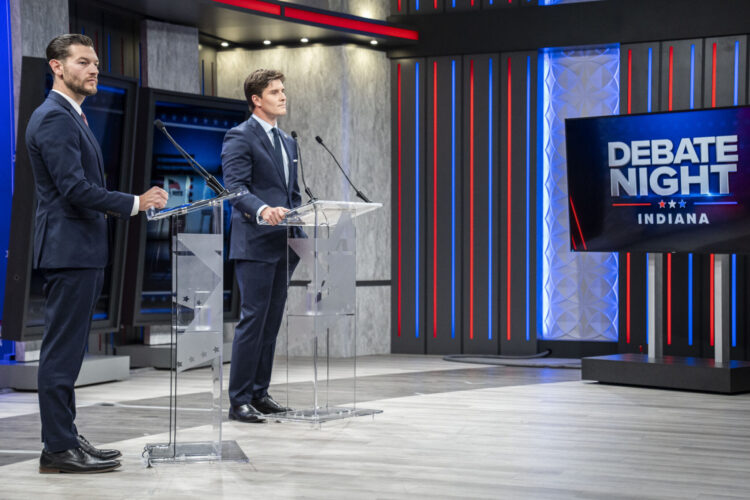
During the FOX59/CBS4 debate between Engling and Bayh on Thursday, both candidates were asked whether the commission should meet before Election Day to review and rule on campaign finance complaints.
Bayh replied, “Absolutely, they should meet on a routine basis, certainly before Election Day.”
Engling responded, “They certainly should meet. There’s no issue with them meeting.”
Bayh then began raising questions about the $60,000 contribution and, at one point, accused Engling of not being truthful about accepting “an illegal campaign contribution from a dark money group.” Also, like Harter, Ballard’s attorney, Bayh alluded to some political favoritism by claiming that “one of the leaders of the commission” is a supporter of Engling.
“So there seems to be some partisan jockeying afoot here to keep that out of the public’s consciousness,” Bayh said.
Engling countered the complaints that had been filed against him were meritless and said Bayh’s accusation that he is being untruthful was “unequivocally false.” Also, he reiterated that his campaign had returned the $60,000 without being ordered by any governmental body to do so.
“I think it would be helpful almost for the commission to look and see, because we’re very confident that not only did we do the right thing, but we did the right thing when nobody was looking,” Engling said.
The case is Greg Ballard v. Indiana Election Commission, et al., 49D03-2610-CT-058232.
Dwight Adams, an editor and writer based in Indianapolis, edited this article. He is a former content editor, copy editor and digital producer at The Indianapolis Star and IndyStar.com, and worked as a planner for other newspapers, including the Louisville Courier Journal.
The Indiana Citizen is a nonpartisan, nonprofit platform dedicated to increasing the number of informed and engaged Hoosier citizens. We are operated by the Indiana Citizen Education Foundation, Inc., a 501(c)(3) public charity. For questions about the story, contact Marilyn Odendahl at marilyn.odendahl@indianacitizen.org.