By Calvin Davis
Capital B Gary
September 9, 2026
It was a regular Tuesday for Adriana Harris. She had just left breakfast and stopped at a gas station on the way home when the sky went white.
“It started pouring down, raining like crazy,” she said. “Everything turned white. The rain was so hard you couldn’t even see the pumps.”
She and her boyfriend sat in the car for a few minutes, waiting for the rain to slow, before eventually driving toward her mother’s house in Portage. She describes what she saw as something out of a movie.
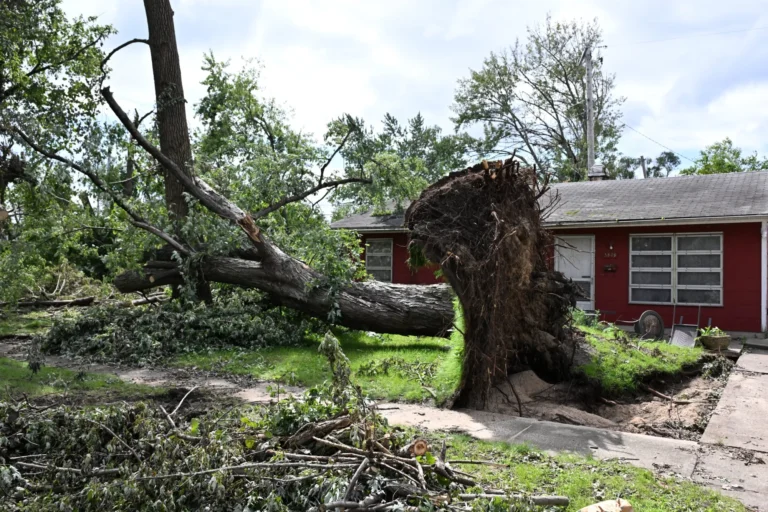
“So we headed there, but on the way there we’re seeing trees fall, cars flying through floodwaters about to spin out, trees landing on cars, power lines falling. It was just crazy.”
The Aug. 11 derecho knocked out power to nearly 400,000 NIPSCO customers across Northwest Indiana in the largest outage in the utility’s history.
But Gary — the only majority-Black city in Lake County — was among the last communities to get its lights back on. Some blocks waited nearly three weeks. The slow response echoed that in other Black communities involved in disasters.
In the days between the storm hitting and the electricity returning, Gary residents built their own response to the crisis. Neighbors pooled money, churches became distribution hubs, and regular folks volunteered to check on elderly residents.
It was a response rooted in a tradition familiar to Black communities like Gary where people turn toward one another to fill the gaps when systems and institutions fall short. When Gary was left in the dark, Gary took care of itself.
Aja Bridges remembers the drive home from work during the storm. Her route took her through Glen Park and past the old Gleason Golf Course, where the tree damage was substantial.
“Just trying to navigate through the area, it was virtually impossible,” she said. “There’s trees laying in the middle of the ground. You have water flooded everywhere. It was horrible. I remember the water from outside coming through my floorboards.”
“It was bad. I had to go up on the curb. Then I got stuck. It was so bad.”
But it was just beginning.
Harris woke up the next morning hoping the lights would be back on.
“Then after about noon, we were looking around like,’Oh this is real. Like real, real.”
Bridges receives Supplemental Nutrition Assistance Program (SNAP) benefits, like many Gary residents, and had just restocked her freezer before the storm hit. After sharing some of what was salvageable with her neighbor, she was forced to throw out roughly $700 of food.
“My neighbor has five kids, and she told me that she had nothing, either. So I remember taking all my little dry goods, everything I could muster together, to try to help someone else.”
Finding food after the storm became one of her biggest challenges. With many streets inaccessible and fast-food restaurants and other businesses without power, the options were scarce. The few gas stations she saw were often cash-only and charged as high as $8 for a bag of ice.
“It got to a point where I wasn’t even eating,“ she said. “I was just making sure my kids could eat because it was so expensive.”
She found those first few days before she got a generator excruciatingly dark and quiet.
“I started asking questions like, ‘Where is everyone?’” she said. “Why do we not see anyone? Why haven’t we heard anything?”
As other cities and communities began to have their power restored, the frustration in Gary only grew. At one point, outages across the region had fallen from roughly 400,000 to fewer than 60,000, but Gary residents still accounted for more than half of those without power.
Harris compared it to waiting for food at a restaurant while everyone around you gets served.
“Imagine being at a restaurant sitting there and the waiter just keeps waking past you with plates and you’re like, ‘Damn, when is it going to be my turn?’” she said. “And that’s literally how you feel. Like you’re hopeless. You’re hot as hell. You’re in the house. You gotta charge your phone in the car. You don’t. You can’t run your car all day. It was inhumane.”
“For those two weeks, Gary, Indiana, was taking care of Gary, Indiana,” Harris said. “I’m not talking about the government officials. I’m talking about the people. The people who were impacted in the storm were coming together putting their money together making these giveaways, making sure the churches are full and the elderly are straight.”
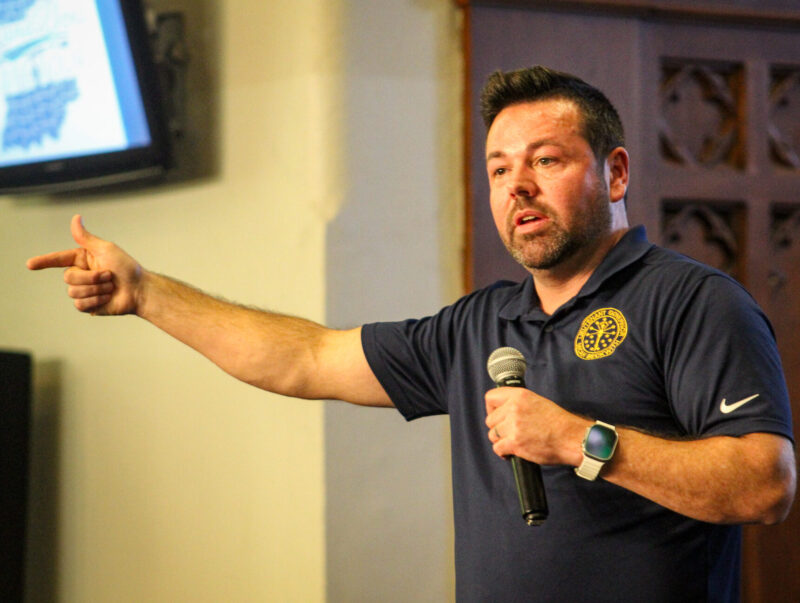
David Aldrich has spent two decades studying disasters and understanding who survives and who doesn’t. As director of the resilience studies program at Northeastern University, he has done fieldwork in Japan, Australia, and across North America.
His lab’s central finding is one that Gary residents like Bridges and Harris just lived through without knowing it: The strongest predictor of how a community recovers isn’t the money spent on infrastructure. It’s whether, and how well, people know one another.
“People are old friends,” Aldrich said. “The children play together. They go to barbecues together, go to church or mosque together.”
That stands in sharp contrast, he said, to communities where “people come home from work, park the car in the garage, and close the door. They don’t know anyone’s last names.”
Aldrich suggests things like neighbor days and block parties are what keep communities close, something Gary residents are very familiar with. That community connection was visible throughout the city.
“Going so many days without, you started to see the community just band together from the churches to the Greek organizations,” said Joshua Austin, executive director of City Life Center.
“I’m a member of Kappa Alpha Psi myself and we went out and barbecued with folks so it was very much a community effort.”
In Gary, churches were among the first pillars the community leaned on. Other organizations followed. Even before the storm, groups like City LIfe Center were already servicing community members.
Having those relationships in place before a crisis, Aldrich said, is crucial when disaster strikes.
“You can’t knock on someone’s door after a storm and just use their materials,” he said. “That’s not going to work. You have to know them beforehand. So ideally, what you’d have in Gary is people would be building those social capital before the storm arrives.”
What’s left is a road to restoration. After President Donald Trump approved a major disaster declaration for Indiana, Gary residents became eligible to apply for federal disaster assistance through the Federal Emergency Management Agency. But faith in the federal government for relief is minimal.
“I’ve tried FEMA, and they want a lot of paperwork,” Bridges said. “They want proof I tried to find childcare, proof of home. It’s just very extensive, and if you’re burnt out like I am, it just feels like a burden.”
Harris hasn’t contacted FEMA, but she’s done her math on thousands of affected households and a process that requires an inspector to physically visit a property before money moves.
“I have no confidence or hope in FEMA or the United States to take care of Gary, Indiana,” she said. “I want the people to know that I want y’all to look at us for these 17 days and see that this is not no state assistance, this is not no government assistance. No national media coverage. This was all the people’s doing. We are resilient. We are the greater Gary.”
That instinct to lean on people as opposed to government systems is the same system a network of disaster survivors has built into an entire model.
Sierra Kos runs a national organization, Extreme Weather Survivors, built exactly for moments like Gary’s, but she said the damage didn’t cross her radar initially.
“I have to admit, I hadn’t even heard of what was happening in Gary for a few days,” she said. “And I work in this field.”
By the time her organization was caught up, several of its members, including a survivor of last year’s Altadena fires, were already in Gary handing out food and hygiene products. They weren’t sent. They just showed up.
Kos co-founded Extreme Weather Survivors after the 2021 Marshall Fire in Colorado. The service now connects people who have lived through everything from fires to floods to hurricanes across 25 states.
“When you live through a fire, a flood, a disaster, or living through extreme heat with no power,” she said, “there is nobody better at navigating that than someone who’s lived through it as well.”
Aldrich’s warning is one that he says all residents, organizers and elected officials should be sitting with.
“If the power went out for this long once, it can happen again,” Aldrich said. “How can you make sure that, for example, more families in Gary have solar systems or batteries? What kind of grants can you get? Can you get a local church or a school to invest in those kind of communities? This is a moment when you really want to not just focus on the current disaster.”
This story was originally published by Capital B Gary.
Calvin Davis is Capital B Gary’s government and politics reporter. You can reach Calvin at calvin.davis@capitalbnews.org. More by Calvin Davis