By Sydney Byerly
The Indiana Citizen
August 25, 2026
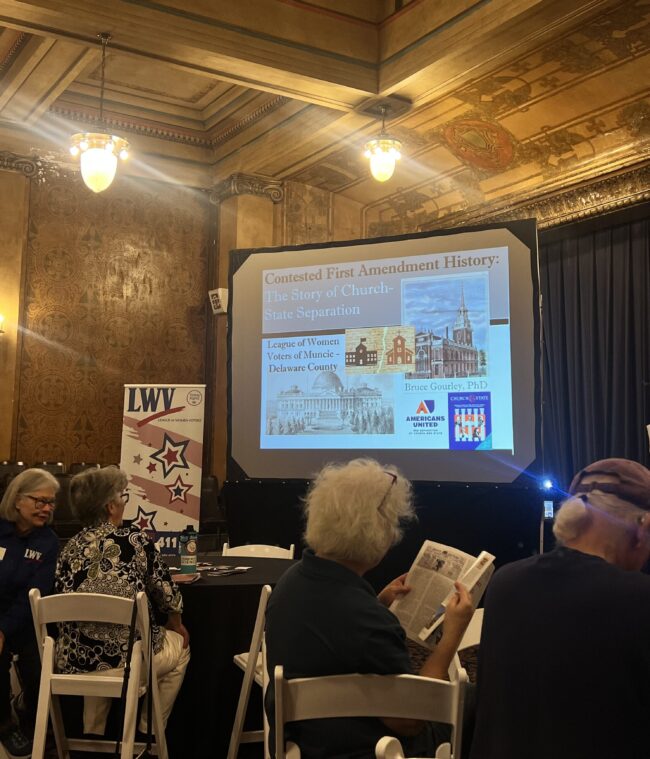
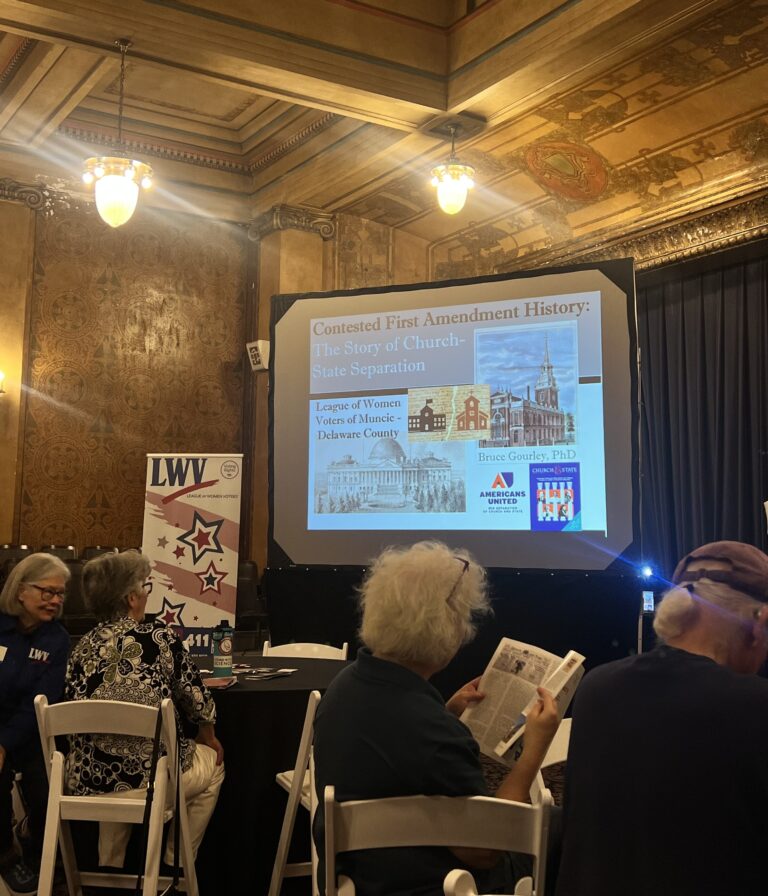
MUNCIE, Ind. — As debates over religion in public life play out in Indiana and across the country, a group of Muncie residents gathered Saturday to examine a question that has been contested since the nation’s earliest days: What does the Constitution actually say about the relationship between religion and government?
The League of Women Voters of Muncie-Delaware County hosted “Contested First Amendment History: The Story of Church-State Separation,” a daylong discussion that brought together a historian and a panel of local religious, civic and academic voices.
About 40 people attended the five-hour event. Organizers described it as a nonpartisan effort to examine the First Amendment, particularly its protections involving religion, and to encourage civil discussion about competing interpretations of those protections.
The discussion comes as questions about religion’s role in government and public schools have become increasingly prominent. Organizers pointed to recent controversies and political clashes involving school vouchers, release time religious instruction during school hours, attempts to require displays of the Ten Commandments on government property and the consequences of private social-media speech as examples of issues raising First Amendment questions.
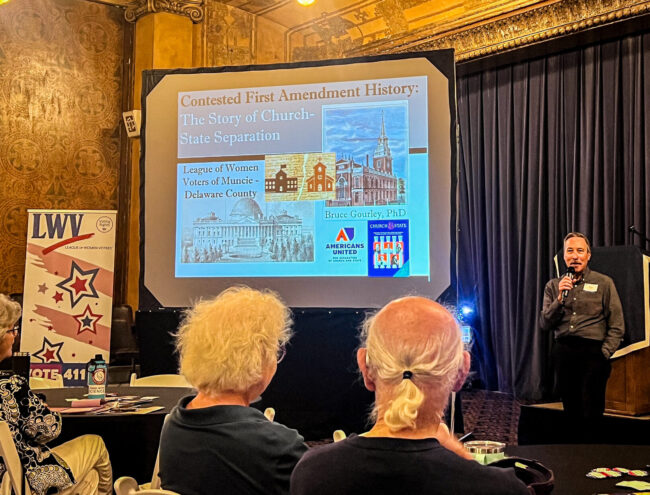
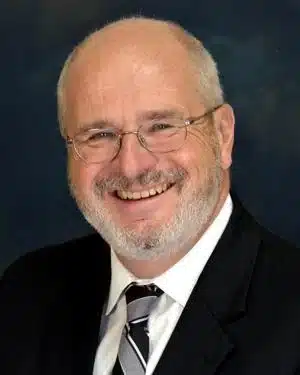
Bruce Gourley, a historian and editor of “Church & State” magazine, which is published by Americans United for Separation of Church and State, opened the event by arguing that America’s path toward religious freedom is not a story of a uniformly Christian nation becoming more tolerant over time.
Gourley said his view of the historical relationship between religion and government in the United States conflicts with the modern Christian nationalist movement, which he described as seeking to make the United States explicitly Christian.
He said some contemporary Christian nationalist narratives portray the United States as founded as a Christian nation that has since become increasingly secular.
But Gourley pointed to the religious diversity of the colonies, the existence of established churches before the Constitution and the role of early religious dissenters in challenging government involvement in religion.
The Library of Virginia’s history of religious freedom in the state, which Gourley highlighted in a PowerPoint presentation accompanying his remarks, notes that Baptists, Presbyterians and other dissenters campaigned during the 18th century for the freedom to practice their faith and challenged the privileged status of the established Church of England.
Gourley said those dissenters played an important role in pushing government away from established religion. The Virginia Statute for Religious Freedom, adopted by the General Assembly in 1786, disestablished the Church of England in Virginia and was one of the sources Congress drew on when drafting the Bill of Rights, according to the Library of Virginia. The Constitutional Convention followed in 1787, with the First Amendment ratified in 1791.
Among the examples Gourley discussed was an early 19th-century dispute over Sunday mail delivery.
Religious groups petitioned Congress to stop Sunday mail delivery, arguing that the government should recognize Sunday as a Christian holy day, according to a history of the controversy published by Middle Tennessee State University’s First Amendment Encyclopedia.
But Congress ultimately rejected efforts to end Sunday mail, concluding that government should not determine which days people considered sacred.
For Gourley, the episode illustrated an important distinction that ran throughout the event: Government can protect an individual’s ability to practice religion without making religious observance itself a government requirement.
The eventual end of Sunday mail service, however, was not simply the result of the religious campaign. The First Amendment Encyclopedia notes that the development of the telegraph reduced the need for Sunday mail to carry urgent news, while railroads later found it unprofitable to run mail trains on Sundays. By the 1850s, postmasters general were eliminating most Sunday mail transportation, and Sunday postal service effectively ended after the Civil War. The 1810 law requiring Sunday mail was not formally repealed until 1912.
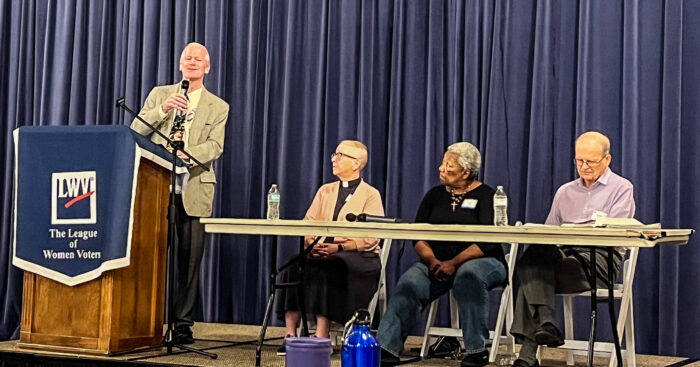
The panelists approached the relationship between religion and government from different professional and personal perspectives, including religious ministry, civil rights and public higher education.
Rev. Dr. Dawn Roginski, priest-in-charge at Grace Episcopal Church in Muncie, said their religious beliefs inform their participation in public life. described participating in rallies, speaking to elected officials and working with faith communities as part of their religious calling.
“As a Christian and especially as an ordained person,” Roginski said, they feel responsible not only to help people who are suffering but also to work to change policies that contribute to that suffering.
Roginski also said they would not want government to establish a single Christian church, in part because Christianity itself encompasses many denominations and theological traditions.
At the same time, Roginski emphasized that separation of church and state does not require religious people to stay out of politics.
Roginski said that, while serving as a pastor in California, they were able to speak for or against ballot initiatives even though they could not endorse political candidates in their church without potentially jeopardizing the church’s tax-exempt status.
Yvonne Thompson, a retired executive director of the Muncie Human Rights Commission, said the Bill of Rights provides a foundation for ensuring people have equal access to basic rights and services regardless of their religion or other personal characteristics.
Ron Sloan, a retired vice chancellor for academic affairs at Ivy Tech Community College, offered another perspective, describing situations in which Christian students had complained about how their faith was treated in college classrooms.
Sloan said he personally identifies as a Christian but, while serving as an officer of a public institution, also believed in protecting academic freedom.
In one case, he said a student objected after an English professor discussed the Bible alongside other literary works. Sloan said his response was to recognize the student’s concerns while also explaining that students do not have to agree with academic viewpoints, but should be willing to consider and discuss those viewpoints in an academic setting.
Gourley said the historical disagreement is particularly relevant to the modern Christian nationalist movement, which he described as seeking to make the United States explicitly Christian. He said some contemporary Christian nationalist narratives portray the United States as founded as a Christian nation that has since become increasingly secular.
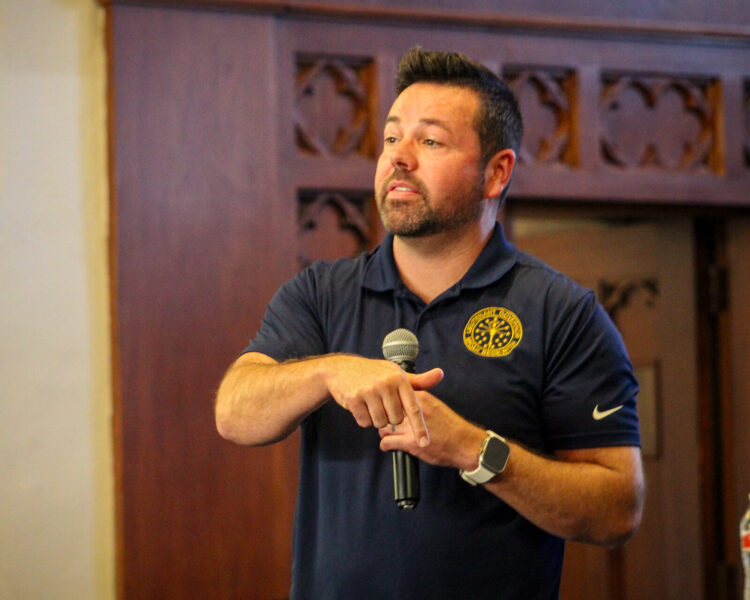
Gourley disputed that account, pointing to the religious diversity of the colonies, the existence of established churches before the Constitution and the role of religious dissenters in challenging government involvement in religion. For Gourley, arguments about whether America should be more explicitly Christian are ultimately also arguments about what the nation’s founding documents mean.
That debate is also playing out in Indiana politics. Republican Lt. Gov. Micah Beckwith, a self-described Christian nationalist and pastor at Life Church in Noblesville, has repeatedly argued that the separation of church and state is a “myth” and has described the United States as a “Judeo-Christian nation.”
Gourley said one of the most effective ways to have conversations across those disagreements is not necessarily to begin with confrontation, but with inquiry. His three words for navigating disagreements over the First Amendment were “conversations, listening, and curiosity.”
Sydney Byerly is a political reporter who grew up in New Albany, Indiana. Before joining The Citizen, Sydney reported news for TheStatehouseFile.com and most recently managed and edited The Corydon Democrat & Clarion News in southern Indiana. She earned her bachelor’s in journalism at Franklin College’s Pulliam School of Journalism (‘Sco Griz!).
The Indiana Citizen is a nonpartisan, nonprofit platform dedicated to increasing the number of informed and engaged Hoosier citizens. We are operated by the Indiana Citizen Education Foundation, Inc., a 501(c)(3) public charity. For questions about the story, contact Marilyn Odendahl at marilyn.odendahl@indianacitizen.org.