This story examining data centers’ encroachment on historic areas around the Indiana is the second in a three-part series by TheStatehouseFile.com. The first story focused on the use of water by data centers and the third will look at the impact of data centers on Indiana’s small towns.
By Olivia O’Neal
TheStatehouseFile.com
July 8, 2026
The Jefferson Proving Ground—a former firing range and weapons test site in Madison that closed in 1995—is 55,000 acres of multi-purpose land.
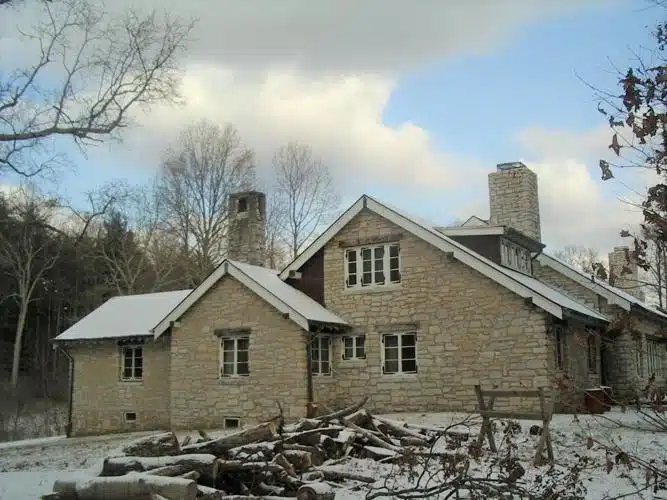
The military still uses the old bombing range. Hunters traverse the portion established as part of Big Oaks National Wildlife Refuge. And volunteers care for Old Timbers Lodge, sitting on a 90-foot bluff and listed on the National Register of Historic Places.
Now 549 acres of the Jefferson Proving Ground may one day be converted to a data center: nine buildings totaling 7.1 million square feet and a consistent concern for the locals since it was first proposed.
But the Jefferson Proving Ground is not the only historic site in the state to be touched by a data center.
The city of Hammond approved expansion of the Digital Crossroad data center campus last year, predicted to be fully constructed by 2028. The existing campus, which supports Chicago, was built in 2020 on the site of the State Line Generating Plant—a coal power plant that went out of commission in 2012, famous for the architectural significance of its 250-foot smokestacks visible along Lake Michigan.
The plant supplied electricity to Northwest Indiana and Northern Illinois for nearly a century, at one point the largest electric generating station worldwide. It was designated a National Historic Mechanical Engineering Landmark in 1977 but shut down and was demolished in 2012 due to its inability to affordably enact EPA pollution controls.
Digital Crossroads hails the data center as an “adaptive reuse” of the plant.
In Granger, plans for a Microsoft data center have concerned the community since its announcement in 2024. The six-building center is being built on just under 1,000 acres of historic St. Joe Farm land.
That farmland was used to feed the Notre Dame University staff and students from 1867 to 1960, when it transitioned to support beef cattle. Indiana Michigan Power runs a solar farm on the east side of the property. An old barn is rented for weddings while Little League sports use part of the lot for parking.
In Indianapolis, residents continue to voice opposition to the $2 billion DC Blox data center planned for the city’s east side, where a former Ford factory sits. Residents express concerns about the contaminated soil, which is a brownfield—land contaminated or polluted after industrial use—and that the center would be built close to the city’s largest protected historic district: Irvington, a neighborhood listed on the National Register of Historic Places.
As data centers continue to encroach on Hoosier land, Mark Dollase, vice president of preservation services at Indiana Landmarks, finds it difficult to answer how the state can balance historic preservation while allowing for economic and industrial growth.
“This is something society has struggled with for hundreds of years, since the advent of the industrial revolution,” he said.
Although Indiana Landmarks does not hold an official position on data center development, it does acknowledge the importance of preserving history.
What makes each community unique and different from another is its historic resources, the character that the places bring, which in one place may be their downtown and in another it may be a neighborhood that is unique and full of historic architecture and businesses that make it vibrant,” Dollase said.
“I think that is what is so special about each different place that we live and work in, and I think that anytime there is a significant outside impact on a community, we have to look closely at the effects that that will have over time on both the community at large as well as a targeted historic area.”
Environmental impacts are at the forefront of anti-data center arguments, but Dollase said data centers can also affect landscape aesthetics and impact historic farms that may have been in families for hundreds of years and hold importance to the community.
Greg Sekula, the southern regional director with Indiana Landmarks, points to a relevant piece of federal legislation: Section 106 of the National Historic Preservation Act. It requires federal agencies to consider how federally funded, permitted or licensed projects could impact historic properties.
If an adverse impact is determined, it triggers a mitigation process and a memorandum of agreement spelling out what the project would or would not do and how it could impact a historic resource, Sekula said. Most highway projects, such as the Ohio River Bridges project, must go through this process.
In the instance of the data center proposed for the Jefferson Proving Grounds, Sekula said you could argue there would be an adverse impact to the Madison National Historic Landmark District in nearby downtown Madison if authorities determined the data center would degrade the quality of life.
In Indianapolis, the DC Blox data center could be found to have the same effect on Irvington.
Section 106 and the overall significance of historic areas are something that Dollase says the state’s elected officials need to keep in mind as they make decisions concerning data centers.
“From our perspective, if there are historic resources in an immediate area where something is being located, of course, we believe that is another factor that should be considered as a part of the decision-making process,” he said.
Olivia O’Neal is a reporter for TheStatehouseFile.com, a news site powered by Franklin College journalism students.