This article was originally published on Andrew Whitehead’s Substack, American Idolatry.
Findings from a new national survey from the Charles F. Kettering Foundation and Gallup shows the role religion continues to play in Americans’ views and commitment to democracy.
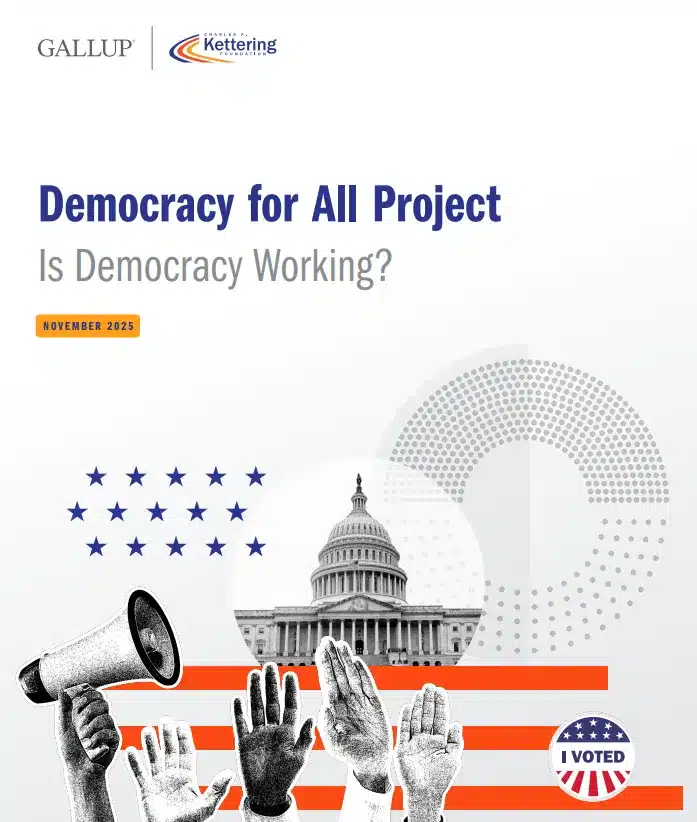
In 2025 the Kettering Foundation and Gallup initiated the “Democracy for All Project,” an annual study of how Americans experience democracy. Surveying over 20,000 U.S. adults, the Democracy for All project helps assess the perspectives of our fellow Americans on the health of democracy, how well the system is functioning, and the extent to which they are participating.
The first report, released in November 2025, showed that around two-thirds of Americans agree democracy is the best form of government. However, there are clear signs that many Americans believe democracy in the U.S. is not functioning well at the moment—half of the respondents to the survey say U.S. democracy is doing poorly or very poorly.

The second report delves deeper into how and why Americans do not believe their role in the democratic process is working well. About a third believe they have very little or no power to create change in the nation and many report multiple barriers to getting involved. Social media and exposure to civic education play an important role in strengthening or weakening engagement with democratic life.
The first two reports from Kettering and Gallup show political affiliation, education, and financial situation are all important to understanding Americans’ views toward and experience of democracy in the U.S. I would like to explore another vital aspect of American life that has a strong association with democratic ideals: religion.
Studying the connection between religion and politics is about as old as our democracy. Alexis de Tocqueville, a French diplomat who wrote extensively about the political and social realities of the United States in the 1830s, remarked even then that, “Alongside each religion is found a political opinion that is joined to it by affinity” (de Tocqueville 2012: 467). This is still true today, even accounting for changes in the political and religious landscape over the last 200 years. The Kettering and Gallup Democracy for All Project can give us an idea of how Americans of different religious traditions experience democracy in the U.S. in the present day.
Commitment to Democracy
The Democracy for All Project report shows 67 percent of Americans agree that democracy is the best form of government. Similarly, over two-thirds of those in the largest religious traditions in the U.S. agree democracy is the best form of government. Only Black Protestants (62%) and Americans unaffiliated with any religious tradition (62%) fall just below the overall average.

While a majority of Americans agree democracy is the ideal form of government, only 24 percent say U.S. democracy is doing “very” or “moderately well.” As shown in the figure below, Evangelical Protestants (42%), Catholics (31%), and Mainline Protestants (26%) are all at or above the overall population average. Unaffiliated Americans (9%), however, give democracy in the U.S. under current political leadership a very poor review.

Likewise, there are dramatic differences across political parties with many more Republicans (48%) thinking democracy in the U.S. is doing well compared to Independents (15%) or Democrats (9%). This suggests that some of the differences we see across religious traditions could be due to the differences in political party affiliation. The figure below shows how this is largely the case.

Focusing on the red bars, which represent Republican respondents, Americans across each religious tradition believe democracy in the U.S. is doing “very” or “moderately well” at rates above the population average. However, fewer unaffiliated Republicans (33%) rate U.S. democracy as doing well compared to other traditions. A similar story exists for Independents (gray bars) and Democrats (blue bars)—there is noticeable variation across religious tradition within each political party.
Another aspect of measuring Americans’ views on the health of democracy in the U.S., and whether they will sustain their commitment to it, is if they believe our national leaders will be held accountable to our nation’s laws and the constitution. Evangelical Protestants (42%) and Catholics (40%) are most likely to agree, while the Unaffiliated (17%) are least likely to agree.

And given Republicans control all three branches of the federal government, it makes sense that Republican respondents (48%) have more trust in U.S. political leaders being held accountable while Independents (23%) and Democrats (26%) are less likely to agree. When we look at the differences across religious tradition while taking political party into account, some interesting patterns are revealed.

Focusing on the green bars first, we see Evangelical Protestants (42%) and Catholics (40%) have the highest levels of agreement. Evangelical Protestants stand out, however, once we look across the different political parties. For each political party Evangelical Protestants have high levels of agreement that national political leaders will be held accountable. Evangelical Democrats, however, are a clear outlier. Fifty-one percent of this group agree national leaders will be held accountable, which is much higher than Democrats in any other religious tradition and is slightly higher than even Evangelical Republicans (46%).
Democratic Participation
Turning to views of democratic participation, the Democracy for All Project reveals widespread agreement that every citizen should have the right to vote. There is very little difference across religious traditions or political party.

However, there is variation in how comfortable some feel with expressing their opinions about the government or laws in this country, and if they feel like their experiences and beliefs are valued and respected (see next two figures below).


Evangelicals (59%; 43%) and Catholics (56%; 42%) are both most likely to agree they 1) feel comfortable expressing their opinions and 2) feeling as though their experiences and beliefs are respected in this country. Unaffiliated Americans, however, are much less likely to feel comfortable expressing their opinions (45%) and they are much less likely to feel like their experiences and beliefs are valued and respected (24%). These same basic patterns hold across religious tradition when we break the responses out by political party. Evangelicals and Catholics are highest, while unaffiliated Americans, no matter the political party, are much less likely to agree.
A key aspect of a healthy democracy is citizens feeling as though their participation in various aspects of civil society is not in vain. If Americans believe their votes or organizing has no real effect on society, and that their interests are not represented in the halls of political power, the likelihood they will continue to participate wanes.
In the second report from the Democracy for All Project we find that 33% of Americans believe ordinary citizens have “almost none” or “very little” power to create change in our nation. Focusing on religious traditions, we see that about one-third of Evangelical Protestants, Mainline Protestants, Black Protestants, and Catholic Americans believe ordinary citizens have “almost none” or “very little” power to create change in our nation. In keeping with trends throughout this column, unaffiliated Americans are even more skeptical of whether ordinary citizens have the power to create change—40% answer with “almost none” or “very little.”

And even when we account for political party alongside being religiously unaffiliated, the finding remains the same. Being unaffiliated with a religious tradition is related to feeling as though ordinary citizens have much less power to create change whether someone is Republican, Independent, or a Democrat. For instance, the share of Republican unaffiliated respondents (37%) who answer this way are almost 10 points higher than Republicans as a whole (27%).

For those interested in encouraging broad democratic participation across the population, it will be important to reckon with how some Americans, particularly the quarter of the population unaffiliated with a religious tradition, do not feel as though they can safely express their beliefs and opinions, that their experiences are valued and respected, and that their actions have the power to create change.
Consensus and Disagreement
One of the most consistent aspects of the current political discourse is how the United States is polarized, both politically and culturally. The Democracy for All Project provides several fascinating data points regarding where Americans are aligned, and where there is legitimate divergence in viewpoints. One set of ongoing disagreement is whether cultural changes have happened too quickly and whether the U.S. is stronger because we are a nation with a diversity of races, religions, and cultures.
In the Democracy for All Project report, we see that Americans are almost equally divided between the statements, “Over the past 25 years, cultural changes in U.S. society have happened too fast,” and “Cultural changes in U.S. society have happened at a reasonable pace over the past 25 years.” Forty-nine percent of respondents chose the first statement, while the other 49% of respondents chose the second statement. Across religious tradition, we see dramatic shifts.
In the figure below, 68% of Evangelical Protestants believe cultural change has happened too quickly. Slight majorities of Mainline Protestants (53%) and Catholics (54%) also believe cultural change has happened too quickly. The unaffiliated stand apart, however, with only 37% saying cultural changes have happened too quickly but 63% saying these changes have happened at a reasonable pace.

Related to beliefs about the pace of cultural change, the Democracy for All Project also asks if respondents believe the U.S. is stronger or weaker because of racial, religious, and cultural diversity. While definite majorities of each religious tradition say the U.S. is stronger because of various types of diversity, Evangelical Protestants clearly diverge. Twenty-two percent believe the U.S. is weaker as a nation because of racial, religious, and cultural diversity.
Conclusion
Hallmarks of a health democracy include widespread commitments to the rule of law, free and fair elections with peaceful transfers of power, and accountability for leadership. People recognize they have a responsibility to participate in their communities and they can make demands of their governments for the common good. Pluralistic democratic societies are where the full diversity of life experiences, beliefs, and voices of all citizens are heard and respected.
The first two reports for the Democracy for All Project provide vital insight into how Americans see, experience, and participate in civil society in the U.S. Expanding on those findings, it is clear religion continues to play an important role in structuring Americans’ views on the health of and their commitment to democracy, where and how they participate, and if the U.S. is a place where all are welcome.
Religious organizations continue to be one of the most likely places of civic engagement for many Americans. Those committed to cultivating a healthy democracy in the U.S. will benefit from knowing where and how religious engagement shapes views of democracy and participation.
Andrew L. Whitehead is professor of sociology at Indiana University Indianapolis and a Charles F. Kettering Foundation Research Fellow. (This article represents the personal views of the author and does not necessarily represent the views of Americans United, Indiana University Indianapolis, or the Charles F. Kettering Foundation.)
The views and opinions expressed are those of the author only and do not necessarily reflect the views of The Indiana Citizen or any other affiliated organization.