Staff report
The Indiana Citizen
May 25, 2026
Although it has been dubbed America’s “fourth arm of defense,” the U.S. Merchant Marine has struggled at times to get recognized for its service and sacrifice.
The mariners trace their roots to the commercial ships and sailors that were enlisted to help the colonies in the months leading to the American Revolution. The vessels were transformed and used to disrupt the British supply ships coming to the young nation.
The Merchant Marine served Union soldiers during the Civil War and helped to maintain the supply routes during World War I.
As tensions brewed in Europe, Franklin Delano Roosevelt signed the Merchant Marine Act in 1936 which established the Maritime Commission and revitalized the building of a new fleet to be used by the mariners. Also, the Act developed and implemented a formal training program for merchant seamen.
During World War II, the Merchant Marine transported supplies and products manufactured in the U.S. to American Allies and troops across the Atlantic and in the Pacific theater. Historian Stephanie Hinnershitz detailed the service of the mariners in her February 2022 article, “Supplying Victory: The History of the Merchant Marine in World War II.”
The mariners earned the praise of Gen. Douglas MacArthur and Gen. Dwight Eisenhower as the United States was on the cusp of victory. “I hold no branch in higher esteem than the Merchant Marine,” MacArthur said in 1945.
However, the Merchant Marine sustained heavy casualties. Of the 243,000 mariners who served in the second world war, 9,521 were killed – a proportion that outpaced the other branches of the U.S. military.
Among the mariners who served and made the ultimate sacrifice during World War II was a young Hoosier, Harold Dossett from Princeton. He was aboard a merchant ship sailing off the coast of Cuba when a German submarine torpedoed the vessel, setting it on ablaze and then sinking into the deep, unforgiving water. Although Dossett was able to abandon the ship with the rest of the crew, he was injured and a few days after being rescued, died in a Florida hospital.
U.S. Sen. Todd Young, R-Indiana, who graduated from the U.S. Naval Academy in 1995 and accepted a commission in the U.S. Marine Corps., honored Dossett and the Merchant Marines in a recent speech on the floor of the Senate.
“As we prepare to observe Memorial Day this coming weekend, we remember the fallen sailors of the forgotten service, and we honor a young Hoosier who gave his life aboard one of its ships,” Young said. “Without the sacrifices of the Merchant Marine, America’s military would be unable to win its war or to defend its people.”
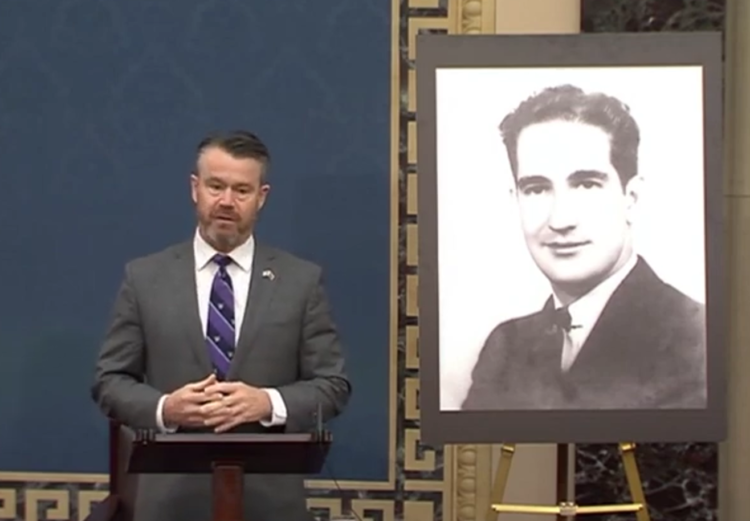
The full speech Young delivered in the U.S. Senate can be seen here.
Young’s remarks as prepared for delivery are as follows:
In May of 1944, before the Allied forces landed on the beaches of Normandy, Dwight Eisenhower signaled out one American service branch for their “loyalty, courage and fortitude.”
When Operation Overlord was complete, and victory won, he predicted, “there is no organization that will share its credit more deservedly than the Merchant Marine.”
The Supreme Allied Commander was correct. But the credit he spoke of was never given to this service branch in proportion to the sacrifices made.
After all, no branch suffered losses at a greater rate during the war.
Not the Marines. Not the Army or Coast Guard. Not the Navy.
Of the 243,000 merchant mariners who joined the fight, nearly 9,500 paid the ultimate price.
As we prepare to observe Memorial Day this coming weekend, we remember the fallen sailors of the forgotten service, and we honor a young Hoosier who gave his life aboard one of its ships.
Without the sacrifices of the Merchant Marine, America’s military would be unable to win its war or to defend its people.
In war, our civilian mariners and commercial vessels transport and supply our soldiers, sailors, and airmen; they are the critical link between the homeland and the front, the one that has made the difference between victory and defeat for 250 years.
During the Revolution, they delivered the gunpowder the Continentals used to beat the British.
In the War of 1812, they armed their clippers and sloops with cannons, ran the enemy’s blockades, and brought clothes and guns to our troops.
Throughout the Civil War, they carried coal, horses, and food to the Union soldiers along the Atlantic Coast and on the Mississippi and Ohio Rivers.
Wherever our men and women in uniform have gone in the world to defend liberty, the Merchant Marine has followed in support.
Whenever America’s soldiers have raised our flag in victory, its mariners helped make the triumph possible.
And they have always done this in the face of grave danger and at great cost.
Commercial sailors were among the casualties in American’s first naval battle at Machias off the coast of Maine.
They were killed by the enemy’s fire on the oceans and the Great Lakes.
From the Republic’s beginning, merchant mariners have died in every major conflict, including Vietnam and Korea, as well as Operations Enduring and Iraqi Freedom.
These civilians transport their cargo into war zones with minimal defense; because of their vital mission, they are the target of and often sunk by warships and aircraft.
In no conflict was the peril greater than World War II.
They left from America’s coasts, headed for the front, carrying Sherman tanks and Mustang fighter planes….steel and lumber…bandages and antibiotics…mail from home, rations and even chocolate.
Onboard those ships were what was required to defeat the Axis and to make a soldiers’ life just a little bit less miserable while doing it.
That is, if they made it to their destination: 733 of America’s merchant ships were sunk during the war.
This Samuel Q. Brown was one of them.
The tanker was on its way from New Orleans to Honolulu, carrying 80,000 barrels of fuel, when it was struck by a torpedo from a German submarine 100 miles south of Cuba.
The ship erupted in fire; its crew jumped overboard and swam to the lifeboats and rafts that they had cut loose after the explosion.
Two men were lost; the rest watched as the U-boat launched another torpedo and sank the Samuel Q. Brown.
After 13 hours afloat, a Navy patrol plane spotted the survivors who were eventually rescued.
The five injured among them were transported to a hospital in Key West, Florida.
All survived but one.
A messman named Harold Dossett.
He died on June 1, 1942.
Harold was 27 years old, from Princeton, Indiana.
He came from a line of heroes. Members of the Dossett family fought in the Revolutionary War, the War of 1812, and the Civil War.
No surprise then that he was active in the History Club at Princeton High School before his graduation in 1932.
He was well-known and well-liked in Princeton, a fixture at the downtown square where the local newspaper noted he was often seen at the front table in the local restaurant, the Alco.
At the end of the 1930s, Harold relocated to Texas, where he found work in the oil industry, and ended up as a messman on the Samuel Q. Brown, which was owned by the Tide Water Associated Oil Company.
He’d served aboard two other ships before the Samuel Brown. Both were sunk after his transfer. “The third one was fatal” his mother later said.
It was during that ship’s mission that he joined the list of Americans who have laid down their lives so that their countrymen could live in freedom.
After his body was brought back to Indiana from Florida, Harold’s mother was presented with the Mariner’s Medal, the Merchant Marine’s highest honor and its equivalent to the Purple Heart.
Another honor arrived later.
To address the incredible losses of commercial vessels during the war, American industry mass produced Liberty Ships, to speed supplies to the front.
In 1945, one of these liberty ships – the SS Harold Dossett – was completed.
Ultimately, it was the men aboard those Liberty Ships who helped win the war.
As Dwight Eisenhower said, the merchant mariners “brought us the tools to finish the job. Their contribution to final victory will be long remembered.”
A contribution that cost many lives.
Let us not lose sight that Memorial Day is not just the beginning of summer, but a solemn day when we honor and do what little we can to give thanks to the men and women who have died so we can remain free.
It is a time too to keep the families of the fallen in our hearts and those serving in danger now in our prayers.
And let us not forget to pay tribute to all of the lost.
One place we can do that is outside of the Gibson County Courthouse in Princeton, Indiana.
A monument there is inscribed with the names of local men who never came home from the World Wars.
Hoosiers, go there and among the Marines, soldiers, and sailors, you will find a merchant mariner: Messman Harold Dossett.
Never forget the debt we owe them all.
The Indiana Citizen is a nonpartisan, nonprofit platform dedicated to increasing the number of informed and engaged Hoosier citizens. We are operated by the Indiana Citizen Education Foundation, Inc., a 501(c)(3) public charity. For questions about the story, contact Marilyn Odendahl at marilyn.odendahl@indianacitizen.org.