By Marilyn Odendahl
The Indiana Citizen
November 12, 2026
JEFFERSONVILLE, Ind. – A voting machine paper jam and a disputed time stamp on a printed record of vote totals have divided the Clark County Election Board, ignited a partisan feud and is sending Senate president-elect Chris Garten’s narrow victory as well as the race for local auditor to the Indiana Recount Commission.
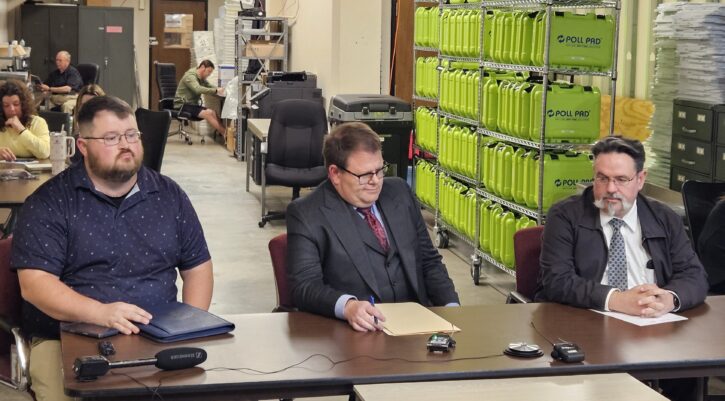
The three-member Election Board met Tuesday night in the basement of the Clark County Courthouse in Jeffersonville to try to settle questions over discrepancies in the total number of ballots cast in precincts 13, 23, 24 and 26 on Election Day. An agenda that had been posted online said the board would just be counting the ballots to see whether the number matched the vote totals.
However, the three officials could not reach an agreement on what the Election Board had the legal authority to do. Moreover, when the two Republican members passed the first of a pair of resolutions finding that concerns about the ballot tallies had been “adequately investigated and explained,” board chair Andrew Steele, the lone Democratic member, initially did not want to sign his name on the paper.
“My expectation is that there will be a recount filed, and that all of that stuff will get addressed through the court process, which is going to cost, obviously, a lot more money for everybody,” Steele said at the conclusion of the board meeting.
Thursday afternoon, the Clark County Democratic Party announced it was filing a recount petition and an election contest in the races for state Senate District 45 and Clark County auditor. Republican incumbent Garten is leading Democrat Nick Marshall by just 297 votes for the Indiana Senate seat, while Republican R. Monty Snelling is only 257 votes ahead of Democrat Antonio Veals for the auditor position.
“Whether a recount changes the outcome, voters deserve to know what happened and what will be done so it doesn’t happen again,” Clark County Democratic Party Chair Miguel Hampton said in a press release. “Citizens have heard a lot about election integrity. The way to show it is to count the ballots in the open. Voters should know their votes were counted.”
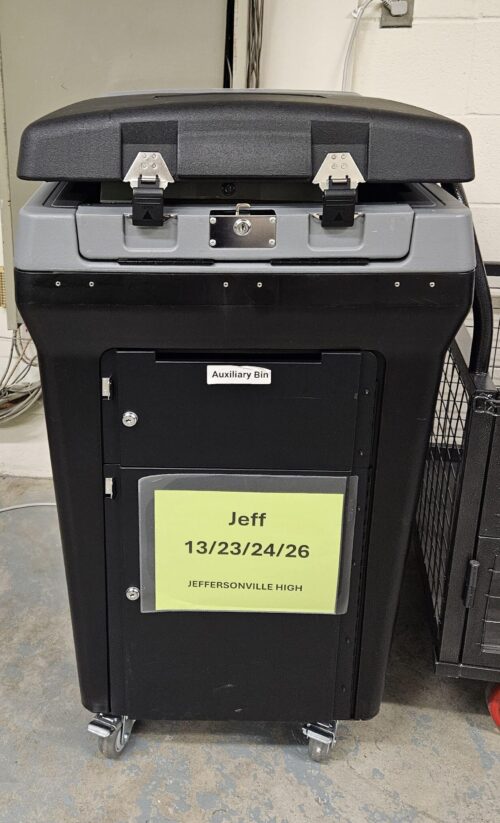
According to Election Board members and attorneys representing the candidates and political parties, the question as to whether all the votes cast in the four precincts were counted started when a paper ballot got jammed in a voting machine about 11 a.m. at the polling site in Jeffersonville High School. Election officials, with Democratic and Republican party representatives watching, replaced the top section of the machine and then transferred the data stick to the new top. The bottom section of the machine where the paper ballots were collected was not touched.
However, the printed record of vote totals from those precincts is timestamped 11:08 a.m. The Clark County Democratic Party is now questioning whether the ballots scanned into the machine between 6 and 11:08 a.m. have been included in the final vote tally.
Complicating the situation is an apparent technical glitch that caused the electronic pollbooks to malfunction. Clark County Circuit Court Clerk Ryan Lynch said the pollbooks were displaying each voter’s information and showing they were at the right precinct, but the books would not allow the poll workers to complete the check-in process.
“I was given the guidance by the manufacturer to re-upload the voter list into the Poll Pad,” Lynch said. “And once I did that, the data worked and they started checking in.”
Election Board members and attorneys said the pollbooks were inoperable at a number of precincts. As a temporary fix, poll workers were having voters sign their name on a pad of paper rather than on the digital screen.
The four precincts at Jeffersonville High School experienced the pollbook malfunction. Consequently, the Poll Pad reads 1,612 voters checked in to those four precincts while voting machine tallies show 1,640 ballots cast there.
Attorneys Jim Bopp and Ted Nolting, representing Garten, argued the 28-vote difference could be explained to the pollbook not working for a period of time. Showing a printed list of the vote totals from precincts 13, 23, 24 and 26 for all of the races, they asserted the number of people who voted matches the number of votes cast, so no ballots remain uncounted.
Bopp dismissed the push for the ballots to be counted as an “ad hoc recount” and said the Clark County Election Board had no legal authority to take such action. Nolting referred to the post-election procedures section in the 2026 Indiana Election Administrator’s Manual and argued the board could not open sealed materials or voting systems unless specifically permitted by state statute or ordered to do so by a court.
“It is not permissible for a specific court clerk, election director, county election board or any other election administrator to access any voting system unit containing voters’ ballot information from the election,” Nolting told the Election Board.
Attorney Mickey Weber, who represents the Clark County Democratic Central Committee, Marshall and Veals, countered the discrepancy was more than 28 ballots.
Clark County Democratic Party Vice Chair Virginia Peck said when officials were preparing to replace the top section of the jammed voting machine, she took a picture of the machine’s screen, which showed that 474 ballots had already been scanned. Weber and Peck are now questioning whether those ballots cast in the morning were actually included in the final tally, since the summary report indicates only the votes cast from 11:08 a.m. to 6 p.m. were counted.
“We want to make sure that every vote that was cast properly is counted and included in the election results as they get certified. If you don’t want to count the votes now, we can count them in a few weeks, and that’ll be just fine,” Weber told the Election Board, alluding to petitioning the Recount Commission. “But there’s a lot of expense and aggravation and uncertainty to go through when all we need to do is see whether the total number of ballots that’s filled out at Jeffersonville High School matches the total number of votes that have been counted from those four polling places.”
In announcing the recount petition, the Clark County Democratic Party also noted additional problems being reported on Election Day in precincts 9 and 10, located in Sacred Heart Catholic School, and precincts 1, 2, 4, and 5 located in St. Augustine Catholic Church.
Weber said Jeffersonville High School is the only place where a voting machine is known to have failed and the data stick had to be transferred. The discrepancies at Sacred Heart and St. Augustine are arising from the issue with the pollbooks. The voters were having to sign their name on paper, but, Weber said, at least one of the sheets with the handwritten signatures is missing from the Sacred Heart location.
Possibly the missing “yellow sheet of paper” was tucked in with the voting materials when the polls closed at 6 p.m., Weber said. Unsealing the materials would quickly show whether the paper was included, “which would be good to know,” Weber said.

Lynch, the Republican county clerk who is also a member of the Election Board, said he received conflicting answers when asking the Indiana Election Division for legal guidance on whether the board could unseal the voting materials and count the ballots.
In prior instances when he posed questions, Lynch said the Election Division’s Democratic and Republican co-directors and their respective attorneys would sometimes debate the course of action, but they usually reached a consensus on what should be done. This time, the co-directors cited to different sections of state statutes and reached opposite conclusions with the Democrat advising that the Election Board could count the ballots and the Republican warning against such action.
Lynch said he opposed doing a count because he wanted to “err on the side of caution” rather than risk violating the law. Also, the vote totals from the same four precincts in the 2026 midterm closely matched the totals from the 2022 midterm, so there is no statistical basis to suspect all the ballots cast on Election Day have not been tabulated, he said.
“The information we get from the Election Division, in my opinion, is very important,” Lynch said during the board meeting. “The fact that we got two separate, very polar opposite guidances tells me that maybe we should hold off and allow a legal recourse to happen.”
Heather Peters, attorney for the Clark County Republican Party, agreed the Election Board should not act. She said the deadline for petitioning the Election Board to canvass the votes had passed and she warned that unsealing the voting materials without a recount petition could have a ripple effect of invalidating every race.
After the meeting, Weber maintained state law does permit local election boards to canvass the votes in the 10 days following an election, but he said lawyers appear to “have been hard at work” convincing the Republicans on the Clark County Election Board otherwise.
“If you cannot so much as count the number of envelopes to see how many votes were counted, then that renders the canvassing period entirely toothless,” Weber said. “The idea that you cannot count the gross number of ballots cast on Election Day and see if the number of votes you recorded matches the number of ballots that you received at a precinct … just strikes me as being absurd.”
Steele, the lone Democrat on the Election Board, offered a pair of resolutions that called for the board to count the ballots from the four precincts. Both resolutions failed.
Lynch then joined Anthony Singleton, the other Republican member of the Election Board, in supporting two resolutions that both said, “No sufficient factual basis exists to justify opening sealed ballot containers for examination.” Steele opposed the resolutions.
Also, some confusion arose over the first resolution’s statement that the Election Board had “reviewed election returns, poll book records, voter check-in records, absentee voting reports, and tabulation records” related to the four precincts. Steele said he had not seen all of those items and there was some discussion about some of the information being presented in screenshots to the board members.
Following the meeting, Lynch rebutted Steele’s allegations. He said he, personally, had seen the reports identified in the resolution and “the information has been available” to the other board members. The screenshot, he said, just showed the totals from the pollbooks.
However, Weber, the Democrats’ attorney, and Hampton, the local Democratic Party chair, said they have not been able to get any information or answers from the Election Board. They said the vote totals could be correct, but the board members should make the reports public and count the ballots so that voters can have confidence in the results.
“Technology will fail and the people on the ground that day did the best job anybody could reasonably expect them to do because they’re dealing with a lot of factors and it’s a busy day,” Weber said of the poll workers. “But rather than certify the election without knowing the answer to whether or not there’s been any mistake, it seems like it’d be a good time to be thorough.”
Garten, the Republican state senator seeking reelection in District 45, issued a statement on Wednesday thanking the Election Board. Also, he accused the Democratic Party of “making inflammatory accusations” about missing votes without providing any supporting evidence.
“Hoosier voters deserve facts, not political theater,” Garten said in his statement.
Indiana Democratic Party Chair Karen Tallian and Ninth District Indiana Democratic Party Chair Adam Dickey responded, saying Republicans were declining to address a discrepancy that they had acknowledged existed. The Election Board could have resolved the issue, the Democrats said, but instead refused to do its job.
“All Hoosiers want is transparency and an accurate count of this election,” Tallian and Dickey said in their statement.
Dwight Adams, an editor and writer based in Indianapolis, edited this article. He is a former content editor, copy editor and digital producer at The Indianapolis Star and IndyStar.com, and worked as a planner for other newspapers, including the Louisville Courier Journal.
The Indiana Citizen is a nonpartisan, nonprofit platform dedicated to increasing the number of informed and engaged Hoosier citizens. We are operated by the Indiana Citizen Education Foundation, Inc., a 501(c)(3) public charity. For questions about the story, contact Marilyn Odendahl at marilyn.odendahl@indianacitizen.org.