By Sydney Byerly
The Indiana Citizen
September 21, 2026
As Indiana prepares for its first school board elections in which candidates can identify their political party affiliation on the ballot, conservative elected officials and activists are increasingly focusing on individual schools and the boards that oversee them, arguing that efforts to eliminate what they call “DEI” or “woke ideology” have not gone far enough.
The Indiana Family Institute made that case in a July report that identified 12 school districts and charter networks it said continued to use diversity, equity and inclusion programs, policies, or practices despite state restrictions on certain DEI-related instruction and training. Lt. Gov. Micah Beckwith has separately used social media to call out individual schools and teachers, while Indiana Attorney General Todd Rokita’s Eyes on Education portal invites parents and others to submit examples of classroom materials and policies they find objectionable.
The activity comes amid a shift toward more explicitly partisan school board elections in Indiana. Under the state’s new election rules, school board candidates can choose to have a Republican or Democratic affiliation appear next to their names on the ballot, or they can identify as independent or decline to disclose a party affiliation.
About half of the candidates who filed for school board seats this year chose a party affiliation, according to Indiana Election Division candidate filing data reviewed by The Indiana Citizen. Of 528 affiliated candidates, 379—about 72%—identified as Republicans, while 66, or about 13%, identified as Democrats.
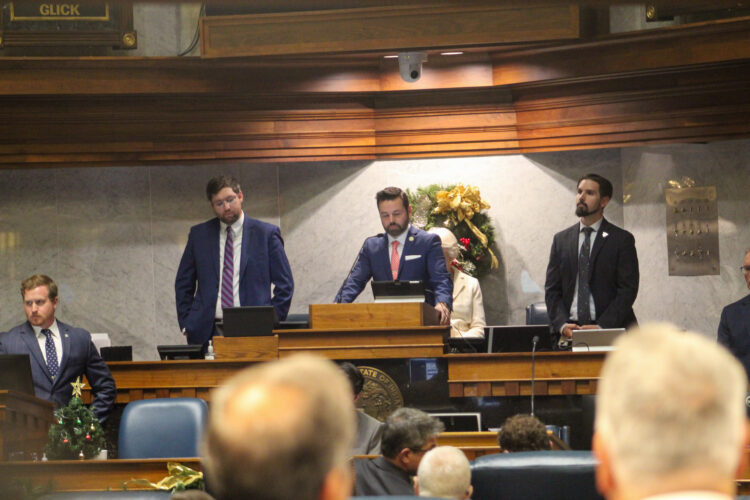
Beckwith has increasingly used his social-media accounts to call attention to individual schools and districts, arguing that public examples can expose a broader problem.
“I think bringing sunlight is the best disinfectant,” Beckwith told The Indiana Citizen. “When we see things, I’m not trying to attack any teacher or any school corporation. I’m trying to actually bring sunlight to a broader problem where some of this stuff still exists in the classroom.”
Beckwith said Gov. Mike Braun’s administration has sought to establish a system based on merit rather than DEI and argued that schools, as government institutions, should follow state policy and direction from the Indiana Department of Education and governor’s office.
He said highlighting individual examples gives parents and government officials a way to see whether those policies are being followed.
The approach is visible in Beckwith’s social media posts on his official and personal pages. In July, he shared a post from IndyStar opinion columnist Jacob Stewart and wrote, “The most PARTISAN elected officials in all the world of politics ARE school board members. The battle for the soul of America is in the classroom.”
Beckwith said Stewart’s column “hits the nail on the head!” He also highlighted a line from Stewart’s column: “The philosophy of the classroom in one generation is the philosophy of the government in the next generation.”
Beckwith said he is not actively seeking out school board races in which to get involved. Instead he said he expects to support candidates he already knows and respects, particularly in Hamilton County, where he is more familiar with the candidates and races.
“I’ll certainly do an endorsement letter again this fall,” Beckwith said.
Rokita’s Eyes on Education portal launched in 2024, allows members of the public to submit and view complaints about classroom materials, policies and other education-related issues.
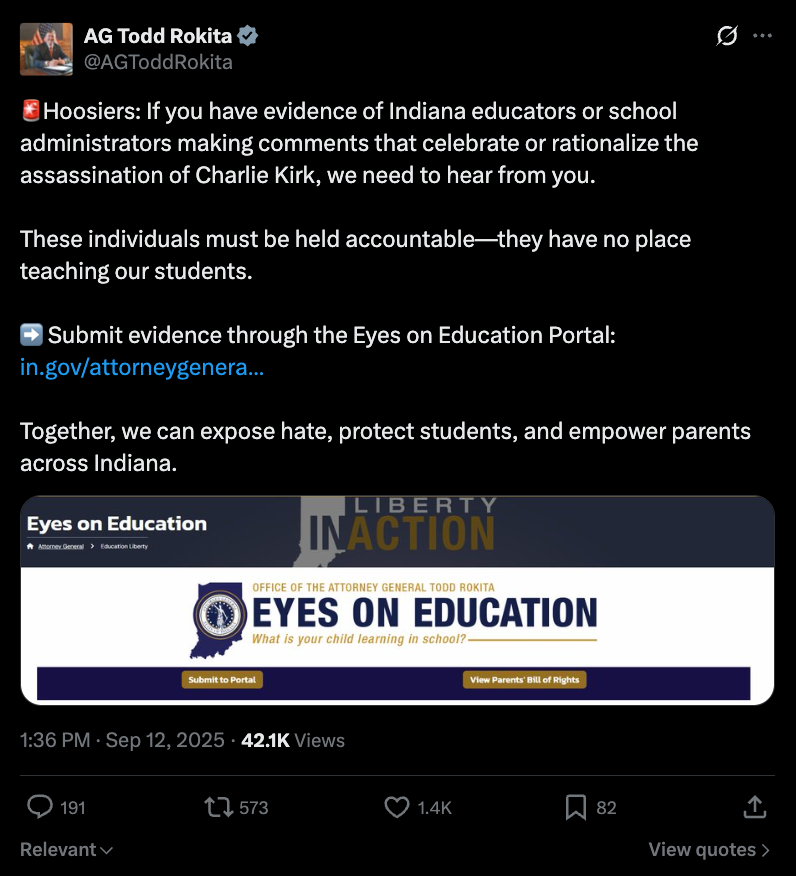
After Charlie Kirk, a conservative activist and founder of Turning Point USA, was killed in September 2025, Rokita’s office used the portal to highlight social media posts by educators “for making comments that celebrate or rationalize the assassination,” prompting scrutiny of educators at schools and colleges around the state. Several Indiana K-12 educators resigned or lost their jobs following controversy over their posts, although no K-12 teacher had lost a state teaching license as of March 2026.

The Braun administration has also taken a more direct role in determining what kinds of political organizations can operate in schools.
In March, Braun announced a partnership with Turning Point USA aimed at expanding Club America chapters in Indiana high schools and colleges. He called on schools and universities to facilitate student organizations such as Club America and said he wanted a chapter in every school district in Indiana, framing the partnership as a free-speech initiative.
“I hope school board candidates share this view and get it done,” Braun said. “We’d love to see Club America in every school district in Indiana.”
The partnership is separate from the state’s restrictions on DEI, but it is part of the broader debate over what political and ideological activity belongs in Indiana schools.
Indiana’s 2025 efforts to restrict DEI in schools included Senate Enrolled Act 289. The law prohibits public schools from requiring instruction or training that teaches that a person is inherently superior or inferior or collectively responsible for past actions based on characteristics including race, sex or religion.
The Indiana Family Institute’s July audit uses a broader definition of DEI than the conduct specifically prohibited by SEA 289. The audit expands the range of programs and terminology to include DEI-related language in strategic plans and staff positions, ethnic-studies courses, social-emotional learning, cultural-awareness programs and LGBTQ-related materials. Not all of those practices necessarily constitute violations of the law, which addresses specific types of required instruction and training.
The audit named 12 districts and charter networks and documented what it described as evidence that DEI had been “rebranded, not removed.”
IFI’s report lists what it calls examples of DEI in Anderson, Fort Wayne, Indianapolis Public Schools, South Bend, Monroe County, East Chicago, Noblesville, Carmel and other districts.
IFI alleged that districts had continued DEI-related practices under different names, including by renaming positions, retaining anti-racism or equity language in policies and strategic plans, offering courses it considers part of DEI, and using LGBTQ-related or equity-oriented materials and displays. The audit also cited consultants and training programs that IFI said reflected DEI principles.
IFI’s recommendations are aimed at identifying and addressing what it considers continuing DEI practices, both through additional scrutiny of schools and through changes to state and local policy. The recommendations include independent, third-party audits of every district, increased parental oversight, new legislation to close what IFI describes as loopholes allowing districts to rename DEI programs or positions, greater action by local school boards, and a state-led review of curriculum recommendations from the Indiana Department of Education. The report says local school boards do not need to wait for the Legislature to act, arguing that boards already have policymaking authority over their districts.
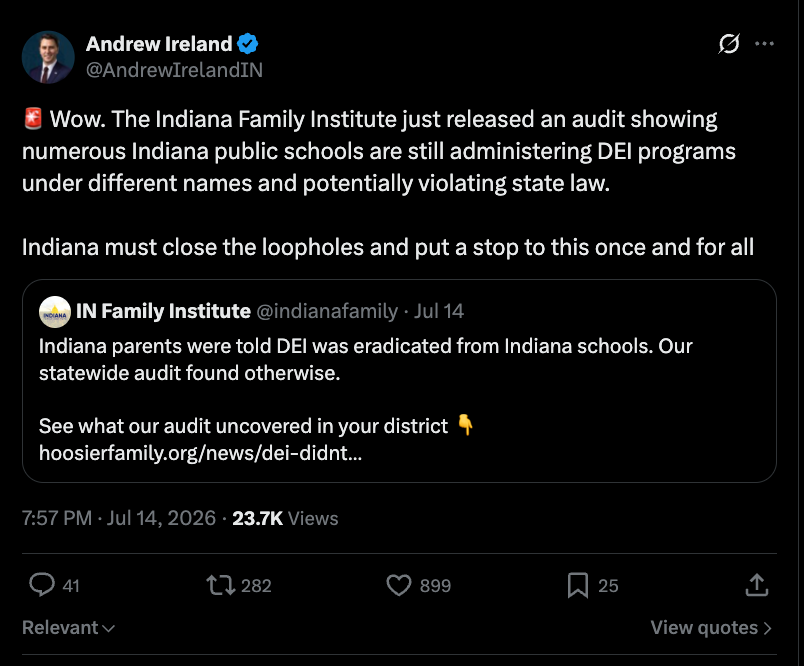
State Rep. Andrew Ireland, R-Indianapolis, wrote on X that the audit showed “numerous Indiana public schools are still administering DEI programs under different names and potentially violating state law,” and called for Indiana to close what he described as loopholes to SEA 289.
Sen. Gary Byrne, the Byrneville Republican who authored SEA 289, told The Indiana Citizen the audit raises questions about whether some of the state’s policies have enough enforcement mechanisms.
“I agree that some of the policies we put in place, sometimes there’s no teeth in enforcement,” Byrne said.
He said lawmakers could revisit the issue if problems continue, although he is not currently drafting legislation specifically in response to the audit.
“That’s why I guess the legislators meet every year—to maybe give them a little more push, or maybe if we need to put teeth into this, if it’s necessary, if the problem continues to exist,” Byrne said.
Byrne said the IFI report nevertheless highlighted what he sees as an ongoing issue with DEI-related practices in schools.
“I do think Indiana Family Institute has put a huge highlight on that we still got a problem and it’s still happening,” he said.
IFI did not respond to multiple requests for an interview or answer emailed questions about its methodology, including how districts were selected, whether districts were given an opportunity to respond before publication and which findings it believes constitute violations of existing law.
At least three districts named in the report disputed how IFI characterized their programs.
Anderson Community Schools specifically rejected the report’s description of a staff position as a renamed DEI position.
“The characterization that this was simply a change in title is not accurate,” Brad Meadows, the district’s director of communications and public relations, said. “The position itself changed.”
Anderson said it reviewed the position and its responsibilities as state requirements changed, including after the passage of SEA 289 and directives from the governor. The district shifted the position toward student and employee support, it said.
The current director of Student and Employee Support holds a Ph.D. and is a licensed psychologist and focuses on the mental health and wellness needs of students and employees, according to the district.
“So, while changes in state requirements were part of the reason the former position changed, what occurred at ACS was not simply a renaming of a DEI position,” Meadows said. “The duties and purpose of the position were redirected to meet different and important needs within the district.”
Anderson said the position and its current responsibilities comply with SEA 289. The district also said it does not require DEI or inclusion training and that diversity and inclusion lessons referenced in older district materials have been discontinued.
“The change was substantive, not terminology,” Meadows said.
Anderson also disputed the suggestion that language in its strategic plan necessarily reflects its current practices. The district’s current strategic plan was adopted before SEA 289 and is scheduled to expire in 2027, Meadows said.
“Regardless of when that plan was written or the terminology contained in it, ACS is applying its programs, practices and policies in accordance with current state law and the Governor’s directives,” he said.
The district also said neither IFI nor Praxis Advocacy, which was involved in the audit, contacted Anderson before the report was published.
“Had the district been contacted, we could have provided that information before the report was published,” Meadows said. “Instead, the report appears to have drawn conclusions about the position based largely on organizational charts without first determining whether the actual duties of the position had changed.”
Similarly, Krista Stockman, director of communication for Fort Wayne Community Schools, said to her knowledge no one from IFI or Praxis Advocacy had contacted the district prior to publishing the report.
The Staff and Students Relations position that was spotlighted by the IFI audit no longer exists, Stockman said. In 2024, the title was changed to Director of School Climate & Culture and the duties shifted to creating safe and respectful learning environments in the schools throughout the district. Also, the director oversees alternative education.
“The changes to the position as it exists now were made to better serve all students and staff and address needs in a variety of programs to support student academic achievement and the well-being of students and staff,” Stockman said.
Noblesville Schools also disputed IFI’s characterization of an image from one of its schools as LGBTQ-related signage.
“We would not characterize the image as LGBTQ signage,” Marnie Cooke, the district’s executive director of marketing and communications, wrote in an emailed statement. “It is student artwork that was voted on and selected by students several years ago. We do not have any DEI programs.”
The disagreement over what constitutes a DEI program or a violation of state policy also raises a question about how much responsibility falls to local school boards.
Byrne said school boards already have substantial authority to oversee and approve curriculum and should make greater use of that authority.
“My deal is, hopefully, that they will start monitoring this a little closer and be aware of the powers that they have,” Byrne said. “I think a lot of local school board members just don’t know the oversight that they have over this.”
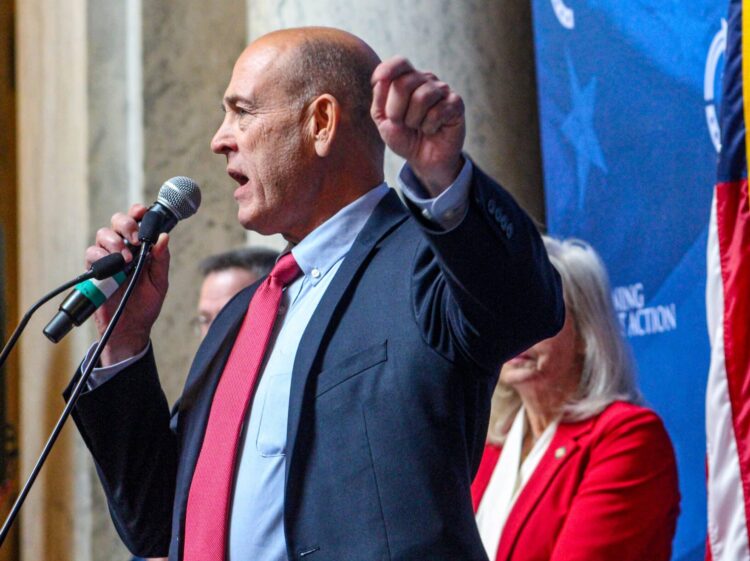
He said board members can use that authority to monitor curriculum and other policies in their districts rather than waiting for the legislature to impose additional requirements.
Byrne pointed to transparency requirements in other education legislation as one way to increase local oversight. In a sex education bill he worked on, Byrne said, just getting the schools to be required to post instructional materials was a win.
“Local access and transparency is the biggest thing,” Byrne said.
He said the requirement gives parents and board members more information without necessarily dictating what schools must teach.
“In that particular bill, we’re not telling you what you need to teach in most cases, but whatever it is, you have to approve and post it,” Byrne said.
Byrne said he believes that type of transparency could affect the use of DEI-related and LGBTQ-related material in schools. The state could take additional action, Byrne said, if local districts do not use their existing authority, including potentially tying compliance to state funding.
“It could be that we do, you know, put some tie to the purse strings if that’s what it takes,” Byrne said. “I’m not opposed to that.”
He said school boards already have authority to monitor curriculum and other policies in their districts, so “they don’t have to wait on the state to do that,” Byrne said.
He said he is not currently drafting legislation specifically in response to the IFI audit, although he expects other lawmakers may introduce measures.
The general election will be Nov. 3. The 2027 session of the Indiana General Assembly will begin with Organization Day on Nov. 17.
Sydney Byerly is a political reporter who grew up in New Albany, Indiana. Before joining The Citizen, Sydney reported news for TheStatehouseFile.com and most recently managed and edited The Corydon Democrat & Clarion News in southern Indiana. She earned her bachelor’s in journalism at Franklin College’s Pulliam School of Journalism (‘Sco Griz!).
The Indiana Citizen is a nonpartisan, nonprofit platform dedicated to increasing the number of informed and engaged Hoosier citizens. We are operated by the Indiana Citizen Education Foundation, Inc., a 501(c)(3) public charity. For questions about the story, contact Marilyn Odendahl at marilyn.odendahl@indianacitizen.org.