By Addison Walter, campus editor
The Purdue Exponent
November 5, 2026
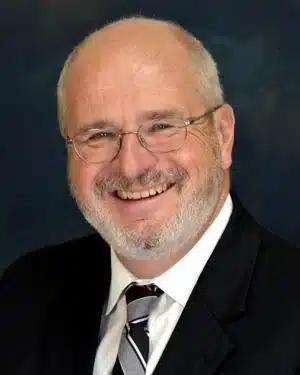
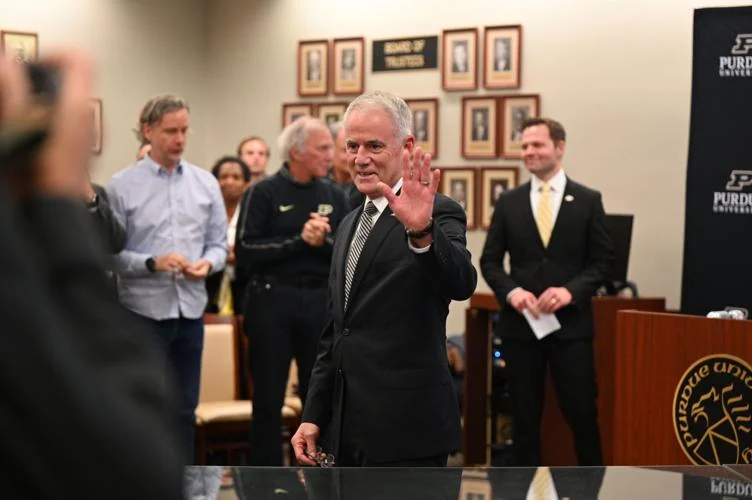
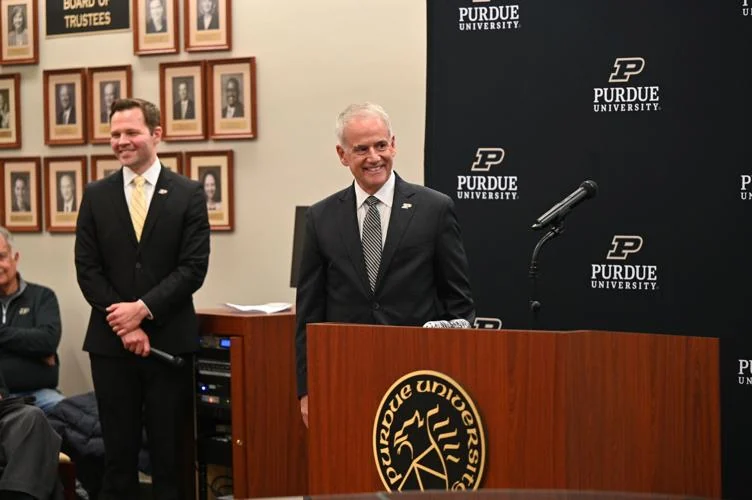
The Purdue Board of Trustees announced Thursday that Jay Silveria, current president of the University of Arkansas System, will be the 14th president of Purdue University.
Silveria will begin his term as Purdue president effective Feb. 1, 2027, with a contract that runs until June 30, 2032. His base salary will be $1 million, with other compensation included.
“Jay is widely regarded as a leader accustomed to aligning strategy with execution, making consequential decisions, accepting responsibility and preparing others to lead,” said Purdue Trustee Major General Theresa Carter.
Silveria received his bachelor of science degree from the United States Air Force Academy in 1985, and his master’s in social science from Syracuse University in 1997.
He retired from the Air Force in 2020 as a Lieutenant General after 35years, with the last three years of his service as the superintendent of the Air Force Academy.
Silveria was also an associate vice president at Texas A&M and the executive director of the Bush School of Government & Public Service Washington, D.C. Teaching Site from November 2020 to January 2025. In January 2025, he began his term at the University of Arkansas.
“We believe Jay’s military experience, leadership of the Air Force Academy, experience building a new urban campus from the ground up and leading a complex and diverse public university system is a perfect fit to those requirements,” Carter said.
Along with outlining Silveria’s qualifications, Carter detailed the compensation included in his contract.
“(His salary) may be increased at the discretion of the board, but not decreased unless there is a university-wide salary reduction,” Carter said. “The president will be eligible for an additional amount of compensation equal to 50% of his base pay, and considered at risk subject to the achievement of measurable goals established annually by the board.”
Other than a salary, the university will also be providing Silveria with a vehicle and driver, which is serving as a security detail. He will also be allowed to live in Westwood, the president’s residence, with his family, and will have access to the “executive lift program for official travel.”
Carter also said Silveria’s compensation package was aimed to be placed in the middle of the Big Ten, as it contains performance incentives. The incentive program started in 2012 with current interim President Mitch Daniels during his official term and was continued for former Purdue president Mung Chiang, who departed to become Northwestern’s president this summer.
The incentivized goals involve multiple areas, including “student affordability, student success, institutional reputation, research excellence and the financial strength of the university,” Carter said.
The contract also allows for additional compensation if the president and his team exceed the established goals.
“This compensation may exceed 50% should the president and his team earn more than 100% of the stated goals, and shall be prorated for the first five months of the contract term,” Carter said.
Chiang made $893,815.70 in 2025, according to public records.
The board began its search for a successor following Chiang’s sudden departure announcement in May.
Board of Trustees Chair Gary Lehman said the board wanted to conduct a quick, yet thorough search.
Over 100 people were considered candidates for the position, but only about 30 were given “detailed consideration,” Lehman said. The board conducted interviews, and “one candidate quickly rose to the top.”
Lehman said the board considered the way other major universities have conducted presidential searches. He said some of the struggles other universities have faced, including having multiple interim presidents, has had a lasting harm on their institutions.
The search included the board reaching out to multiple groups with a survey. Lehman said they wanted input directly from a diverse amount of people.
“We did something we hadn’t done before. We had a survey that asked some questions and also from nominations across a wide variety (of people),” Lehman said.
There were four things the board considered to be extremely important. The first point was that the survey recommended the board choose someone with “academic credibility,” while still having “financial fluency.”
“They have to understand how higher education works, but they also (have) to understand a balance sheet,” Lehman said.
A comment from the board was Silveria’s contribution to the Texas A&M rollout in Washington, D.C
“His involvement in that is completely relevant with what we’re doing in Indianapolis, and (it) is our biggest bet right now,” said Vice Chair Michael Klipsch.
The board also wanted a candidate that had good communication skills that can build trust.
Responses to the survey said the president needed to have a “successful experience running a large complex organization (or) perhaps more than one,” Lehman said.
Another consideration was that the candidate needed to be cognizant of Purdue’s land-grant institution status and its “responsibility” to the state.
“Now we’ve got an awful lot of external issues that’s come about due to the political environment that we have to deal with, and (the public) wanted somebody that was comfortable dealing with that,” Lehman said.
Silveria also mentioned the importance of protecting freedom of speech and academic freedom within the university.
“I think that academic freedom is essential to what we do as an institution, and we should always balance having freedom of speech and academic freedom so that we can develop and grow our students,” Silveria said.
One concern the board had was the amount of time Silvaria has been at Arkansas, since he started in January 2025. One of the reasons he was interested in Purdue is that he is able to be “back at a university where he’s out amongst the students,” unlike his experience at Arkansas. Lehman noted that since Silveria is Arkansas’ system president, he is not able to be with the students.
Silveria said he has the same answer for any question, whether it is about athletics or what he is doing next.
“Today I have the same answer for all of those questions. I want to meet the faculty. I want to meet the staff. I want to meet the coaches. I want to meet the students,” he said.
“Everybody that has to do with Purdue University, I want to meet them. I want to listen and I want to learn.”
Silveria noted that he would like students to know that he wants to meet each of them. He said he is here to be “approachable and accessible” for students.
Silveria assured the trustees that he would live up to the expectations set with their unanimous vote of confidence.
“It is a privilege to be a part of Purdue University, but it’s an honor to be selected as the next president,” Silveria said. “It’ll take every piece of my background to take on being the president of Purdue University.”
This story was originally published by The Purdue Exponent.
The Purdue Exponent is the independent student media organization serving the Purdue University community. It is published by the Purdue Student Publishing Foundation, a non-profit educational organization. For questions about the story, contact editor-in-chief Avery Goldthorpe at editor@purdueexponent.org.