By Marilyn Odendahl
The Indiana Citizen
June 26, 2026
When Benjamin Harrison moved into the White House in 1889 as the 23rd president, he was continuing his family’s legacy of nurturing and encouraging the young nation to fulfill the promises made in the Declaration of Independence.
He was also helping to write the country’s history that came after its founders declared all men are endowed with certain unalienable rights that include “Life, Liberty, and the pursuit of Happiness.”
As the country prepares to celebrate its 250th birthday since the signing of the Declaration of Independence in 1776, the Benjamin Harrison Presidential Site, located at the Indianapolis home built by Harrison and his wife Caroline, is focused on what followed. The site is highlighting the Harrison family’s deep roots in the American story and has been hosting programs and events that reinforce the ties binding all citizens.
“While it’s the 250th anniversary of the Declaration of Independence, it’s the other 249 years that really count,” Charles Hyde, president and CEO of the Harrison Presidential Site, said. “How have we lived up to those expectations, those obligations to the larger vision that was set forth in the Declaration of Independence?”
The Harrison Presidential Site is sticking to its unique approach in preserving Harrison’s life and legacy and in getting a wider audience to think about the ideals of democracy and civic engagement. Programming and events range from the thoughtful, such as the Off the Record panel discussion, to the fun, including the Juneteenth food festival, and the patriotic, such as the naturalization ceremony to be held on the site’s lawn on July 2.
Hyde said BHPS offers an array of activities to help engage people in the history and story of America.
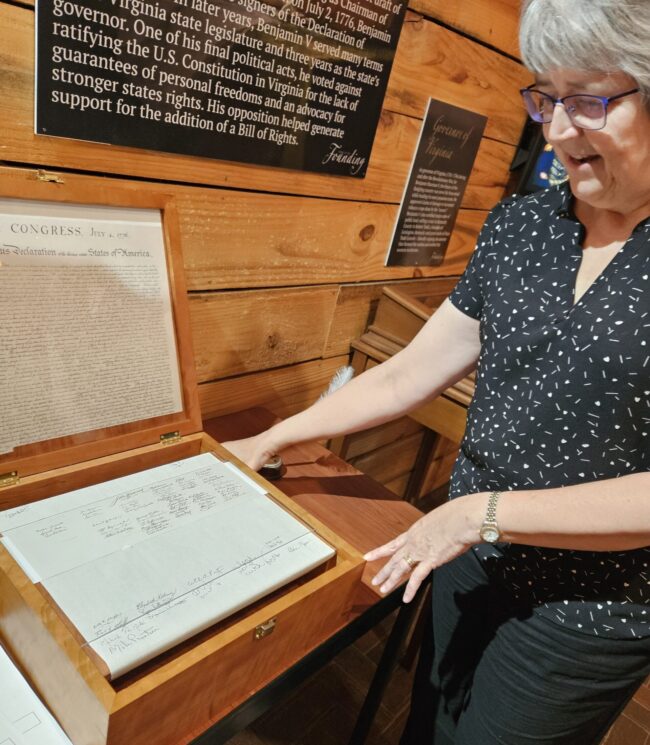
Especially for the 250th anniversary, the Harrison home is offering enhanced tours and two special exhibits: “There at the Founding” examines three generations of the Harrison family that shaped American governance from the America Revolutionary era through the westward expansion and into the Gilded Age, and “Presidential Ink: 45 Signatures that Shaped a Nation” showcases documents bearing the signatures of all 45 U.S. presidents.
The exhibits and programming remind visitors that the country has withstood turbulent times and strife. Noting antagonism and imagined grievances can flourish when people feel isolated, Hyde said the Harrison Presidential Site views its role as creating a space where everyone can gather.
“If we can at least find those ways to bring people together and have civil civic conversations, they may find that common ground by recognizing that we likely share many more commonalities than we do differences,” Hyde said. “And where those differences exist, if people are approaching those differences in good faith and seeking to resolve them for the common good, then … ultimately that’s how we’ll find success in the 250 years to come.”
With the Harrison family’s roots in this country stretching back to the 1600s, the “There at the Founding” exhibit spotlights the public lives and contributions of Harrison and his grandfather, William Henry Harrison, the country’s ninth president, and his great-grandfather, Benjamin Harrison V, signer of the Declaration of Independence.
Separate sections are devoted to each Harrison. Their stories are told through interactive displays, such as a copy of the Declaration of Independence that visitors can sign, panels of text from various documents, and lots of artifacts, all of them from the Harrison Presidential Site collection.
“We’re lucky that the Harrison family, through the years, saved a lot of things,” Jennifer Capps, vice president of curatorship and exhibitions at the presidential site, said.
Thomas Crain, Indiana University-Indianapolis museum studies curatorial fellow, helped to create the “There at the Founding” exhibit.
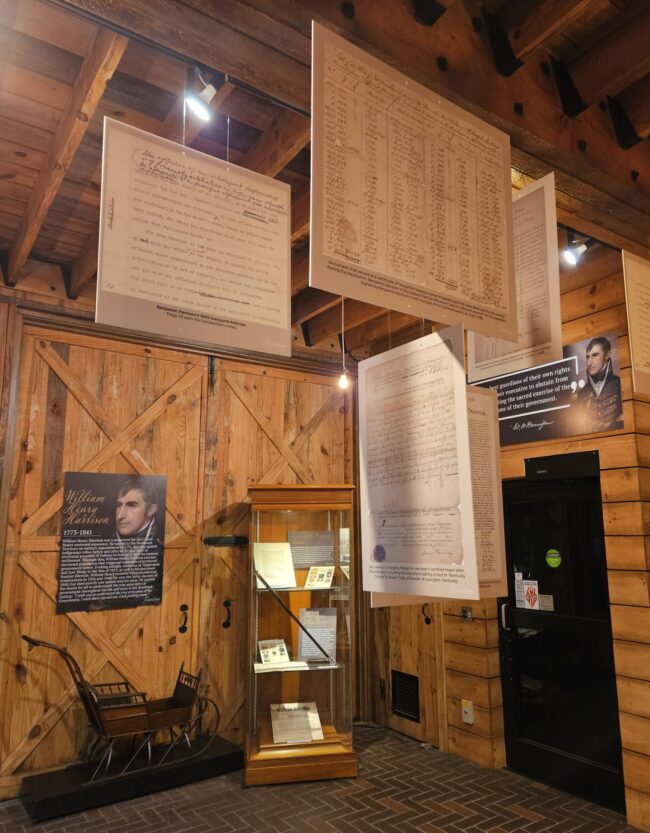
The exhibit begins with Benjamin Harrison V, who played a key role in the development of the founding documents.
Harrison V, a former member of the Virginia House of Burgesses, was managing the the family’s plantation when he journeyed to Philadelphia for the Second Continental Congress and was among the 56 delegates who signed the Declaration of Independence. Later his opposition to the ratification of the Constitution helped spur the creation of the Bill of Rights.
William Henry Harrison, the son of Harrison V, extended the family’s reach westward. He joined the military and served under Gen. “Mad Anthony” Wayne in battles against Native Americans and later became the governor of the Indiana Territory. In 1840, he became the ninth president by defeating incumbent Martin Van Buren, but he served only about four weeks in office. He was inaugurated in March 1841, then succumbed to a sudden illness in April, making him the first president to die in office.
His grandson, Benjamin Harrison, settled in Indianapolis where he established his law practice. When the Civil War erupted, Harrison, a descendant of slave owners, raised a regiment of Hoosier soldiers for the Union Army and led them into the fighting, earning the rank of brigadier general for his achievements on the battlefield.
Although he only served one term as president, Harrison expanded America’s influence abroad and grew the country’s footprint by admitting six states into the union, the most by any president. He also tended to the citizens’ patriotism by promoting the Pledge of Allegiance and the flying of American flags outside of schools and public buildings.
Among the memorabilia and artifacts in this exhibit is a handwritten land deed from 1782 for property in what is now the Commonwealth of Kentucky. Harrison V, who was then governor of Virginia, signed the deed, which transferred the land from the Commonwealth of Virginia to Robert Todd, a great uncle of Mary Todd Lincoln.
“I just think it’s interesting when you look at those threads of history and how we all interweave and connect with each other,” Capps said.
Also included in the exhibit is an engraved walking stick William Henry Harrison used at his inauguration and a hand-painted poster from his campaign.
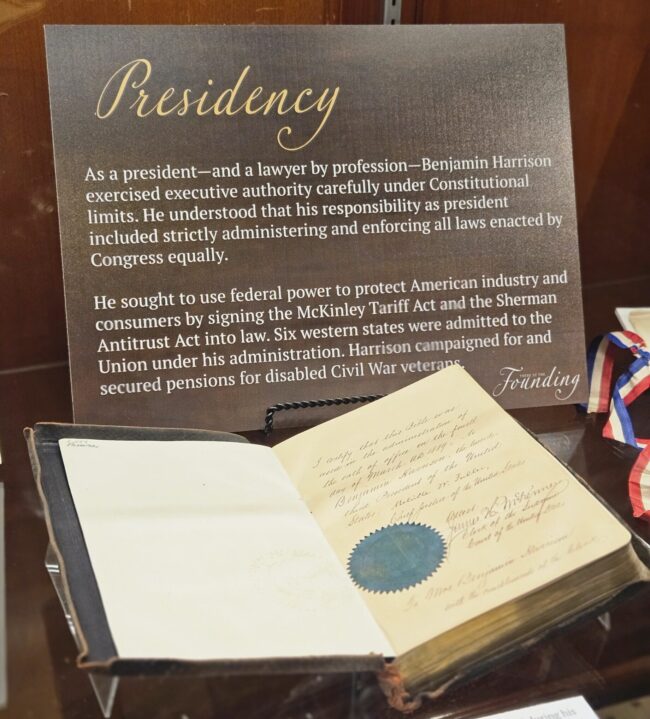
The remnants and objects from Benjamin Harrison’s life include the Bible he used at his inauguration, some pages of his inaugural address, and campaign materials. In addition, several items connect Harrison with the Revolutionary War, including different artifacts that celebrate the Hoosier president serving 100 years after George Washington took the oath of office, and mementos from when he attended the dedication in Vermont in 1891 of the 306-foot Bennington Battle Monument, which commemorates a victory of American forces over the British in the Aug. 16, 1777, battle.
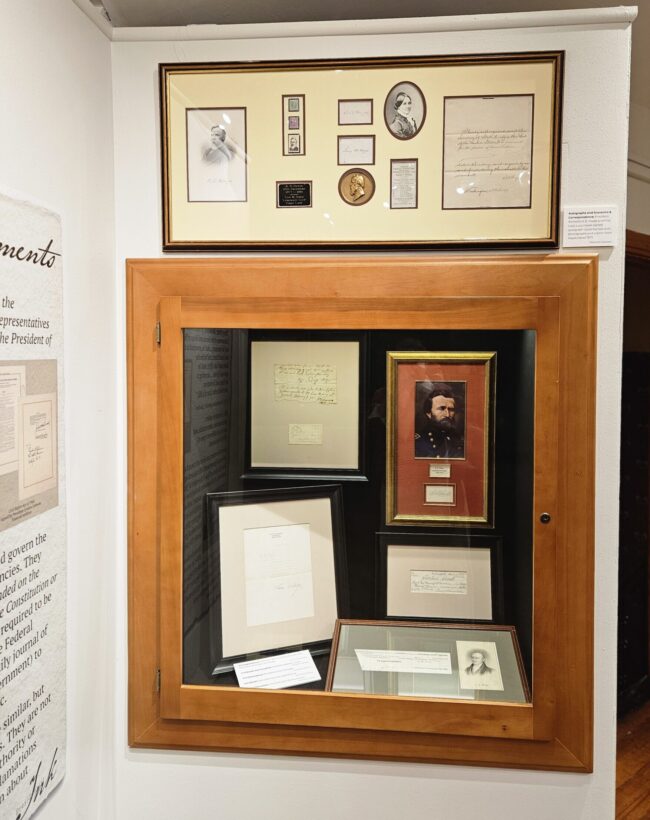
The separate exhibit, “Presidential Ink: 45 Signatures that Shaped a Nation,” showcases the “John Hancocks” of all 45 presidents across 47 administrations.
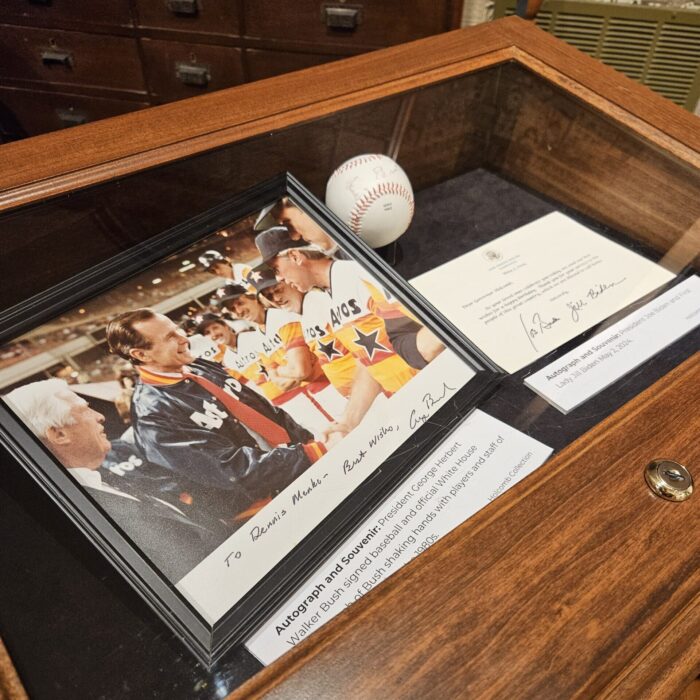
Drawn from the collections of former Indiana Gov. Eric Holcomb, Indianapolis attorney Tom C. Huston and the Harrison Presidential Site, the autographs are featured on laws, letters, treaties, commissions, and souvenirs. In particular, the exhibit features a ship pass – kind of like a passport for cargo ships – signed by Thomas Jefferson, a copy of the Emancipation Proclamation that Abraham Lincoln signed for a fundraiser, and a picture of the Houston Astros baseball team plus a couple of baseballs signed by three southpaws: George H.W. Bush, Bill Clinton and Barack Obama.
Benjamin Harrison and his familial ties to America’s early history are prominent in the exhibit.
A letter from George Washington to Gen. Anthony Wayne was written in response to a request from, at the time, the Harrison family patriarch. Harrison V had asked Washington to keep an eye on his son, William Henry Harrison.
The signature of William Henry Harrison comes from his tenure serving as secretary under Arthur St. Clair, then governor of the Northwest Territory. Signing his name to the document which made him a justice of peace, William Henry Harrison essentially signed his own promotion.
Herbert Hoover’s signature is on a letter he wrote about a chance encounter with Benjamin Harrison. The 23rd president was visiting Stanford University when Hoover was a student and manager of the school’s baseball team. Harrison decided to take in a game, but when he arrived at the gate, the future 31st president did not recognize the then-current occupant of the White House and charged him admission.
Pointing to a land grant that carries Benjamin Harrison’s name scrawled in cursive, Capps revealed the 23rd president likely did not actually sign the document. The clue that a secretary probably penned Harrison’s moniker is the first name, Benjamin, which is spelled out. Harrison normally abbreviated his name, scribbling just the “B” and to the “J.”
The signatures of Warren Harding, Franklin Delano Roosevelt, William Henry Taft and Theodore Roosevelt are on letters of condolence the presidents sent to Harrison’s second wife, Mary, after his death.
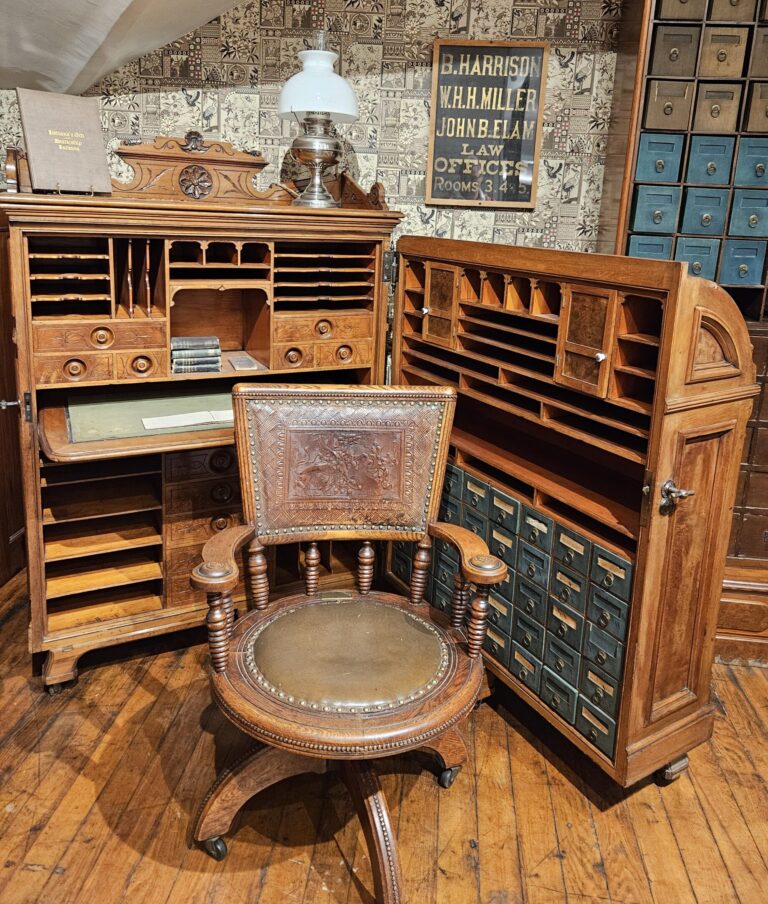
The exhibit also features Harrison’s folding desk that swings open like a door and the cabinets that he used in his downtown Indianapolis law office. The desk chair was actually given to Harrison when he was in the White House and he, in turn, gifted the wooden seat to Col. William H. Crook, who worked in his administration possibly as a clerk or secretary. The colonel subsequently passed the piece of furniture on to his family and years later, the family gave the chair to the Harrison Presidential Site.
The signatures create a connection to the presidents, Capps, the BHPS curator, said. The elected leaders touched the documents and signed their names, sometimes carefully and at other times by quickly scribbling on the paper.
Hyde said the Harrison Presidential Site and the exhibits tie the present to the past, so Americans of today can reflect and contemplate how we can “live up to those promises” we made to ourselves at the founding of this country.
However, Hyde resisted the temptation to describe the 250th anniversary as a culmination.
“I think we would make the argument … that this is in many ways a new beginning for the country,” Hyde said. “You think about the way in which this country has come together, person-by-person, over 250 years and meeting these larger obligations. So, what are we going to do to contribute to these next 250 years?”
Dwight Adams, an editor and writer based in Indianapolis, edited this article. He is a former content editor, copy editor and digital producer at The Indianapolis Star and IndyStar.com, and worked as a planner for other newspapers, including the Louisville Courier Journal.
The Indiana Citizen is a nonpartisan, nonprofit platform dedicated to increasing the number of informed and engaged Hoosier citizens. We are operated by the Indiana Citizen Education Foundation, Inc., a 501(c)(3) public charity. For questions about the story, contact Marilyn Odendahl at marilyn.odendahl@indianacitizen.org.