By Sydney Byerly and Marilyn Odendahl
The Indiana Citizen
October 30, 2026
When Olivia Reyes filed to run for the Anderson Community School Board, she did not check either the Democrat or Republican box but rather identified herself as an independent.
Reyes, who is a women’s life and leadership coach and is on the November ballot, said she is concerned that politics and party affiliation are overshadowing the focus all school board candidates should have: the actual needs of the children. Party labels tell voters very little, if anything, she said, about the candidates’ understanding of child development, knowledge of educational policy and ideas for addressing whatever unique challenges the local school corporation is facing.
More than perhaps distracting voters, Reyes pointed out partisan politics can interfere with the work that she said the school board members should be doing, which is serving every child and not pushing a particular political agenda.
“Children should not become casualties of ideological disagreements between adults,” Reyes said. “We should be asking candidates how they intend to improve educational outcomes, support teachers, protect students, and ensure accountability, rather than assuming a political label tells us everything we need to know about their qualifications or intentions.”
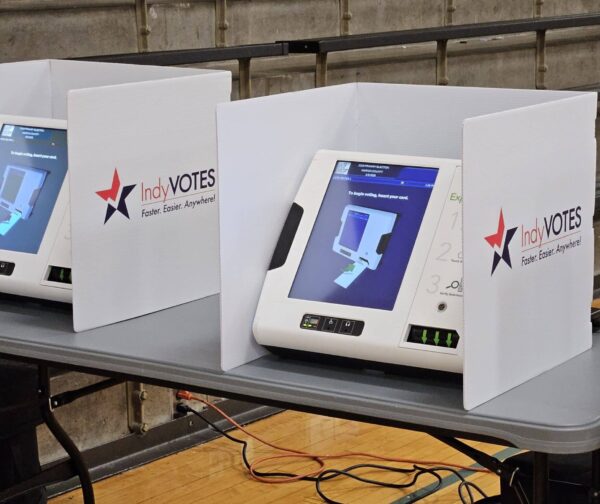
Hoosiers going to the polls this midterm election will see that the school board candidates listed on the ballot have some kind of party affiliation beside their names. For the first time, school board hopefuls in Indiana can either run as a member of the Democratic, Republican, or Libertarian parties or eschew such a label altogether and identify as independent, nonpartisan or no party affiliation.
The 2025 Senate Enrolled Act 287 that ushered in partisan school board elections has fomented some division among the electorate. Supporters of the statute joined the bill’s author, Sen. Gary Byrne, R-Byrneville, in asserting the party labels will give voters more information about what items and initiatives the candidates would likely promote and approve if elected. Opponents counter the affiliations will just inject politics into school boards, which function best as nonpartisan entities.
However, Rebecca Jacobsen, a professor and expert in education policy at the College of Education at Michigan State University, has been carrying out research that shows the belief that keeping school board races nonpartisan will completely remove any politics may be something of a myth.
Jacobsen and Cameron Arnzen, a research affiliate at Brown University’s Annenberg Institute, conducted exit polling on 839 voters in Michigan, which has nonpartisan school board elections and in Rhode Island, which has partisan school board elections, to learn how the different election structures influence voters’ decision-making.
In the working paper they published in December 2025, Jacobsen and Arnzen presented data which indicate that national politics influence voters even in nonpartisan races. They said their findings suggested that while partisan school board elections may amplify the degree of partisanship among voters, nonpartisan elections are “no panacea for the polarization plaguing U.S. democracy.”
Comparing the two groups of voters, Jacobsen and Arnzen found student safety, their mental health and preparing students for life after graduation were the voters’ top priorities.
Conversely, the groups differed on two of the factors that shaped their choices, the researchers said. Rhode Island voters cared much more about each candidate’s political party affiliation, which is expected in a state with partisan school board elections, while Michigan voters cared slightly more about endorsements, which suggests that endorsements might be filling some of the void created by the absence of political party labels.
“Partisanship now structures issue priorities and candidate selection across both formally partisan and nonpartisan elections,” Jacobsen and Arnzen concluded in their published paper, “The Influence of Partisanship in Local School Board Elections.” “Even in Michigan, where ballots omit party labels, we observe a moderate degree of partisan influence in voters’ priorities for school board elections, suggesting nationalization has reshaped local school board priorities.”

Hoosier voters looking to party labels to help choose school board candidates may be disappointed in the 2026 midterm election.
Of the 1,034 people running for a seat on a school board, a majority of 591 identified either as independent, nonpartisan or no party affiliation. Of the remainder, 375 candidates are running as Republicans and 60 as Democrats, along with four Libertarians and four American Solidarity Party members.
South Bend School Board candidate Cheryl Moody chose to run under the “no party affiliation” category. She said she appreciates that Indiana’s new partisan school board law does not require candidates to pick a party, especially since she said she has voted for both Republicans and Democrats in past elections and does not consider herself a member of either party.
Still, Moody also sees a benefit to partisan races.
“I think it is true that as much as people want to believe partisan politics shouldn’t matter in school board races, they do matter,” Moody said. “Party affiliation is a useful shorthand for voters to see who is most likely to align with them on values and priorities.”
Loren Heger, who is running as a Democrat for the Indianapolis Public Schools School Board, agreed with Moody, but noted Hoosiers could still be confused when they go to the polls. Most voters who pay attention, he said, have a pretty good sense of the candidates’ political leanings. Yet, when they get to these school board races on the general election ballot, they might be surprised to see some of the candidates are affiliated with a political party and others are not.
“So, it’s strange because it’s a half measure,” Heger said. “I think if it was a typical process where there is a primary and then a general election, (that) would frankly make much more sense.”
Jacobsen, the Michigan State University education professor, said partisan elections are creating a “new wild west” that can result in school boards that get very little done.
School boards with members who align as either Republicans or Democrats can get mired in divisive national issues, such as who can play on girls’ sports teams even though the school corporation might not have any transgender students wanting to be athletes, Jacobsen said. In extreme cases, that infighting can cause communication to break down among the members so that instead of making decisions collectively and many times unanimously, the majority gets pitted against the minority. The school board can then resemble Congress, Jacobsen said, with the majority trying to ram something through and the minority having to rely on procedural maneuvers to stop the process.
What gets left unresolved are the local issues, Jacobsen said. The typical concerns of a school board, such as bus routes, student lunches and teachers’ professional development, are eclipsed, she said, by the debates over national issues.
“That’s why I think what will matter more than just the labels that people are running on is the composition of the board and how willing somebody is, who has the R or that D behind their name, to still say, ‘You know even if I’m in the majority, we are a collective,’” Jacobsen said.

Jon Shapiro, a member of the Carmel Clay School Board, was among those who went to the Statehouse in 2024 and testified against the partisan school board bill.
Echoing Jacobsen, Shapiro said having members affiliated with a political party could shift the focus away from working collaboratively to help provide students with a high-quality education. The board, he said, could instead start paying more attention to the political winds, so that, for example, when lawmakers in the Indiana General Assembly talk about curriculum, those ideas or viewpoints will trickle down to the school board members of the same party.
“For me, public schools serve the entire community and it’s not a Republican, Democrat, independent or Libertarian issue,” Shapiro said. “If we start factoring in politics into how we’re making decisions about educating kids, I think it’s a slippery slope before potentially it could impact the way we provide high-quality education.”
Jacobsen said an unknown in partisan school board races is the impact of money.
As individuals align with a political party, the parties will begin making endorsements and possibly connecting the candidates with donors, Jacobsen said. These funders and contributors can have a positive impact by introducing some professionalism into school board campaigns and educating candidates about policies and best practices for the classroom.
However, Jacobsen said, the donors can also have a strong ideological bent or be giving money with the expectation that once the candidates get elected, they will push a particular agenda. Consequently, the candidates can feel pressure to be more extreme in their viewpoints.
Jacobsen recalled one school board member saying donors wanted the people they support to be pounding their fists on the table at meetings, rather than looking for ways to collaborate and compromise.
“I do think that there’s been widespread recognition that schools really matter, that local control really matters, and that (school board races are) sort of a soft target because they are relatively low stakes and with a little bit of donor money, you can go a really long ways,” Jacobsen said.
Sydney Byerly is a political reporter who grew up in New Albany, Indiana. Before joining The Citizen, Sydney reported news for TheStatehouseFile.com and most recently managed and edited The Corydon Democrat & Clarion News in southern Indiana. She earned her bachelor’s in journalism at Franklin College’s Pulliam School of Journalism (‘Sco Griz!).
Dwight Adams, an editor and writer based in Indianapolis, edited this article. He is a former content editor, copy editor and digital producer at The Indianapolis Star and IndyStar.com, and worked as a planner for other newspapers, including the Louisville Courier Journal.
The Indiana Citizen is a nonpartisan, nonprofit platform dedicated to increasing the number of informed and engaged Hoosier citizens. We are operated by the Indiana Citizen Education Foundation, Inc., a 501(c)(3) public charity. For questions about the story, contact Marilyn Odendahl at marilyn.odendahl@indianacitizen.org.