By Sydney Byerly
The Indiana Citizen
June 25, 2026
When Indiana Lt. Gov. Micah Beckwith called Islam a “demonic death cult” during an appearance on the Christian political program FlashPoint in May, the remarks drew swift backlash from faith leaders across Indiana.
It also highlighted the growing influence of the Christian media network that amplified them – one where Beckwith is a frequent guest.
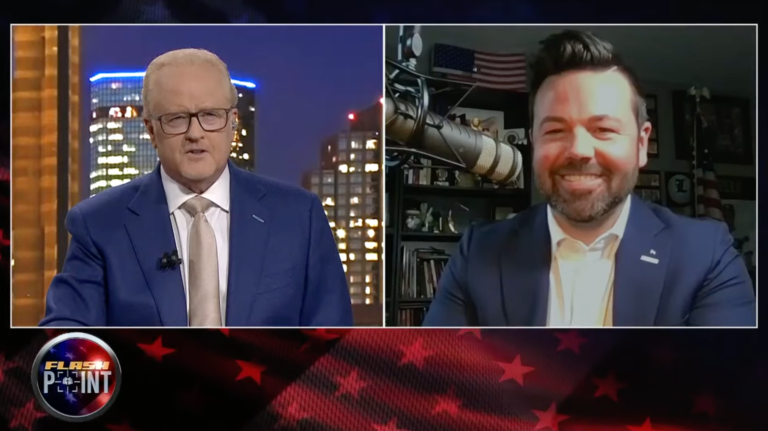
Since November 2025, Beckwith, a self-described Christian nationalist, has appeared at least 11 times on FlashPoint’s page. Acting as a Christian media organization, FlashPoint describes itself on its website as equipping believers to influence culture and government through a biblical lens.
Beckwith is part of an influential roster of Republican politicians and activists who frequently appear on FlashPoint, which began as a television-style commentary program and has evolved into a broader political and religious media network.
Originally launched as a program on Kenneth Copeland Ministries’ Victory Channel around the 2020 election, FlashPoint separated into an independent nonprofit in April 2025 led by host Gene Bailey and his wife, Teri Bailey. It describes itself on its website as a place “where faith meets current events” and says its mission is to equip Christians to “affect culture for Jesus.”
FlashPoint’s growth comes amid a broader expansion of Christian media consumption in the United States. A 2026 Pew Research Center study found that 45% of American adults listen to some form of religious audio programming, including religious talk shows, sermons, music and podcasts. The study also found that seven in 10 religious-programming listeners use online streaming or podcast platforms, highlighting how religious broadcasting has expanded beyond traditional radio.
Researchers say digital platforms have allowed religious media organizations to build audiences that extend well beyond local congregations or broadcast markets, creating new avenues for political commentary, community-building and activism.
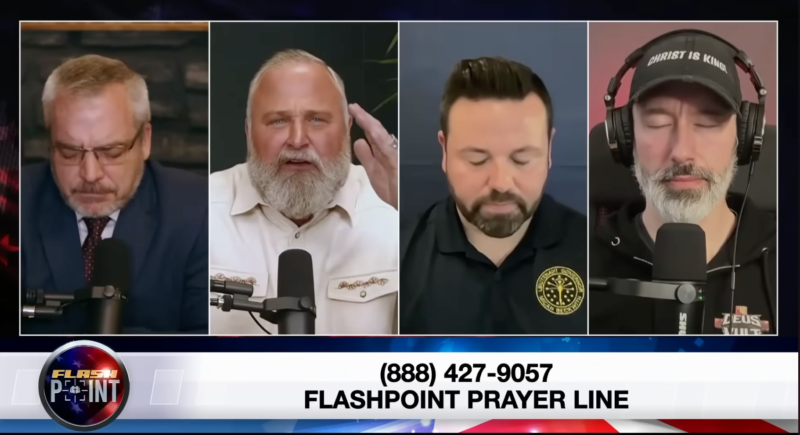
The guest roster places Beckwith within a broader network of conservative Christian activists and political organizers whose work often centers on reshaping government and public life through explicitly biblical principles.
Recurring guests include Tim Barton, whose Texas-based (and Beckwith-backed) organization WallBuilders promotes an interpretation of American history that emphasizes the country’s Christian founding; Mark Meckler, a leader in the Convention of States movement who has advocated for a constitutional convention to impose federal term limits and other reforms; and Rick Green, who runs Patriot Academy, where he trains Christians and conservative activists in what he calls “biblical citizenship.”
The show has also featured figures known for hardline warnings about Islam, including Brigitte Gabriel, a Lebanese-American activist who founded ACT for America and has long framed Islam as a national security threat, and John Guandolo, a former FBI special agent who has argued that mainstream Muslim institutions in the United States operate as political and military fronts.
Beyond activists and commentators, FlashPoint regularly hosts Republican political figures, including Oklahoma congressional candidate Jackson Lahmeyer, Michigan gubernatorial candidate Ralph Rebandt, Oklahoma gubernatorial candidate Mike Mazzei, and Ben Carson, a member of President Donald Trump’s Cabinet during Trump’s first term.
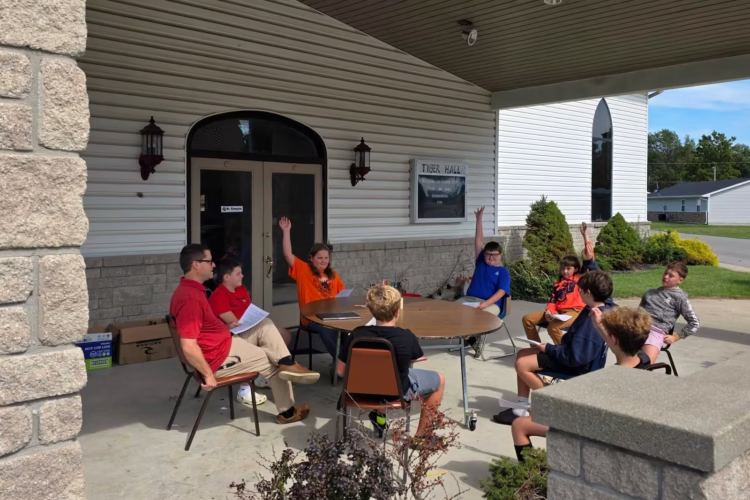
The platform also features leaders in conservative education and media advocacy, including Marissa Streit, CEO of PragerU, and Joel Penton, founder of LifeWise Academy, an Ohio-based ministry that provides off-campus Bible instruction for children during school hours. LifeWise has expanded into Indiana and been the subject of debate in several districts over student participation, transportation logistics, and the role of religion in public education.
For political candidates, the platform offers access to a nationwide audience of conservative Christians. FlashPoint’s YouTube channel has more than 66,000 subscribers and 10 million views since it was started in March 2025.
Rebandt, who also serves as senior chaplain for Michigan State Police and spent 35 years as pastor at Oakland Hills Community Church, said he pursued an appearance on FlashPoint after supporters and political contacts encouraged him to connect with the program’s evangelical audience.
“FlashPoint does reach out to them,” Rebandt said of evangelicals. “They’ve got a large audience nationwide.”
Rebandt also pointed to FlashPoint Army, the organization’s effort to build local groups around the country, describing it as an initiative intended to unite people around shared Christian values and civic engagement. According to FlashPoint, the initiative seeks to build local church chapters, train political candidates and encourage congregations to move “from gathering to governing” in support of what it describes as a “Kingdom-driven agenda” in public life.
Rebandt also said he views political engagement by clergy as a longstanding American tradition and sees faith-based media as a way to encourage Christians to become more involved in civic life.
The organization also extends its messaging beyond broadcasts through an online store, offering downloadable reports, various books and pledge materials — many of which focus on Islam and Sharia law.
FlashPoint did not respond to requests for information about its Army chapters, candidate training efforts or organization.
For Beckwith, FlashPoint has become a favorite stage.
The Indiana lieutenant governor — who has aligned himself with Christian nationalist ideas and frequently argues that faith should play a more direct role in government — has used appearances on the program to promote political views, discuss cultural issues and frame public office as part of a broader spiritual struggle.
At a FlashPoint Live event in Crown Point last October, Beckwith told supporters that politicians should be “unapologetically faith-forward” and said government should be more openly aligned with Christian principles.
His most controversial appearance came May 21, when he told host Gene Bailey that Americans should be given “permission to hate again” before describing Islam as a “demonic death cult.”
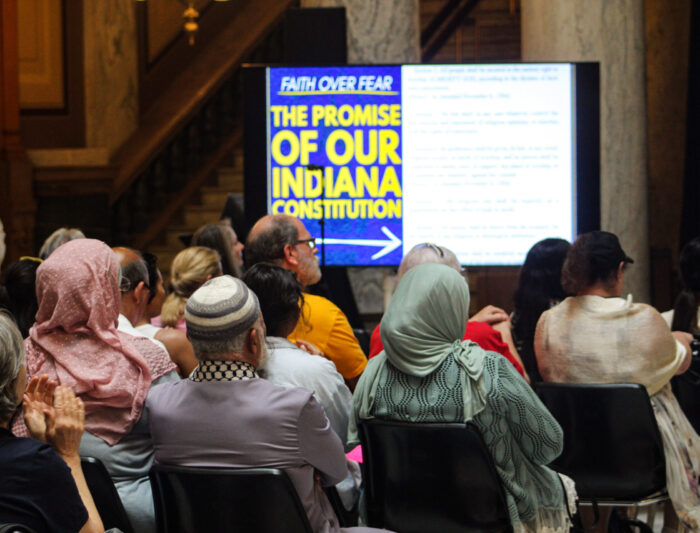
The remarks drew condemnation from Muslim leaders, civil rights advocates and interfaith organizations. On June 11, faith leaders and elected officials from both parties gathered at the Indiana Statehouse for a “Faith Over Fear” event calling for renewed commitments to religious freedom.
Two days earlier, Beckwith revisited the controversy in a June 9 “Ask Micah Anything” video, saying he did not regret his remarks and warning against what he described as the influence of Sharia law in American public life.
Matthew Taylor, an author and visiting scholar at the Center on Faith and Justice at Georgetown University who studies Christian nationalism and evangelical political movements, said FlashPoint reflects a broader ecosystem where charismatic evangelicals combine spiritual warfare theology and modern prophecy beliefs with current events.
“We’re talking about a kind of independent charismatic sector of evangelicalism … very lively, very interested in politics,” Taylor said.
He pointed to what some participants describe as the “Seven Mountain Mandate,” a framework in parts of Christianity that divides society into spheres of influence — government, education, media, business, family, religion and arts — and teaches that Christians are called to bring those arenas under Christian influence.
“They divide society up into seven different arenas of authority … and they imagine Christians are mandated by God to go and conquer the seven mountains in every society on earth,” Taylor said.
In that framework, Taylor said, political figures can take on outsized symbolic importance.
“A figure like Beckwith is very important to them,” he said, noting Beckwith’s role as both a pastor and a statewide elected official gives him “crossover appeal,” and places him within what adherents would consider the “government mountain.”
Taylor said while many leaders associated with charismatic Christian movements have attempted to enter politics Beckwith has achieved something relatively uncommon by winning statewide office.
“He’s also been a breakthrough figure who has made his way into politics. Beckwith has managed to do that and become lieutenant governor,” Taylor said, which could help explain why Beckwith has become a frequent presence on FlashPoint and other platforms within the movement.
“I think in their mind that makes him a very high-potential leader in their ecosystem and in their networks,” Taylor said.
Stewart Hoover, professor emeritus of media studies at the University of Colorado Boulder and a scholar of media and religion, said FlashPoint is also part of a longer evolution in evangelical broadcasting that has moved from televangelism into digitally networked media ecosystems.
He described the platform as part of an “infrastructure of evangelical digital ministries” that are as defined by their media reach as by their theology.
“These have roots in traditional televangelism and are also typically connected with large multi-site non-denominational churches,” Hoover said. “Their media presence and mediation is part of what defines them almost more than their theology.”
Hoover said the shift to digital platforms has dramatically expanded reach and reduced traditional media constraints.
“What is different is their accessibility and reach through their circulation in digital spaces,” he said. “They don’t need channels or broadcast licenses … the portability and platform ubiquity makes it so personal and so absorbing.”
He added that the reduction in influence of legacy media organizations has changed how political and religious messages spread.
“With digital media, anything goes. Clicks and likes and attention are the whole point,” Hoover said. “The most controversial things get the most attention.”
That dynamic, Hoover said, has helped ideological and political movements reach audiences far beyond their original geographic or institutional boundaries.
“These media provide legitimacy, access, and new networks of political and social action,” Hoover said.
Sydney Byerly is a political reporter who grew up in New Albany, Indiana. Before joining The Citizen, Sydney reported news for TheStatehouseFile.com and most recently managed and edited The Corydon Democrat & Clarion News in southern Indiana. She earned her bachelor’s in journalism at Franklin College’s Pulliam School of Journalism (‘Sco Griz!).
The Indiana Citizen is a nonpartisan, nonprofit platform dedicated to increasing the number of informed and engaged Hoosier citizens. We are operated by the Indiana Citizen Education Foundation, Inc., a 501(c)(3) public charity. For questions about the story, contact Marilyn Odendahl at marilyn.odendahl@indianacitizen.org.