By Marilyn Odendahl
The Indiana Citizen
September 11, 2026
Although GOP candidates running for statewide office in Indiana have long won at the ballot box, this year’s race for secretary of state has caused one national political forecaster to shift its prediction of the outcome from “Likely Republican” to “who knows?”
Sabato’s Crystal Ball, part of the Center for Politics at the University of Virginia, has released its updated predictions for the 26 secretary of state contests across the country. The analysis found six states have competitive contests, including Indiana and Michigan, which are the only two states now in the toss-up category.
About a year ago, Sabato’s had predicted Indiana’s secretary of state seat would likely remain in Republican hands and incumbent Diego Morales would win reelection.
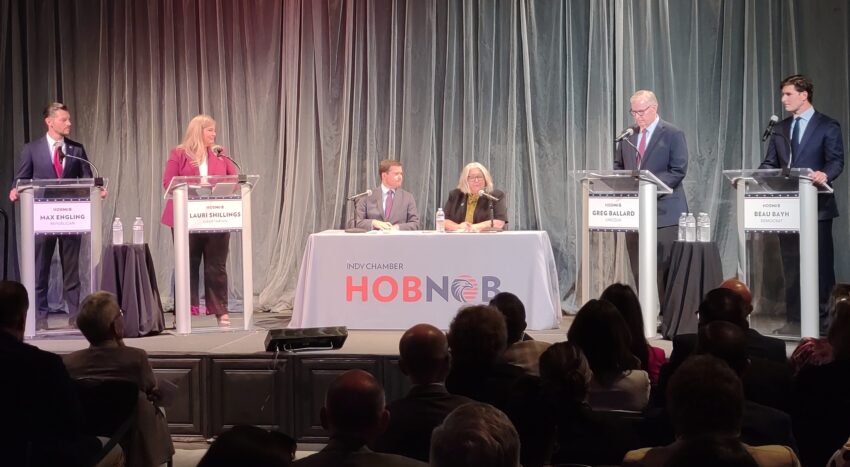
However, a wave of controversies drowned Morales’ renomination bid and Max Engling, regional director for U.S. Sen. Jim Banks, R-Indiana, was tapped as the Republican nominee. Also, Beau Bayh, son and grandson of former Indiana political leaders, is running as the Democratic nominee, while Greg Ballard, former mayor of Indianapolis, collected more than 40,000 signatures to get on the ballot as the Lincoln Party candidate and Lauri Shillings, businesswoman and entrepreneur, is running as the Libertarian Party candidate.
Sabato’s described Indiana’s secretary of state race as the “most interesting” this election cycle. The analysis only considered the candidacies of Engling, Bayh and Ballard, but could not see a clear frontrunner.
“Conceivably, any of them could win,” Sabato’s predicted.
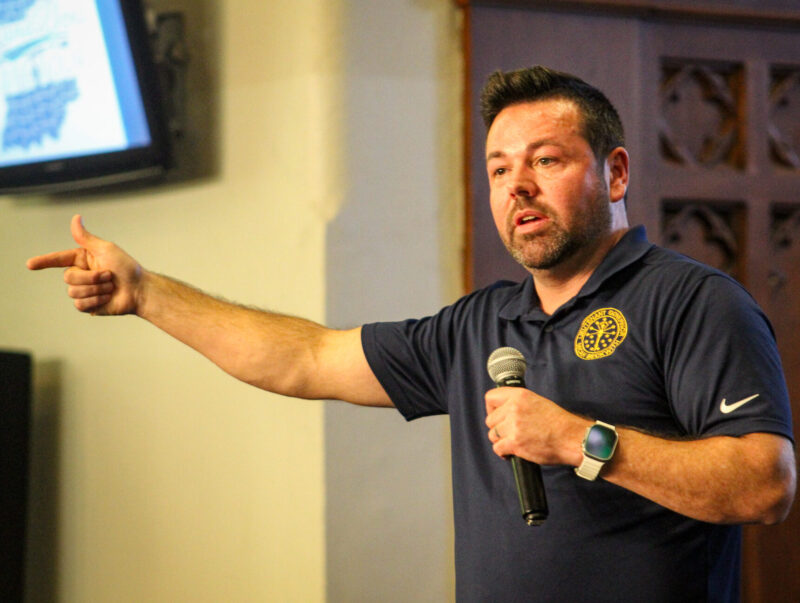
Aaron Dusso, associate professor of political science at Indiana University Indianapolis, said he is not surprised by Sabato’s predicament in finding the most likely winner. He pointed to another unpredictable time in 2008 when Barack Obama turned Indiana blue, but he noted a confluence of unique events that is making the secretary of state race competitive this election.
In the deep red state of Indiana, the Republican candidate, Engling, is not only facing strong and viable opponents in Bayh and Ballard but is also the least-known to the voters. Moreover, enthusiasm among Republican voters to go to the polls in November is waning as President Donald Trump’s approval rating has fallen to historic lows and high prices have persisted.
Even the power of straight-ticket voting will not save Indiana Republicans if the base opts to stay home on Election Day, Dusso said. GOP officials and candidates will have to work to get their voters to turn out, because the consequences of a loss could ripple beyond the secretary of state’s office.
“The reality is, I think that it can change politics in that the person in charge of the secretary of state’s office is basically … head of elections,” Dusso said. “I think this becomes a big issue going forward and particularly, I think, in 2028, it might even be a bigger issue as to how elections are run.”
Engling brushed off the Crystal Ball analysis. In a statement, he noted his campaign got a late start, but he was upbeat about his chances, saying he was “in a strong position” and anticipating he could become the leader in the race in the next few weeks.
“Hoosiers are ready to stand up for conservative leadership and keep Indiana moving in the right direction,” Engling said in a statement. “Our grassroots are fired up, and we’re ready to finish strong.”
Engling seemed to nod to Dusso’s observation that the next secretary of state could be overseeing and administering some momentous elections in the coming years. He devoted part of his response to Sabato’s Crystal Ball by saying he believes “in secure elections, strong voter ID, citizen-only voting, and following Indiana law.”
Still, Dusso said the Libertarians are posing another obstacle for Engling, since Shillings could significantly alter the result on election night, even if she does not win the race.
In recent secretary of state races, the Libertarian candidate captured from 3% and nearly 6% of the vote in the general election, which likely drew votes away from the Republican candidate. Dusso said that the GOP nominees in the past won by a such a large margin that losing a small percentage to a minor party did not matter, but now, in a four-way race where one of the candidates could be victorious with much less than 50% of the vote, a sliver of the electorate supporting Shillings could prevent Engling from taking office.
Shillings’ campaign questioned the legitimacy of Sabato’s analysis since it did not include her, but her campaign agreed the secretary of state race is a toss-up.
“We have no doubts that the campaigns funded by mountains of special interest money have been polling this race,” Shillings’ campaign said in an email, referring to Engling and Bayh. “Yet, none of them have seen results they like enough to release to the public. That alone says this race is anyone’s ball game.”
As the secretary of state race enters the final months, Shillings’ campaign took a swipe at her opponents by emphasizing her Indiana roots.
“She didn’t spend her life in D.C. She spent it here, working hard and building a life for her family,” Shillings’ campaign said. “She’s not doing this to start some new mystery political party, to serve big donors, or to further her political career. She’s running for secretary of state because it’s a service role and she just wants to serve Hoosiers to the best of her ability.”
Both the Bayh campaign and Ballard said they were not surprised by Sabato’s inability to make a prediction.
“Indiana voters are sick and tired of politics as usual and the corruption in this office,” Jack Tormoehlen, Bayh’s campaign manager, said in an email. “Beau has built a winning campaign that appeals to all Hoosiers and is focused on bringing people together and restoring integrity and trust in Indiana government.”
Ballard interpreted Sabato’s toss-up rating as national recognition that he can win the race for secretary of state.
“Everywhere I campaign, Hoosiers tell me they want a leader with a track record of independence as an elected official to over see Indiana’s election for the next four years,” Ballard said in a press release. “There’s only one candidate on the ballot who meets that criteria.”
Dusso said a key to Bayh and Ballard remaining competitive is that they focus their attacks on Engling and not each other. Throwing their punches at each other will only raise their negatives and cause voters to assume all the contenders on the ballot are the same and to revert to selecting the candidate from their party.
Also, Dusso said, Engling will struggle to fend off attacks from multiple opponents. The Republican nominee’s response could then be less effective, because he will likely have to divide his campaign money to create individualized ads and messages targeting each opponent.
“So, your attacks are less effective, less consistent, and … more confusing to voters,” Dusso said.
Sabato’s said Morales was one of just three secretaries of state from across the nation who lost their bids for renomination. The Crystal Ball attributed his defeat to “a string of controversies” that included acquisition of a luxury car, hiring of family members for state government jobs and overseas travel to meet heads of foreign countries.
However, even though he is not on the November ballot, Morales issued a press release this week punching back at Bayh’s criticism, saying the Democrat was making “misleading accusations” and creating “political nonsense.” The secretary of state countered Bayh’s allegations of corruption and no-bid contracts, and defended his fiscal management.
“Before attacking an office he wants to lead, Beau Bayh should understand how that office actually operates,” Morales said in the press release. “Throwing around words like ‘corruption’ may entertain his base, but repeatedly publicizing untrue, misleading, defamatory, accusations does not make them true.”
Bayh has made Morales a focus of his campaign, repeating allegations of malfeasance. He responded to the secretary’s rebuttal by issuing his own press release, which highlighted his plan to conduct an independent audit of the office.
Also, Bayh brought his opponents into the spat by offering an “anti-corruption pledge” and saying he hoped all the candidates for secretary of state would adopt it.
“Restoring trust and integrity to our government should be every candidate in this race’s number one priority,” Bayh said in his press release.
Dusso pointed to the folly of Morales’ attack on Bayh: It only draws more attention to the allegations of his abuse of power. Responding to negative claims, even if they are completely false, just keeps the accusations in the headlines. Constituents will continue to talk about the headline, Dusso said, and probably miss the story that the attack is dubious.
As for the motivation to issue a strong rebuttal, Dusso was skeptical that Morales was hitting Bayh to weaken the Democrat and help boost Engling’s candidacy.
“I would say it’s more about self-preservation,” Dusso said. “Like, ‘you’re attacking me, personally and I’m going to respond to that,’ rather than the thought that ‘I’m going to help the Republican Party.’”
Dwight Adams, an editor and writer based in Indianapolis, edited this article. He is a former content editor, copy editor and digital producer at The Indianapolis Star and IndyStar.com, and worked as a planner for other newspapers, including the Louisville Courier Journal.
The Indiana Citizen is a nonpartisan, nonprofit platform dedicated to increasing the number of informed and engaged Hoosier citizens. We are operated by the Indiana Citizen Education Foundation, Inc., a 501(c)(3) public charity. For questions about the story, contact Marilyn Odendahl at marilyn.odendahl@indianacitizen.org.