By Tracey Compton
Indianapolis Public Editor
November 25, 2026
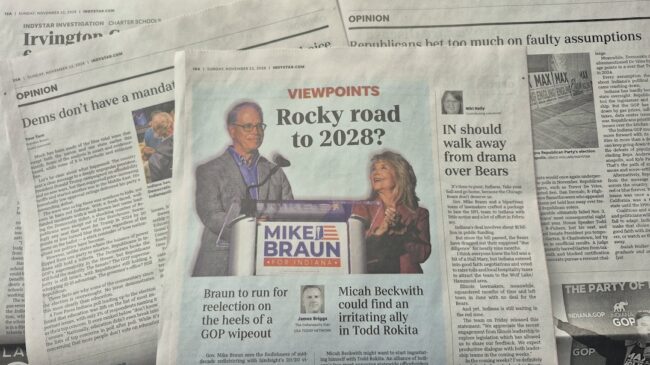
I have been interested in IndyStar’s opinion section ever since I learned from its editor, James Briggs, that it is one of the most-read sections of the paper and a reason people renew their subscriptions.
This fascinated me because, historically, the opinions of columnists have made people cancel their subscriptions. And, opinions dominate our world. Everyone has a hot take, from celebrities to 24-hour cable news pundits, to the influencer with a massive social media following.
In other words, we’re bombarded with viewpoints. By contrast, we are bereft of local information. Could it be that local opinions, curated by an editor, can help bridge that gap?
First, a quick bit of newspaper history and terminology.
Editorial pages were the section in the newspaper where the editorial board, made up of the paper’s leadership, voiced the official opinions of the paper and its publisher. They would endorse political candidates and advocate for policy changes. Opinion sections, commonly called “op-ed” because they ran on the page opposite the editorial section, featured columnists and points of view of people in the community.
Over the past two decades, newspaper staff have dwindled, with economic turbulence leading to rounds and rounds of layoffs. Editorial boards and opinion columnists were some of the first to be cut. Also, many newspaper executives and owners have been less enthusiastic about taking heat for political endorsements in an increasingly polarized society.
Many veteran journalists bemoan the loss of editorial boards, citing them as the only real “weapons,” besides investigation teams, that papers had for effecting change in a community and holding those in power to account.
“In my view, the community wants leadership, wants an authoritative voice, and editorials are the best way to do that,” said Ken Paulson, a former editor-in-chief of USA Today.
As top editor of four major daily newspapers and as a former president of the American Society of Newspaper Editors, Paulson witnessed newspapers across the country scrap their editorial boards.
“I think they’re both beneficial,” he said of editorial boards and op-ed pages. “But too many newspapers have subbed the op-ed page for editorials and that, in my view, was a mistake.”
Paulson’s preference leans toward editorials. Without editorials and investigative reporting, Paulson said newspapers risk becoming just another community blog.
Essentially, IndyStar has eliminated the official editorials of the paper, replacing them with opinion columnists and contributing voices from the community. Other newspapers have stumbled into this transition less gracefully.
There was significant public backlash, when Washington Post owner Jeff Bezos infamously decided the newspaper would not endorse anyone in the 2024 presidential election. Although Bezos’ timing was suspect, he was not alone in arguing that political endorsements have outlived their usefulness.
IndyStar was less conspicuous than The Washington Post in adopting a new approach to its opinion section.
But Paulson argues that, when done well, authoritative editorials and endorsements help people work through their own thoughts on issues and candidates.
“Great editorials never told people what to think,” said Paulson, head of the Free Speech Center at Middle Tennessee State University. “They told people what was important to the community and why they felt a certain issue had to be resolved in favor of the men and women of that town.”
I did a Q&A with Indy Star’s opinion editor, James Briggs, so that we all can see how he curates the opinion section.
Q: What do you think is the role of an opinion columnist/section at a daily newspaper today?
Much the same as it’s always been: to drive conversations. Columnists make sense of the news, introduce ideas and advocate on behalf of a particular worldview. One thing that has changed, I think, is good column writing often looks more like analysis than a pure expression of opinion. In other words, a columnist today should aspire to make people smarter even as they’re seeking to persuade. Columns also should make people feel something — joy, anger, sadness or hope. They should include humor. In an increasingly algorithmic world, columns should stimulate critical thinking and put people in touch with their humanity.
Q: What is your current vision for IndyStar’s opinion section? What did the former section lack and what did it get right that you would like to continue?
This is still evolving. I’m immensely proud of what we’ve accomplished so far. I started my job in January 2024 with no staff or contributors. It was just me sitting around writing as much as I could. We built the section up to over a half-dozen regular columnists between staff and contributors. We expanded the Sunday print section to make room for all the great columns we’ve been publishing online. IndyStar has been publishing the highest volume of Indiana-focused opinion columns since at least the early-2000s.
We’ve lost some of that momentum this year as columnists have moved onto other roles and opportunities. That has provided an opportunity for my colleague Jacob Stewart and me to expand our own voices in the section. We’ve been doing more writing lately, which I’ve enjoyed. We have a lot to talk about, especially after the midterm elections. We’re still working to find the right mix of contributor voices and also determine how to expand into video, which is a massive growth area in media.
Q: How did you choose the current mix of columnists?
I’m looking for a few qualities in columnists. I mentioned before that analysis is important, so I’m looking for subject matter experts who can share insights on topics that people have shown us they care about, including education, urban planning and the economy. Economist Michael Hicks is the prototype. I’m also looking for compelling generalists. Rob Kendall, the radio host and podcaster, is a great example. Jeffery Tompkins fits into both buckets. Finally, I want engaging voices. People you’d actually want to talk to in real life, who enjoy lively discussions and don’t take themselves too seriously.
I’m pleased with the viewpoint diversity we’ve offered spanning center-left to center-right. We avoid the fringes. We try to publish columnists who agree on facts despite drawing different conclusions.
Q: You’ve written that you wanted “insightful writers who could offer rigorous good-faith analysis without fear of offending people.” Was there a trend or issue you observed that prompted this statement?
Opinion has to be provocative yet grounded in reality. That’s a difficult line to walk. Some people just want to say crazy things to get attention, and others just want to say smart things in a boring way. The latter instinct is especially common in Indiana, where there seems to be an aversion to causing offense. And I get it. There can be social and professional consequences to articulating sharp viewpoints on topics that people feel passionately about. But we need people to take those risks so we can grow as a society. People who are willing to embrace discomfort and earnestly work through disagreements in the public square are the people who counter bad-faith actors and move our city and state forward. I want IndyStar Opinion to be a platform for constructive debate.
Q: Gannett began eliminating editorial sections from its newspapers in 2022, but an opinion section prevailed at The Star. How did The Star manage to keep the section going, and why is that important? What purpose does the section serve in today’s media climate?
The company’s leadership has prioritized opinion in recent years. My hire in 2024 reflects that investment, as does our build-out. I couldn’t have grown this section if the company hadn’t committed to opinion. On top of the mission-driven case for opinion I’ve been making here, I’d say there’s also a business case for opinion. Strong opinion and analysis creates a special connection between us and our audience, which makes people want to join us as subscribers. I feel that connection from the people who reach out to share thoughts on what we’re doing.
Q: How do you distinguish the paper’s commentary and opinion columnists online when we are awash in online commentary from content creators and social media influencers?
We’re competing against every other way in which any person could be spending their time. That includes other news sites, Netflix or TikTok. Anything. We have to prove we’re worthy of attention by providing analysis and insights that don’t exist anywhere else. That can be Jacob sharing his first-hand expertise on how the Indiana Statehouse will move forward in the current political climate or me writing about Indianapolis’ education landscape based on my sourcing and experience as a parent.
Q: Do you think opinion columnists still resonate in spite of all of the sources of commentary online?
I know they do. Our audience shows me that every single day.
Did a friend forward you this email? Sign up for the newsletter here.
The Indy Public Editor is a grant-funded pilot project run by the Poynter Institute. This column is edited by Kelly McBride and copy edited by Lauren Klinger. The project is managed by Nicole Slaughter Graham with support from Amaris Castillo.
The views and opinions expressed are those of the author only and do not necessarily reflect the views of The Indiana Citizen or any other affiliated organization.