By Marilyn Odendahl
The Indiana Citizen
August 21, 2026
Although the 43-year-old Minority and Women’s Business Enterprise program was eliminated in the blink of an eye this summer, leaders of the Indiana Black Legislative Caucus concede the brewing fight to restore the initiative will be neither quick nor easy.
“This is going to be a long process,” Sen. Greg Taylor, D-Indianapolis, said. “This is going to be a tough process.”
The process the IBLC is focused on is litigation.
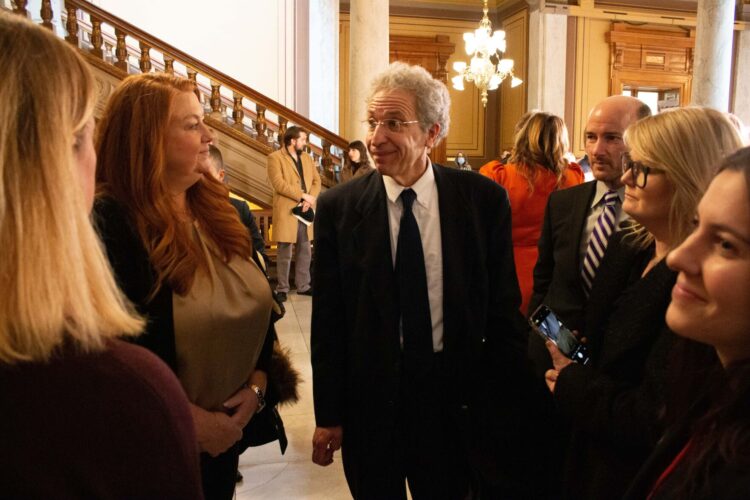
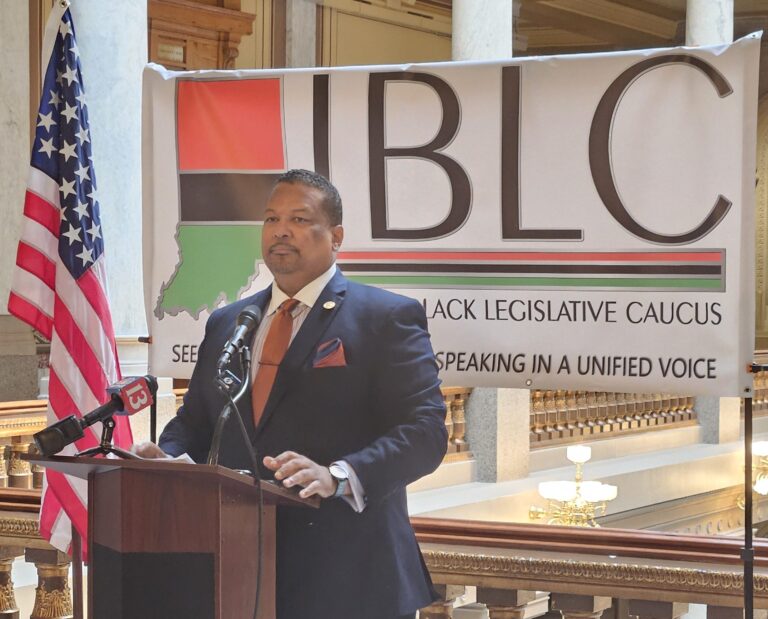
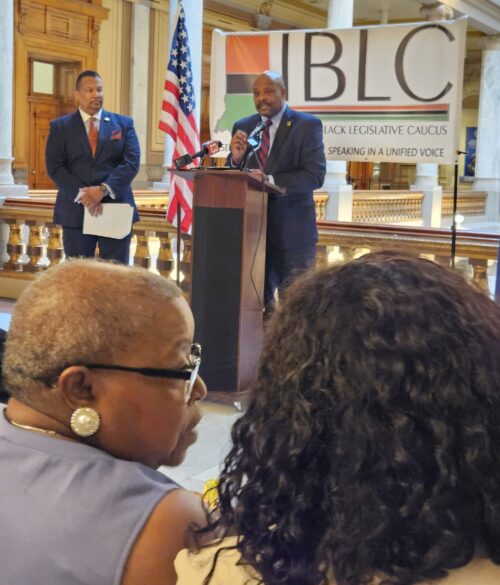
Convening a news conference at the Indiana Statehouse on Monday, Black lawmakers and community business leaders expressed their anger and frustration at Gov. Mike Braun and Indiana Attorney General Todd Rokita for ending the MWBE program. They disputed the inference that the initiative was a handout to businesses that otherwise could not compete in the free market, and they pointed out the program only established a goal of awarding about 8% of state contracts to minority- and women-owned businesses.
“The goal was to make sure qualified businesses had an opportunity to compete,” Rep. Earl Harris Jr., chair of the IBLC, said. “That matters because competition benefits the taxpayers of Indiana.”
As the IBLC defended the program, the lawmakers revealed they believe the way to get the MWBE initiative reinstated is to file a lawsuit against the state of Indiana. However, they need someone to serve as a plaintiff before a legal proceeding can be initiated.
Taylor asked minorities and women who own businesses and have been impacted by the governor’s action to contact a legislative member of the IBLC.
“We need someone and some businesses to come forward,” Taylor said. “This is illegal. Make no doubt that what has happened to small businesses in the state of Indiana needs to be addressed. … We address it by people coming forward to talk to their legislators about what has happened to their small businesses.”
In a coordinated action on the morning of July 15, Braun and Rokita issued their own press releases, announcing the end of the MWBE program. The governor and the state’s top lawyer said Indiana was ending race- and sex-based contracting preferences and implementing a merit-based approach.
Underpinning the swift elimination of the MWBE program was Rokita’s formal advisory opinion, detailing both what he said were the legal problems with the diversity effort and why the governor could bypass the courts and the legislature and unilaterally order the Indiana Department of Administration to discontinue the initiative. Rokita pointed specifically to the U.S. Supreme Court’s 2023 ruling in Students for Fair Admissions Inc. v. President & Fellows of Harvard College, which blocked the use of affirmative action in college admissions, to support his argument that the race- and sex-based preferences in the MWBE initiative are discriminatory and violate the Equal Protection Clause of the 14th Amendment.
Braun’s executive order immediately suspended the Supplier Diversity Program, which included the MWBE program, and halted all pending and active certifications of businesses to participate in the program. Also, while allowing all existing state contracts with minority- and women-owned business participation to “remain in full force and effect,” Braun ordered the guidelines for awarding future contracts to be amended and reissued without the supplier diversity commitment.
“Our Constitution mandates equal protection under the law, because a system where the government picks winners and losers on the basis of race or sex can never be fair,” Braun said in his press release. “Indiana has replaced divisive, politically-charged programs with a focus on Merit, Excellence, and Innovation: a level playing field where every single Hoosier has the chance to get ahead with hard work.”
Speaking at the IBLC news conference, Tony Mason, president and CEO of the Indianapolis Urban League, called upon Braun to provide more answers. Mason wanted to know the criteria for merit, excellence and innovation, and he wondered if the governor had sought input from Black lawmakers and chambers of commerce before dismantling the MWBE program.
“I still have to ask another question: Why the change? With no disparity study, no data, why the change?” Mason asked. “Well, let me just say this: We have some ideas and speculations on why the change.”
Taylor dismissed Rokita’s reliance on the Students for Fair Admission ruling, which focused on students getting into college.

Instead, he pointed to a 2003 decision from the 10th U.S. Circuit Court of Appeals, which centered on a dispute about the constitutionality of a minority- and women-owned business enterprise program for public contracts in Colorado. In Concrete Works of Colorado v. City and County of Denver, the federal appellate court upheld the program, finding the municipality demonstrated compelling and important interests in remediating racial and gender discrimination within the construction industry. Moreover, the court found the affirmative-action initiative was “narrowly tailored.”
“There’s a case that specifically discusses contracts and remedying of past discrimination in contracts, and he left it out of his decision,” Taylor said of Rokita and his advisory opinion.
Taylor also took issue with Rokita’s assertion that the governor had the power to halt a program that was created by the legislature and put into state law.
“Does the governor have the authority under an Indiana code or Indiana Constitution to eliminate an entire program that is in the Indiana Code and in the rules promulgated in the Indiana Administrative Code?” Taylor asked rhetorically. “We say no.”
In his 43-page advisory opinion, Rokita reached a different conclusion.
The attorney general argued a governor can decline to execute or implement a state law under two conditions.
First, the statute is “clearly unconstitutional.” Rokita indicated the Indiana Code establishing and implementing the MWBE program has become unconstitutional because of “changed circumstances and new developments in the law.” In particular, he pointed to the U.S. Supreme Court’s decisions overturning race-based initiatives not only in the college admission process but also in protecting the rights of minority voters with such landmark cases as Shelby County, Ala. v. Holder and Louisiana v. Callais.
Also, Rokita goes further and argued the governor is justified in declining to implement the MWBE program because the statute “inflicts an egregious deprivation of individuals’ constitutionally protected rights.”
Second, the statute’s constitutional violation is likely to continue without the governor’s intervention. The attorney general asserted that a judicial review or legislative amendment to correct the error is either unavailable or “in some way impaired.”
Rokita contended the governor can take action because the other branches do not appear to be remedying the error. His office has not found any cases filed in Indiana courts that have addressed the constitutional question of the MWBE statute. Also, he noted, while the law has been amended during recent legislative sessions, the General Assembly has not shown an inclination that it will eliminate the program’s unconstitutional provisions.
Moreover, Rokita asserted racial and sex-based preferences inflict a “stigmatic harm” on minority and women business owners. The MWBE program can stamp the participants as inferior and unable to compete in a meritocratic system, and can violate the Equal Protection Clause, because everyone is not being treated the same.
“Race-and sex-based preference programs of course operate as the expense of individuals who do not qualify for the preferences,” Rokita wrote in his opinion, referring to the Students for Fair Admissions ruling. “A program that grants government preferences to certain races and one sex over other races and the opposite sex harms member of the races and sex that are not granted the preferences.”
Harris and Taylor of the IBLC said Braun canceled the MWBE program without doing any kind of study or collecting any data on where the disparities are and the economic consequences for dismantling the initiative. They pointed out that a study has been conducted on the program every five years to measure its impact and effectiveness, but Braun scrapped the contract for that research.
The last disparity study was completed in 2020 under Gov. Eric Holcomb’s administration.
“If the administration believes its new approach is better, then show us the data,” Harris, D-East Chicago, said. “Show us how Indiana businesses, minority-owned, women-owned and all qualified businesses, will have a fair opportunity to compete. This should not just be about politics. It should be about building the strongest possible business environment for Indiana.”
Rep. Robin Shackleford, D-Indianapolis, said the MWBE program actually provided access to the places where business deals can happen but minorities and women are not always welcomed. Being at country clubs, golf courses and poker games can help, especially small businesses, get noticed by larger companies that have state contracts.

The program was a “solution to the challenges” of getting access, Shackleford said. Now, minority and women business owners will have to develop new strategies for connecting with and selling their products and services to the companies being awarded state contracts.
Shackleford acknowledged the minority- and women-owned businesses that had participated in the program could still maintain the partnerships and still subcontract for larger white-owned companies. Still, she said, without the governmental incentives to work with the small businesses owned by women and minorities, the enterprises with majority white ownership will be less likely partner to with people who do not belong to their country club or church.
“The (MWBE program) guaranteed it would happen,” Shackleford said of minority- and women-owned businesses gaining access. “Now you’re working on hope and prayers.”
Dwight Adams, an editor and writer based in Indianapolis, edited this article. He is a former content editor, copy editor and digital producer at The Indianapolis Star and IndyStar.com, and worked as a planner for other newspapers, including the Louisville Courier Journal.
The Indiana Citizen is a nonpartisan, nonprofit platform dedicated to increasing the number of informed and engaged Hoosier citizens. We are operated by the Indiana Citizen Education Foundation, Inc., a 501(c)(3) public charity. For questions about the story, contact Marilyn Odendahl at marilyn.odendahl@indianacitizen.org.