By Marilyn Odendahl
The Indiana Citizen
November 25, 2026
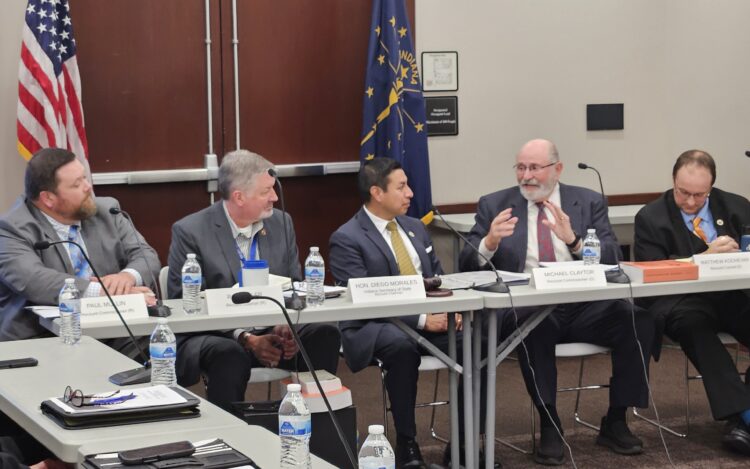
More than two weeks after the 2026 midterms, the Indiana Election Commission met on Nov. 20 to review four campaign-finance complaints filed in July and September against the two major-party candidates running for secretary of state.
One of the complaints lodged against Republican Max Engling and his campaign, Max for Indiana, had been filed by Knox County Circuit Court Clerk Dave Shelton and was the impetus of an October lawsuit trying to force the Election Commission to hold a hearing on all the complaints prior to Election Day.
The lawsuit, filed by Greg Ballard, Lincoln Party candidate for secretary of state, was dismissed on Nov. 19. Ballard had argued that the commission’s failure to meet and address the complaints was depriving him, as a candidate, and Hoosier voters of “the timely enforcement of Indiana’s campaign finance laws in a contest for the office that oversees Indiana’s elections.”
However, the Marion County Superior Court denied Ballard’s request for a preliminary injunction to order the Election Commission to convene a meeting. Judge Jennifer Prinz Harrison noted, in part, in her Oct. 26 ruling, that the commission had already provided public notice of the Nov. 20 meeting and Ballard had not offered any evidence explaining why that meeting would not be sufficient to review the pending allegations of campaign finance violations.
Ballard filed a one-page stipulation of dismissal on Nov. 19, which the trial court granted the same day.
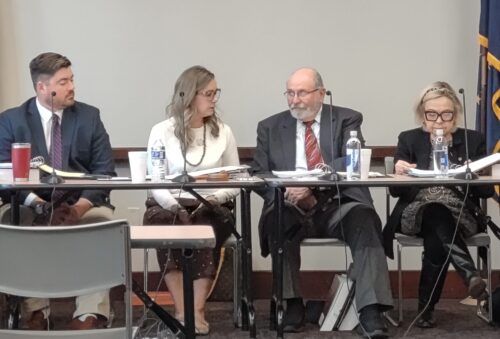
At the Nov. 20 meeting, the four-member commission spent nearly an hour determining the procedure for how they would hear and act upon the complaints. The members offered motions and amendments to the motions and searched through the Indiana Code to figure out what to do.
The Election Commission members eventually agreed to a two-step process. In the first step, the commission would hear from the parties involved and decide whether the complaints provided a “substantial reason” to believe campaign finance laws were violated. If the members determined a violation may have occurred, then they would move to step two and investigate, which would include taking testimony from the parties.
The Election Commission then reviewed and made determinations on two complaints filed against Engling as well as two filed against Democrat Beau Bayh, now secretary of state-elect. Also, the commission members cleared a backlog of at least 34 complaints filed against candidates, campaigns and political action committees dating back to 2014.
Commission Chair Beth Boyce publicly thanked co-general counsels for the Election Division, Republican Ron Miller and Democrat Matthew Kochevar. The two attorneys dug through Indiana Election Division records and compiled the list of complaints that had never been resolved by the commission.
Republican commission members Boyce and John Westercamp were appointed by Gov. Mike Braun in 2025. Democratic members Suzannah Overholt and Karen Celestino-Horseman had been appointed in 2012 and 2021, respectively.
Boyce said she did not want to disparage or comment on the work done by previous members of the commission, but she noted Miller and Kochevar undertook “a large effort to go back and try to clean up” some of the complaints that had sat unresolved for a long time.
“I do appreciate all your work,” Boyce told Miller and Kochevar.
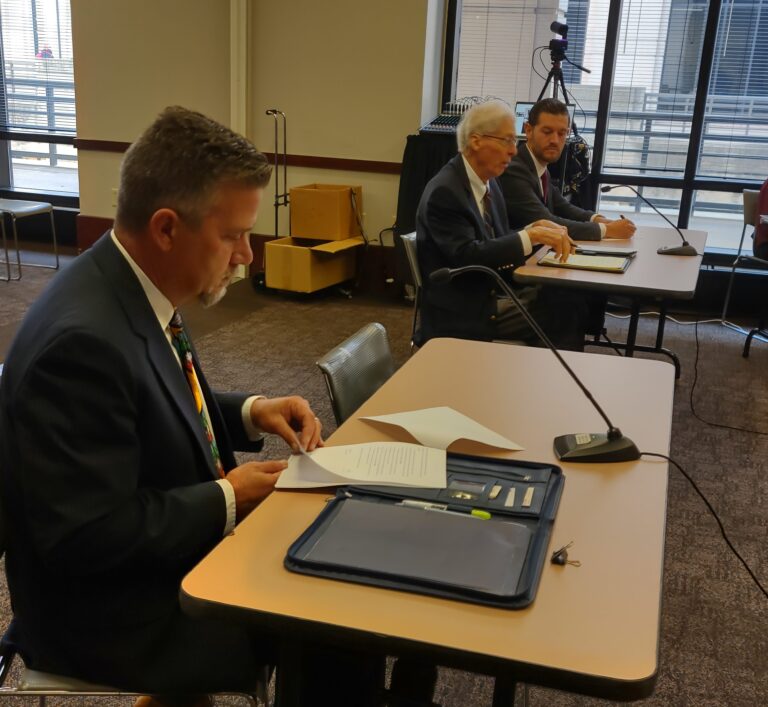
Shelton, who lost the GOP nomination to Engling at the Indiana Republican State Convention in June, filed his complaint on July 24, alleging a $60,000 contribution from Hoosier Leadership for America Inc. to Engling and his campaign exceeded the $5,000 annual limit on political donations by corporations. In addition, Shelton alleged the Engling campaign misclassified the corporate donor as an “other organization,” a designation which has no cap on contribution amounts.
Engling and nationally-known conservative attorney James Bopp appeared before the Election Commission on Friday.
In the response filed with the Indiana Election Commission on Oct. 16, Bopp argued Engling and his campaign did not violate any state campaign finance laws by accepting the contribution. The campaign did not know Hoosier Leadership was a nonprofit corporation at the time the donation was made on June 30, he asserted, and did report the money to the Indiana Election Division as required.
Only when Hoosier Leadership requested a refund on July 10 did the Engling campaign learn the entity was a nonprofit corporation, Bopp said.
Moreover, the $5,000 cap applies solely to corporations making political contributions and not to the campaigns receiving the donation, Bopp asserted, citing to Indiana statutes.
Engling’s response also included a declaration by Derek Hugo, manager of Three Point Advisors, which provided campaign finance reporting services to the “Max for Indiana” committee. The declaration included copies of a bank statement, Hoosier Leadership’s request for a refund and the outgoing wire transfer showing the $60,000 was returned.
Saying the bank documents that had been provided answered his questions, Shelton told the Election Commission he was withdrawing his complaint against Engling and the Engling campaign.
After his portion of the commission meeting, Shelton said the dates cited in the declaration aligned with Engling’s quarterly campaign finance reporting.
“As an election administrator, it is a concern of mine the amount of dark money that comes into our elections,” Shelton said. “I believe Hoosiers have a right to know where the campaign funding is coming from for our candidates.”
In a statement posted on social media, Engling slammed the complaint and said the commission’s decision to dismiss the allegations showed his campaign had acted properly.
“For months Mr. Shelton and Mr. Bayh publicly accused our campaign of illegal conduct while misrepresenting the facts of the alleged infraction,” Engling wrote on X. “Those accusations were false – adding to their pattern of, and willingness to, put false political attacks ahead of the truth. Unfortunately for them, campaigns have a way of revealing character. And in this instance, both men came up short.”
However, Shelton’s complaint against Hoosier Leadership still stands.
The Election Commission held off reviewing those allegations because the 501(c)(4) corporation “was mistakenly not timely notified of the complaint,” Miller, the Republican general counsel, said. Miller said Hoosier Leadership did not receive notice of Shelton’s claim until a few weeks prior to the commission meeting and, therefore, the organization has not had an enough time to respond
Commission members debated whether they could proceed without Hoosier Leadership being present. They talked about the possibility of reviewing the complaint to determine whether further investigation was warranted and then asked Bopp for advice.
Bopp recommended the commission wait until Hoosier Leadership could attend a subsequent meeting. Subsequently, the commission tabled that portion of Shelton’s complaint.
Hoosier Leadership for America is also included in a second complaint filed by Chris Douglas against the Engling campaign.
According to Douglas’ complaint, the nonprofit corporation sponsored a reception featuring Engling and U.S. Sen. Jim Banks, R-Indiana, for delegates at the Indiana State Republican Convention. The Engling campaign did not report any spending or in-kind contribution related to his hospitality suite, presumably paid for by Hoosier Leadership, Douglas said in his complaint.
Douglas requested the Election Commission investigate how much Hoosier Leadership for America spend on the event and order Max for Indiana to amend its campaign finance report to accurately report this in-kind contribution.
At the Nov. 20 meeting, the Election Commission did not review the complaint. Douglas could not appear because of a death in his family, so the commission members unanimously granted his request for a continuance.
The Election Commission also unanimously dismissed the two complaints filed against Bayh. Both raised allegations of improper reporting of in-kind contributions.
Michael Neal alleged Bayh did not report in-kind donations related to political events, such as local Democratic party dinners with Bayh as the featured speaker. In addition, Neal asserted Bayh had not included the proper disclaimer on some campaign materials.
Before the meeting, Neal had withdrawn his complaint. The Election Commission then voted to dismiss Neal’s complaint.
The complaint Danny Shields lodged against the Bayh campaign raised similar concerns about unreported in-kind contributions made as part of meet-and-greet events and dinners at which the then-Democratic candidate was a special guest.
The commission unanimously dismissed the complaint as well.
Bayh did not attend the Election Commission meeting but two representatives of his campaign were present and prepared to answer questions. However, the Shields complaint was dismissed without the commission asking for more information.
Both of Bayh’s representatives declined to speak with the media.
The backlog of complaints that had been filed with the Election Commission dated as far back as 2014 and included a variety by allegations.
Some alleged disclaimers were allegedly not placed on advertising, errors were made in reporting campaign contributions and in-kind donations, finance reports were not filed on time, and political action committees were not properly registered. Also, the complaints cited some particular allegations, such as a county’s election board website included a link to a candidate’s webpage, a candidate using a raffle to induce voters to call his campaign, and allegations that irregularities were observed in the processing of early voting in Vanderburgh County.
At the time each complaint was filed, the response of the Election Commission varied, but mostly the allegations were left unresolved. Some of the candidates or individuals alleged to have made a violation were notified and in few cases, both parties responded to the commission’s questions and some of the parties appeared before the commission.
The current members of the Election Commission unanimously approved a motion dismissing all the backlogged complaints. The dismissals were made because of the complaints were old or did not state an alleged violation of election law or the commission lacked jurisdiction.
Dwight Adams, an editor and writer based in Indianapolis, edited this article. He is a former content editor, copy editor and digital producer at The Indianapolis Star and IndyStar.com, and worked as a planner for other newspapers, including the Louisville Courier Journal.
The Indiana Citizen is a nonpartisan, nonprofit platform dedicated to increasing the number of informed and engaged Hoosier citizens. We are operated by the Indiana Citizen Education Foundation, Inc., a 501(c)(3) public charity. For questions about the story, contact Marilyn Odendahl at marilyn.odendahl@indianacitizen.org.