By Marilyn Odendahl
The Indiana Citizen
November 13, 2026
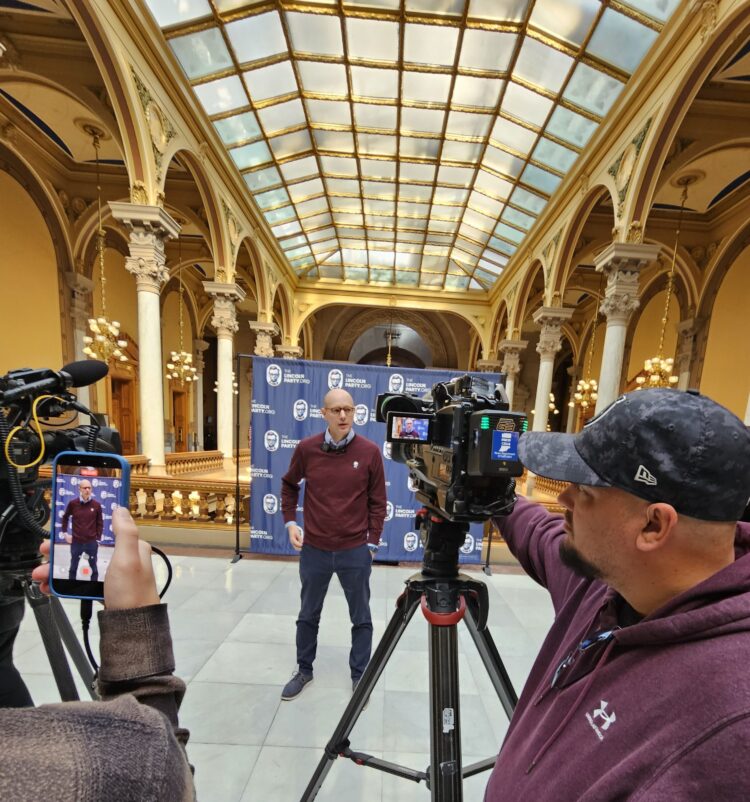
Two days after his Lincoln Party finished a distant third in the race for Indiana secretary of state, Nathan Gotsch declared politics in the Hoosier State has been changed.
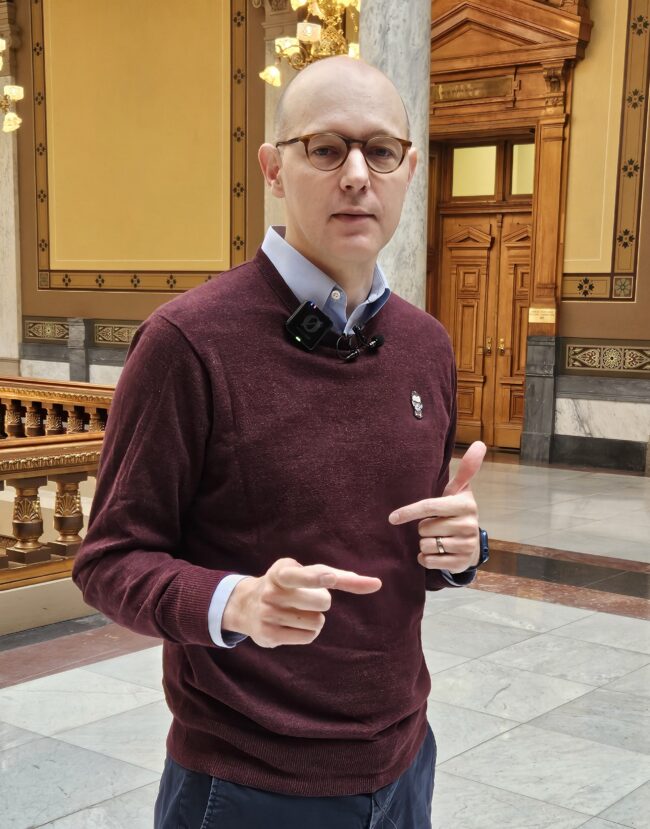
“Every single elected official in Indiana now has been put on notice, because the Lincoln Party will be able to run candidates anywhere statewide,” Gotsch, founder and chair of the Lincoln Party, said at a news conference following the midterm election. “If they’re not listening to their voters, even if they’re in what they thought was a safe seat, they could have a challenge from one of our party members going forward.”
Gotsch’s confidence comes from the 3.6% of the vote the Lincoln Party garnered in the 2026 midterm election. Under state statute, a political party that meets or exceeds 2% of the vote in the secretary of state race can place candidates for any office on the ballot in future elections without having to collect an onerous number of signatures from registered voters.
However, the hard work to become a viable political party is just beginning.
Municipal elections in 2027 and the presidential election in 2028 will provide plenty of opportunities for the Lincoln Party. Yet to even get on the ballot, the independent political upstart will have to identify races where it can do well, recruit candidates for those races, court donors, raise money and keep introducing itself to voters all the while hoping the Indiana General Assembly does not take action to hinder third parties or independents running for office.
Moreover, the Lincoln Party will have to outrun history to avoid becoming a footnote in Indiana political lore.
“We have a system that is set up for third parties not to be successful unless there is a major upheaval,” Chad Kinsella, associate professor of political science at Ball State University, said. “I don’t think we’re at that time.”
The Republican Party was able to become a mainstay in American politics because the Whig Party fractured in the 1850s when the members could not agree on whether to support or oppose slavery. In the 1990s, the Reform Party was established following Texas billionaire Ross Perot’s 1992 presidential campaign in which he finished third after capturing 19% of the vote. However, other than former pro wrestler and actor Jesse Ventura’s surprise win in the Minnesota gubernatorial race in 1998, the party has struggled to consistently field strong candidates and win elections.
Kinsella sees the Lincoln Party as benefiting from the backlash within the GOP over the MAGA movement and from having former Indianapolis Republican Mayor Greg Ballard, who was popular during his time in office, run as the Lincoln candidate in the Indiana secretary of state race.
“Depending on what happens in 2028, the Lincoln Party may just morph back into the Republican Party if the Republican Party becomes less extreme, maybe less MAGA,” Kinsella said.
Gotsch acknowledged that Hoosier Republicans are especially open to the alternative offered by the Lincoln Party, but he is still confident Hoosiers across the state, whether affiliated with a political party or not, want moderate candidates who can provide competition in elections.
The attention independent candidates have gotten at the ballot box in Indiana is underpinning Gotsch’s conviction.
In particular, he pointed to the results of a survey his nonprofit, Independent Indiana, commissioned in 2025 which showed nearly 90% of Indiana voters were willing to support an independent candidate running for office. Also, he highlighted Indiana’s 2023 and 2024 elections in which 244 independent candidates ran and 52% won.
Gotsch, himself, ran as an independent for Indiana’s 3rd Congressional District in 2022. Like Ballard in the secretary of state race, he finished a distant third with 4.7% of the vote, which was dwarfed by the 30.1% received by Democrat Gary Snyder and the 65.3% garnered by the winner, Jim Banks.
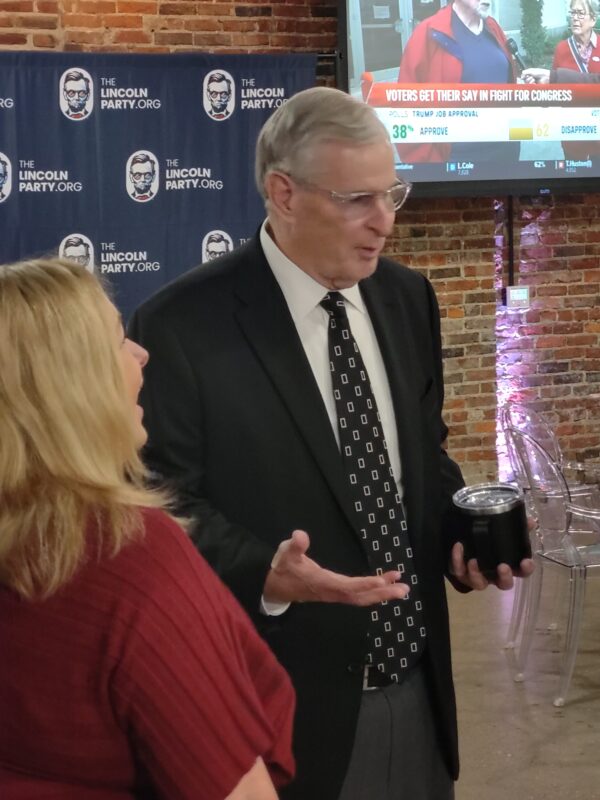
Speaking to Ballard supporters who had gathered in downtown Indianapolis to watch the results of the 2026 midterm election, Gotsch explained his reason for launching the Lincoln Party.
“I grew frustrated at the downward spiral of our politics,” Gotsch said. “Every election, we were promised this was going to change and yet we kept ending up in an even worse place, angrier, more divided, and with no end in sight. And in that moment, I realized there was an obvious answer. We needed a new political party, a party for normal people.”
Aaron Dusso, associate professor of political science at Indiana University Indianapolis, noted to have any kind of success, the Lincoln Party will have to overcome the psychological attachment American voters have to the major parties. The electorate so strongly identifies with being either a Democrat or Republican, he said, that they choose to live in communities and neighborhoods that exhibit the same partisanship and marry people with the same political views.
“These are all the things that seemingly have nothing to do with politics and yet, people go on a blind date and (they) find out (their date) is from the wrong party and it’s like, ‘Well, forget about it. I can’t date that person anymore,’” Dusso said. “It’s part of who we are.”
Gotsch is careful to distance the Lincoln Party from the label of “third party.” He conceded third parties have traditionally not fared well because Democrats and Republicans are so entrenched in the political landscape.
Consequently, Gotsch is positioning the newcomer to be a second party. Too often, he said, general elections in Indiana have just one candidate running for each office, so he wants the Lincoln Party to enter those kinds of races in order to give Hoosier voters a choice.
Gotsch pointed to the 2026 race for Indiana House District 65, which includes portions of Lawrence, Orange, Washington, and Jackson counties, as an example. Independent candidate Sean Steele challenged incumbent Republican Rep. Chris May and, despite lacking funds and the campaign assistance usually provided by the major parties, Steele captured 43% of the vote in the race that May won with 57%.
“Those are the kind of races that in 2028 and beyond the Lincoln Party wants to be part of,” Gotsch said. “Those one-party rural races, those so-called safe seats where the community is like, ‘No, this is not good for us. We want a competitive general election. We want a high-quality candidate. We want a real choice at the ballot box.’”
The Lincoln Party’s birth and Ballard’s tantalizing run caught the attention of Washington Post political columnist George Will. In a piece published before the Nov. 3 midterm election, Will described the Lincoln Party as a new instrument that can be used to challenge the two-party duopoly.
“Greg Ballard’s quest to become Indiana’s secretary of state will fall short on Tuesday,” Will wrote. “But the state’s two-party duopoly has been put on notice: A permanent challenge has been born.”
Ball State’s Kinsella does not share Will’s optimism.
The Democratic and Republican parties have been around for a long time, in part because they have changed to meet their voters’ needs and expectations, Kinsella said. In addition, the two major parties have money and donors.
“Kudos to the Lincoln Party for even getting on the ballot, because in a lot of states it’s even harder for third parties to get on the ballot,” Kinsella said. “The rules, the whole entire system really is set up against third parties.”
Ballard raised $1.4 million during his run as the Lincoln Party candidate for secretary of state, according to campaign finance reports. Democrat Beau Bayh, the winner of the race, reported $7.9 million in contributions, while Republican Max Engling reported $3.5 million and Libertarian Lauri Shillings reported $52,460.
Gotsch sidestepped a question about the Lincoln Party’s financial health, saying every dollar the party has raised and will raise will be available in the public campaign finance reports, and, instead, focused on what he said will be the key to long-term viability: the candidates. To succeed, he said, the party has to recruit “really high-quality” people to run.
“In these first few cycles, we’re going to be really careful and cautious about the races that we get in,” Gotsch said, “because we want to make sure that people understand that the Lincoln Party is about high-quality candidates who are out to fight corruption and increase that accountability.”
Dwight Adams, an editor and writer based in Indianapolis, edited this article. He is a former content editor, copy editor and digital producer at The Indianapolis Star and IndyStar.com, and worked as a planner for other newspapers, including the Louisville Courier Journal.
The Indiana Citizen is a nonpartisan, nonprofit platform dedicated to increasing the number of informed and engaged Hoosier citizens. We are operated by the Indiana Citizen Education Foundation, Inc., a 501(c)(3) public charity. For questions about the story, contact Marilyn Odendahl at marilyn.odendahl@indianacitizen.org.