By Tom Davies
Indiana Capital Chronicle
November 9, 2026
Frustrated by more than a decade of near irrelevance, some Indiana Democratic legislators sensed more than a year ago that they had a breakthrough opportunity with the 2026 midterm election.
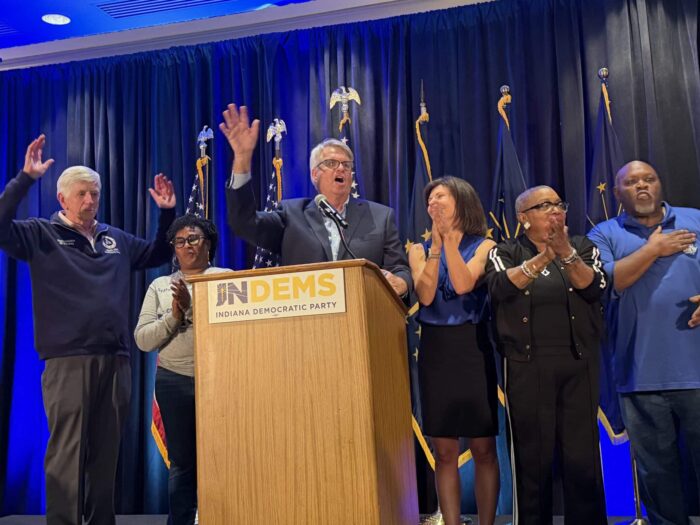
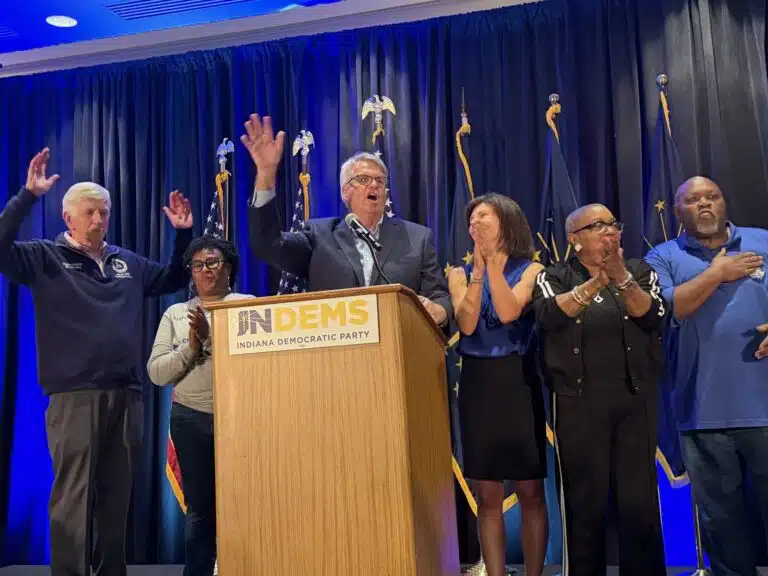
Their strategy — more candidate recruitment, better fundraising and strategic spending — paid off as the national Democratic wave helped the party gain 16 Indiana House seats, which included a reelection loss for Republican House Speaker Todd Huston.
Republicans will still hold a 54-46 House majority for the 2027 legislative session — but the Democratic seat flips amount to the most from a single election in more than 50 years.
Here’s at look at how Democrats pulled it off:
Democrats were on the ballot in 97 of the 100 state House races this year after they fielded no candidates for 26 districts in the 2024 election.
Democratic House Caucus Chair Carey Hamilton said it was a “very intentional” goal to fill as many ballot spots as possible. That intense recruiting began in the spring and summer of 2025.
It involved talks with county party officials, along with local civic leaders, teacher groups and labor unions, the Indianapolis representative said.
“We were reaching out to our networks across the state, and letting them know we were going to be fighting really hard in ’26 and needed great people running,” Hamilton told the Capital Chronicle.
One such candidate was Misti Meehan, who ran against eight-term Republican Rep. Bob Morris of Fort Wayne after he faced no challengers in either the 2022 or 2024 elections.
Despite being a former Allen County Democratic chair, Meehan received no money from state party committees. She unseated Morris with 51% of the vote, even though she had less than $10,000 in campaign cash. Morris had more than $200,000.
“Everybody was, ‘Hey, try to get 45%,’ and I’m like, ‘No, I’m going to try to win,’” she said in an interview.
Meehan said she was motivated to run after “watching all the money get sucked out of public schools” and safety-net programs while Republicans touted the growing state budget surplus.
“I think as these things are coming to fruition and being enacted and the actual effects of some of this are hitting our communities, people don’t like what they’re seeing,” she said. “I think that provoked people to show up.”
Voters also gave Democrats wins in suburban Indianapolis districts that Republicans had held continuously back to the 1970s or longer, according to a database maintained by the political history website Capitol & Washington.
Democrats won in a cluster of north suburban districts — including Huston’s seat — in an area that had become more competitive over the past few election cycles.
But three little-known Democrats stunned even party leaders by knocking off incumbent Republicans Bob Behning, Julie McGuire and Andrew Ireland in what had been solid Republican districts in southern Marion County.
Those three Democrats combined for less than $20,000 in campaign fundraising and didn’t get any financial boosts from state party sources, according to filings with the Indiana Election Division.
Mike Murphy, who was a GOP legislator from southern Indianapolis for 16 years until 2010, said the possibility of those seats flipping “wasn’t on anybody’s radar.”
Murphy said many voters were clearly out to repudiate President Donald Trump.
“For whatever reason you want to be mad at Trump, you can’t vote against him this time,” Murphy said. “So what do you do? You take it out on the next Republican down the line.”
Republicans didn’t run challengers this year against 20 incumbent Democratic House members, including 10 from Indianapolis and five from northwestern Indiana’s Lake County.
Murphy said it was smart for Democrats to be poised with candidates across the state for a wave election in their favor.
“There’s an old saying in politics: you can’t win with nobody,” he said.
Democrats have languished with little influence in the House since Republicans captured a supermajority with the 2012 election.
By having more than two-thirds of the House membership, Republicans could have taken action on bills even if the Democratic members weren’t present.
“Breaking the supermajority” was a consistent goal that Democrats had missed in seven straight elections since then, with Republicans holding 70-30 margins after both the 2022 and 2024 elections.
As this year’s election grew near, Democrats saw poll results in the Indianapolis suburb of Fishers that startled them, said Rep. Ed DeLaney of Indianapolis.
“It was just amazing how strong the Democrats were,” DeLaney said.
Dem challenger defeats Indiana House GOP leader in stunning upset
Those numbers for an area making up much of Huston’s district — and word that the Republican speaker was apparently worried enough to do door-to-door canvassing after not having a Democratic opponent in 2024 or 2022 — sparked a decision to go after him.
The House Democratic campaign leadership directed nearly $250,000 in late October for advertising against Huston.
One TV ad labeled Huston as “the man pulling all the strings in Indiana,” criticizing him for the state’s data center policies, gas tax increases and property tax changes blamed for reduced school funding.
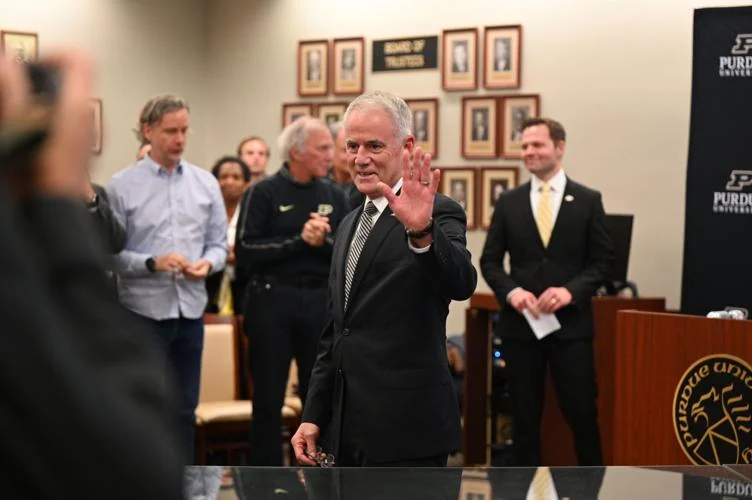
Huston lost his bid for an eighth term in the House as Democrat Lauren Cole received 51.5% of the vote.
“This was a conscious attempt. It was not a smart aleck move to force him to waste money,” DeLaney said. “It was an attempt to dethrone him and it worked.”
Huston said in a concession statement that he was “incredibly proud of the progress we’ve made in Indiana to grow our economy, bring good-paying jobs to our state, lower taxes and create thriving communities.”
“This was an incredibly challenging midterm election and ultimately the national headwinds were too difficult to overcome in a number of our races,” he said.
That same polling prompted Democrats to go bigger in a neighboring district where they pumped in some $300,000 in advertising money during October to help Stephanie Jo Yocum defeat GOP Rep. Chris Jeter of Fishers by eight percentage points.
House Democratic Leader Phil GiaQuinta of Fort Wayne said the day after Election Day that he had been surprised by the campaign polling.
“Maybe I shouldn’t have been, because I go door to door myself, and I hear what Hoosiers have to say, and they were very frustrated,” he said.
The long Republican supermajority established years of campaign fundraising dominance as individuals, business groups and activist organizations were much more generous to the party they felt certain would control the legislative agenda.
House Republicans reported raising about $6.5 million for their main campaign committee through early October for this year’s campaigns.
Democrats, meanwhile, had raised about $2.5 million by Oct. 9. But that figure was about 50% more than the roughly $1.7 million their campaign arm raised for the 2024 campaign.
Republican cash advantage showing up with late spending in Indiana legislative races
Some of that came from convincing Indiana donors to support in-state candidates rather than sending money to states where they thought Democrats had better chances.
Hamilton said House Democrats ultimately had about $3.5 million with the help of national party groups.
“We’ve always believed that we didn’t need to raise as much as them, but we needed to raise enough to get our message out and to make sure voters understood what their choices were,” she said.
The prospect of Beau Bayh leading the Democratic ticket this year as the secretary of state candidate also factored into campaign planning.
That paid off as Bayh defeated Republican Max Engling by nine percentage points for the first statewide Democratic victory since 2012.
“We were prepared to ride a blue wave, but we were also prepared to deal with the benefits that Beau Bayh gave to us,” DeLaney said. “We knew we’d get more attention, more participation, because of his name and his candidacy.”
House Republicans picked Rep. Ben Smaltz of Auburn last week as their choice to take the speaker’s chair for the legislative session starting in early January.
Despite the much more narrow majority, Smaltz said Republicans were “still going to operate like a body in the majority.”
He also cited the “national headwinds” for the election losses suffered by state and local Republicans.
Indiana House Republicans pick new leader after big election losses
Democrats also gained five seats in the state Senate with last week’s election. Republicans will retain their supermajority with a 35-15 margin.
The 16 House seats gained by Democrats represent the largest single election jump by either party for the chamber since Democrats flipped 28 seats with the post-Watergate scandal election in 1974, according to the Capital & Washington database.
The last previous significant swing in legislative control came with the 2010 election, when Republicans flipped 12 seats to gain a 60-40 majority. They controlled redistricting in that cycle and added nine more seats in the 2012 election to establish the supermajority that lasted through 14 legislative sessions.
House Democrats say that while they are still in the minority, they expect to have more influence over state spending priorities, education policies and other issues than they have had for many years.
“We got hungry,” DeLaney said. “We had people that didn’t want to stay in this position.”
Indiana Capital Chronicle is part of States Newsroom, a nonprofit news network supported by grants and a coalition of donors as a 501c(3) public charity. Indiana Capital Chronicle maintains editorial independence. Contact Editor Niki Kelly for questions: info@indianacapitalchronicle.com.