By Marilyn Odendahl
The Indiana Citizen
October 16, 2026
Lincoln Party candidate Greg Ballard has filed a lawsuit, asking the Marion County Superior Court to require the Indiana Election Commission and its four members to convene a meeting this month to review four complaints that have been filed against two of his opponents in the race for Indiana secretary of state.
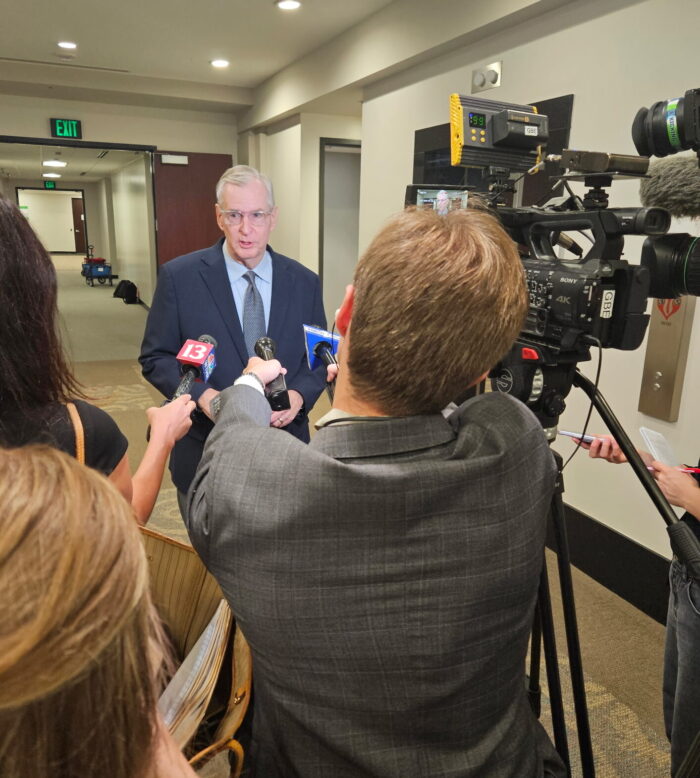
Speaking to reporters after delivering a notification of his lawsuit to the Indiana Election Division on Thursday, Ballard said he was not pushing the Election Commission to reach a specific conclusion on any of the complaints. Rather, he wants the commission to meet and review the complaints to determine whether any campaign finance violations have occurred and what, if any, penalties should be imposed.
“We are not asking for a particular outcome; that is entirely up to the commission,” Ballard said. “But we are asking the commission to do its job by holding a meeting on any complaints that have been filed to date and take action well before Election Day, so voters have all the information that they deserve. The Indiana Election Commission should convene a meeting, do its job, and get to work on behalf of Hoosier voters.”
Election Commission Chair Beth Boyce and member John Westercamp, both Republicans, did not respond to a request for comment on Ballard’s lawsuit and on whether a meeting would be called.
The Democratic members of the commission are Suzannah Overholt and Karen Celestino-Horseman. Overholt, who serves as vice chair, told The Indiana Citizen that the Election Commission has not decided as a whole to let the complaints go unexamined. Also, she said if the chairperson does not call a meeting, she as vice chair can convene a meeting if the other two commissioners give their approval.
“In accordance with those statutory provisions, I have asked Chair Beth Boyce if she is going to convene a meeting of the IEC to address the complaints and let her know that if she does not plan to do so, I will ask Commissioners Celestino-Horseman and Westercamp to approve my convening a meeting,” Overholt said in an email.
Celestino-Horseman agreed the Election Commission should meet to consider the four complaints.
“Anytime a complaint is filed, it should come before the commission,” Celestino-Horseman said. “People took the time to make the complaint and they are entitled to be heard.”
Ballard’s 11-page lawsuit focuses on two complaints filed against the Republican candidate Max Engling and two complaints filed against the Democratic candidate Beau Bayh. Each complaint was submitted by a different Indiana resident and each alleges the campaigns either misreported or failed to report some contributions.
In his lawsuit, Ballard is asking the trial court to issue an injunction or an order of mandate requiring that the Election Commission hold a public meeting, consider the four pending complaints and determine whether “there is substantial reason to believe” campaign finance laws were violated.
Ballard’s lawsuit said that state statute obligates the Election Commission to “expeditiously make an investigation” if election law is believed to have been violated. Indiana law does not require the commission to meet, but gives the chairperson the discretion to decide whether calling the members together is “necessary for the performance of the commission’s duties.”
Ballard argued in his lawsuit that the members have a “clear legal duty” to convene and while the chair has discretion as to when a meeting is necessary, that discretion does not extend to leaving “those duties unperformed until the election to which they relate is over.”
In his lawsuit, Ballard asserted the commission’s inaction permits Engling and Bayh to compete for votes in a tight race for secretary of state, while potentially benefiting from the “alleged violations that have gone unexamined.” As a result, Ballard said, he is being denied the “even-handed enforcement” of the state’s campaign finance laws.
“I want them to at least address it,” Ballard said of the complaints pending before the Election Commission. “If they dismiss them all, OK, it’s their call, not my call.”

Ballard is representing himself in his lawsuit, but he said a “fair number of lawyers” have looked at his complaint already. He said he would drop the lawsuit if the Election Commission met by Oct. 26, but he might look to hiring legal counsel if he moves forward with his litigation.
Filed on multiple exhibits, Ballard’s lawsuit comes just under three weeks before the Nov. 3 general election. Saying he was waiting to see whether the commission would meet, he brushed off criticism his lawsuit was a political move against his Republican and Democratic opponents in the secretary of state race.
“I’d suggest it was a political move on their part,” Ballard said of the commission members. “I’m just responding to it. It’s a political move not to meet. It’s a statement to not meet because they’re protecting their own parties.”
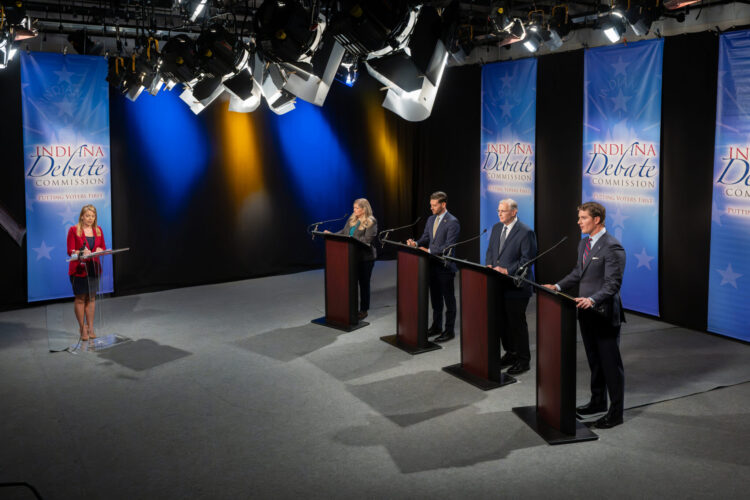
After he provided a copy of his lawsuit to the Election Division, Ballard called upon his opponents, Engling, Bayh and Libertarian Lauri Shillings, to join him in pushing the Election Commission to meet.
Both Shillings and Jack Tormoehlen, Bayh’s campaign manager, agreed with Ballard that the Election Commission should meet to consider the pending complaints. Shillings added that the commission might also be able to address other issues including forms with incomplete and confusing instructions and an Election Division website that, she said, keeps failing as candidates try to file paperwork before a legal deadline.
However, Shillings was skeptical of Ballard’s decision to go to court.
“I do feel the lawsuit is just another way that Ballard is proving he is a remnant of the old party system—with a frivolous lawsuit and no real intention of following through and is seemingly an effort to gain attention,” Shillings said.
Bayh’s campaign alleged that Engling was behind some of the complaints filed with the Election Commission but offered no evidence for that accusation.
“Max Engling accepted an illegal campaign contribution from a dark money group,” Tormoehlen said in an email. “His response was to file frivolous complaints in an effort to make a mockery of the system. Hoosiers are tired of a secretary of state who treats election law like a joke and don’t want more of the same from Max Engling.”
Engling was dismissive of the lawsuit and accused Ballard of not including a required disclaimer on the Lincoln Party’s website.
“Greg Ballard’s continued politicalization of government systems and the process in which they operate showcases he is unfit for this office,” Engling said, as reported by CBS4/FOX59. “Moreover, it is somewhat ironic that the only candidate that has been fined this election as well as the only candidate who currently has a political party violating the disclaimer law on their own website, is trying to grandstand on campaign compliance law.”
Engling’s allegation prompted the Lincoln Party to respond by saying it was not required by either state or federal law to put a “paid for by” disclaimer on the website. Still the political upstart did post a disclaimer on its landing page.
“Going beyond what the law requires, the committee will add ‘Paid for by the Lincoln Party State Committee’ to the website,” Nathan Gotsch, chair of the Lincoln Party, said. “The addition is voluntary and is not an acknowledgment that any disclaimer was ever required.”
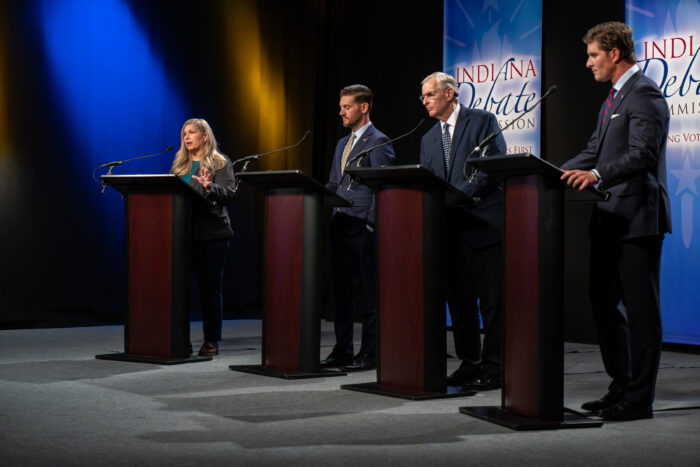
In court filings, Ballard detailed the four complaints which he wants the Election Commission to publicly review.
Ballard declined to comment on the specific complaints, instead reiterating that the reason he is suing was to get the commission to at least review them. He alleged the members were not meeting because holding a hearing on these complaints would not be in the best interest of the Republican and Democratic parties.
“It looks to me like the parties are protecting themselves again,” Ballard said. “Part of the system that I’ve been talking about is to ensure that they stay in power. People who want to run for office, who want to provide voters more choices, they can’t get in the game.”
Ballard did acknowledge that his campaign had run afoul of campaign finance laws by missing a reporting deadline for fundraising totals earlier this year. He described the reporting glitch as a “small error” and said his campaign paid the fine and then moved on.
The four pending complaints at the center of Ballard’s lawsuit are as follows:
Ballard’s lawsuit highlighted news reports that said the Election Division has requested the Engling campaign respond to the complaints filed but has not received a response to the Shelton complaint.
Also, the lawsuit said an Access to Public Records Act request was filed with the Election Division on Oct. 12 for materials related to the four complaints. The documents being sought include correspondence between the Election Commission and the political campaigns and correspondence about a proposed meeting of the commission.
Ballard said holding a meeting so close to Election Day would not be unusual, pointing to the 2022 midterm and the 2024 presidential elections when the commission convened in September to consider campaign finance enforcement matters.
“Each day the Commission fails to act, more Hoosiers cast final, irrevocable ballots for Secretary of State without knowing how the body charged with enforcing Indiana’s campaign finance laws has resolved the complaints pending against both major-party candidates,” Ballard said in his lawsuit.
Dwight Adams, an editor and writer based in Indianapolis, edited this article. He is a former content editor, copy editor and digital producer at The Indianapolis Star and IndyStar.com, and worked as a planner for other newspapers, including the Louisville Courier Journal.
The Indiana Citizen is a nonpartisan, nonprofit platform dedicated to increasing the number of informed and engaged Hoosier citizens. We are operated by the Indiana Citizen Education Foundation, Inc., a 501(c)(3) public charity. For questions about the story, contact Marilyn Odendahl at marilyn.odendahl@indianacitizen.org.