By Tracey Compton
Indianapolis Public Editor
October 7, 2026
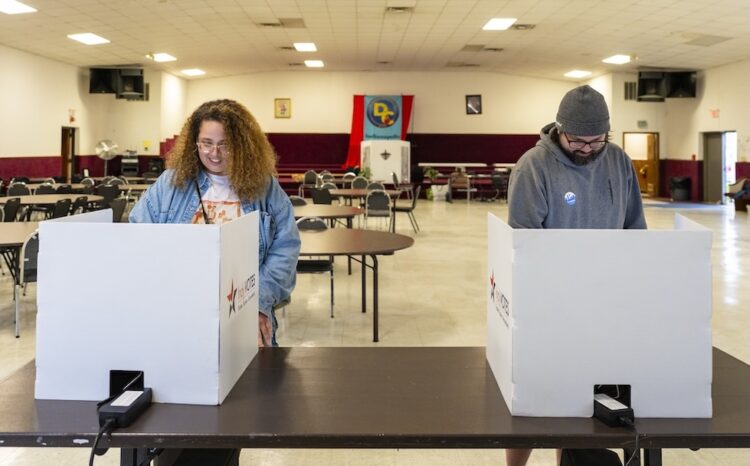
Voting in Indiana is not an easy process. Doing your civic duty requires optimism and nimbleness. There’s very little state voter education, and registration deadlines fall almost a month before the November 3rd election. We have one of the lowest voter turnout rates in the country because most races are not competitive. And, with a supermajority in the state legislature, many think their votes don’t matter.
Hoosiers’ hesitation is understandable when you consider the research required to articulate your political wishes. But, you shouldn’t feel guilty, stupid or uneducated because the task seems daunting. Voting can be confusing, intimidating and overwhelming. It’s not surprising that so many people who are registered give up before they cast their ballot.
The journalists in Indy newsrooms know voters in our state are not engaged. And every newsroom has a different approach to help residents feel more confident about voting. But some legwork is still up to voters. Here’s what the local press does to help voters navigate midterm elections.
At this point in the election season, most of us are familiar with the biggest issues and races in the state. The glossy political ads are out, debates are happening, and the local media has honed in on the issues that seem to be of concern to residents. This work helps voters get through about one third of their ballots. But what about lesser known races, judicial retention, school board elections and referendums?
Indy newsrooms anticipate that your knowledge will decline as you move down the ballot. Here’s what they do to try and meet voters’ needs.
Most of the local news outlets devote their resources to competitive statewide elections and issues that have the greatest impact on the largest number of residents. Keep in mind, there are 125 open state legislative seats and more than 200 candidates. No newsroom has the resources to cover it all.
This year, IndyStar reporters are traveling around the state for the second time to listen to residents. They’ve been to eight of Indiana’s 92 counties, collecting residents’ opinions and concerns to inform their coverage of statewide candidates, knowing that Hoosiers aren’t monolithic.
“Our second annual statewide reporting tour lets us ask Hoosiers directly which issues matter most to them, and prevents us from getting stuck in a Central Indiana bubble,” said Kaitlin Lange, IndyStar news director.
Last year, reporters at The Star learned that southern Indiana residents felt cut off from the rest of the state. They are dealing with the realities from an influx of immigrants, counties with political realignments, and the impact of property taxes.
FPI News is taking a similar approach. To avoid duplicating the work of other local news outlets, the Free Press Indiana organization is sending a reporter to areas with low voter turnout to ask residents why they don’t vote and sending another reporter statewide to learn about barriers older Hoosiers face in getting to the polls. Check out this story the outlet did on LGBTQ+ candidates in rural Owen County.
Mirror Indy tries to fill news gaps, covering the local races and issues not addressed by other news organizations. Reporters ask voters open-ended questions to learn about voter behavior, said managing editor Chris Sikich.
“We are talking to voters ahead of the election for social media stories and we will talk to them at the polls on Election Day,” he said. “We word questions in a way so as not to lead voters to an answer. We want to know what they think.”
FOX59 and CBS4 news director CJ Hoyt explained how those stations rely on voters and their reporters’ experience to drive their focus on the issues. The stations’ owner, Nexstar Media Group, Inc., partners with Boston’s Emerson College for polling, which both FOX59 and CBS4 feature in their newscasts.
“For example, for the upcoming secretary of state debate we are hosting on October 22, we have asked our viewers to send us the questions they would most like to have asked,” Hoyt said. “Beyond that, we rely on the wide spectrum of perspectives and experiences in our newsroom to identify issues that deserve coverage.”
FOX59 anchor and political director Dan Spehler interviewed all four secretary of state candidates for the newscast and the channel’s public affairs show, “IN Focus.”
Indiana Capital Chronicle Editor-in-Chief Niki Kelly said that her newsroom already knows that data centers, flock cameras and property taxes are the major areas of public concern. She and her staff include questions about those issues when interviewing candidates, on top of gathering information on issues specific to the particular office.
Kelly has been reporting on the Statehouse since 1999. States Newsroom, which launched ICC in 2022, is a nationwide nonprofit news organization reporting on state capitals. Kelly remembers how in years past the focus of election coverage was more basic. Now, there is a lot more explanatory coverage, she said.
“It was a lot more of ‘here’s the race, here’s the candidates, here’s their salaries, and here’s a little bit about them,’” she said. “I think now a lot of outlets are doing more explanatory pieces on elections, and I think part of that is knowing that some people have lost trust in the election process. So I think journalists feel like we need to explain.”
When University of Indianapolis political science professor Laura Merrifield Wilson moved from Greene County, Alabama to Indy in 2014 she was struck by how low voter turnout was in the state.
“Alabama has really low voter turnout, but Indiana was like ‘hold-my-beer-low’ that particular year,” she said. “For all the things I can’t remember, I’ll never forget our voter turnout in that congressional midterm was 26.2%. It was in fact the lowest in the country that election cycle.”
When so few residents are responsible for electing the officials that make our laws, we are likely to get a government that is not responsive to our collective wishes.
Merrifield Wilson says the most important thing news outlets can do to create an “engaged citizenry” beyond informing and engaging the public, is share how to vote and to get residents excited about voting. She’s often tapped as a commentator on WFYI’s “Indiana Week in Review,” FOX59 and CBS4’s “IN Focus,” serves on the Indiana Debate Commission and has moderated a number of debates.
“Oftentimes there’s been a race on the ballot that people felt was close or was interesting or was important in some sort of way that it motivated them to make the choice to vote versus what is more common for us in the state of choosing not to,” Merrifield Wilson said.
So, hopefully you’ve checked your voter registration and met the October 5th deadline to register to vote. (And most of us have—Indiana has high registration but low participation.) Before you dive in, you should know that many of us aren’t completely informed about every race. It’s exhausting to try to develop fully-formed political opinions about weird land use issues or unopposed judges. The good news is that local newsrooms have anticipated your needs. Here’s what I would do to become a more confident voter.
If you need someone to walk you through your ballot:
Mirror Indy Votes’ Indiana General Election 2026 hub takes you down the ballot from national, state, and county races through judicial retention, township races and school measures. Mirror Indy explains what the people in these offices are responsible for and includes their picture and bio, if the candidate answered their questions. The hub also has related election stories.
The Indiana Capital Chronicle’s 2026 Voter Guide provides an overview of all state and federal races, plus the two state constitutional measures on the ballot this year. In addition to candidate bios, the news outlet provides the term limits and salaries of each position and any stories related to the candidates.
WFYI’s 2026 Voter Guide includes bios, photos, office information, and candidate interviews for secretary of state, state comptroller and state treasurer offices. It also includes all nine of Indiana’s congressional districts.
If you want to see what your ballot will look like, go to The Indiana Citizen and put in your address or select your ballot via an interactive map. The Indiana Citizen provides the most specific display of what voters will see on their ballots and links to Ballotpedia for info on how each candidate fared in the primary election.
If you want to know about the mechanics of voting:
Indiana Capital Chronicle has the best “How-To” information for applying for a mail-in ballot, finding your polling place, working the polls and voting in person. In yet another approach to the mechanics, this story by Mirror Indy service reporter Sophie Young tells you where to grab a copy of their 2026 election zine, which explains how voting works, what your rights are, and what each office does.
If you want to know about school board elections:
This voter guide produced by a collaboration that includes Chalkbeat Indiana, Mirror Indy and WFYI gives voters information about school board elections in Marion County. It includes a Q&A and background for every Indianapolis Public Schools candidate and township candidate.
If you want the best coverage of the biggest races:
Deciding what coverage is “best” is more subjective and depends on your interests, but I recommend relying on the news outlet that other outlets look to for political coverage: Indiana Capital Chronicle.
Indiana Capital Chronicle makes their content available for reprinting by any publication for free. When it first launched in 2022, they received a couple dozen story reprint requests per week. A weekly report from Sept. 28 showed the number at 170. The Associated Press no longer provides election coverage of Indiana that news outlets can pick up, according to Editor-in-Chief Kelly. So, newspapers, radio and TV across the state use ICC’s content.
Indiana’s voter participation rates probably aren’t going to change dramatically, but we’ve got to start somewhere. It shouldn’t require a contentious race or policy issue to draw us to the polls. If less than 50% of the population is turning out to decide what public policy should be for the rest of us, how good can it be? The news can inform us, but you can’t complain about the policies if you’re not actively participating in democracy.
The Indy Public Editor is a grant-funded pilot project run by the Poynter Institute. This column is edited by Kelly McBride and copy edited by Lauren Klinger. The project is managed by Nicole Slaughter Graham with support from Amaris Castillo.