By Marilyn Odendahl
The Indiana Citizen
September 29, 2026
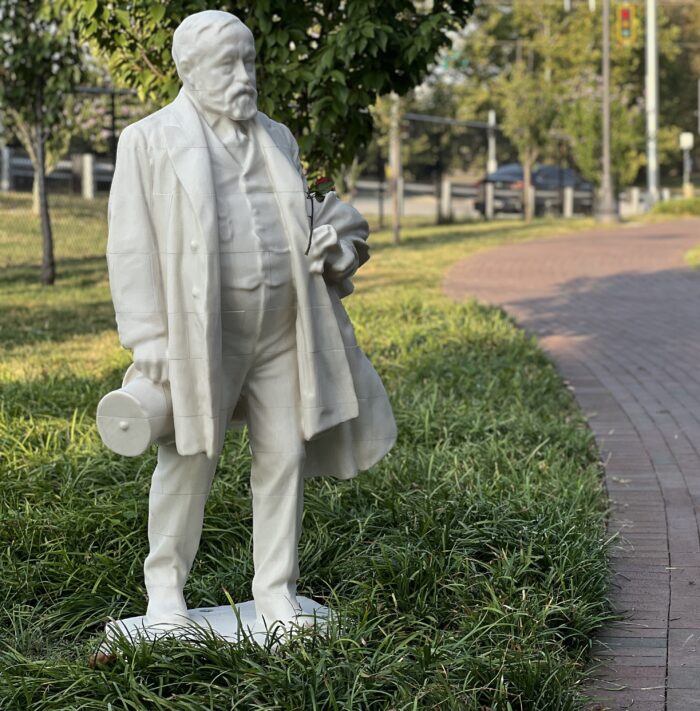
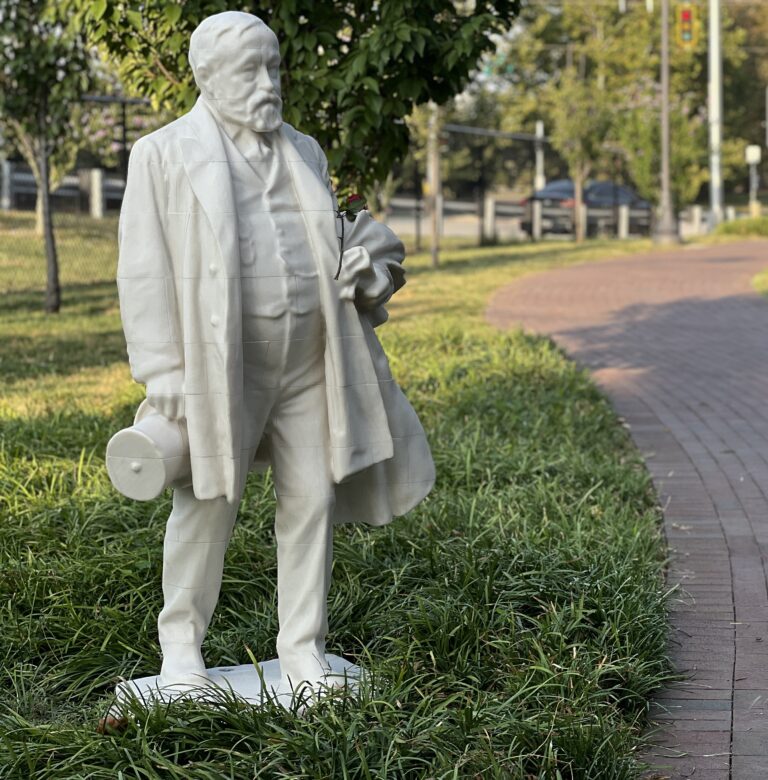
A life-size statue of President Benjamin Harrison, installed less than two weeks ago at the Benjamin Harrison Presidential Site in Indianapolis as part of a new collaboration to create public art, was destroyed by fire early Sunday morning.
An arson investigation is underway.
Charles Hyde, president and CEO of the Harrison Presidential Site, called the destruction a “senseless act of vandalism” and said the artwork, created by 3-D printing, was the result of 10 years of work led by students and faculty at the Herron School of Art and Design at Indiana University Indianapolis. The historic home is turning to crowdfunding to raise $15,000 to recreate the Harrison statue.
“We remain committed to providing hands-on and project-based experiential learning opportunities and so we’re prepared to move forward with rebuilding this 3-D-printed statue of Harrison,” Hyde said. “Clearly, we want to make sure that the materials that we use for this iteration are even more durable, so as to preclude another heartbreaking incident like this.”
Hyde said security video taken by the Harrison Presidential Site shows the fire seems to have started around 1:30 a.m. Sept. 27. The Indianapolis Fire Department responded about 15 minutes later, but Hyde and his team did not learn what had happened until the facilities manager arrived later Sunday morning to do some work on the grounds and discovered the large burn spot where the statue had been.
The Indianapolis Metropolitan Police Department was then called and the presidential site staff and law enforcement were able to “connect the dots,” Hyde said. IMPD then brought the fire department back to take a closer look.
“It’s an investigation right now,” Hyde said. “But I will say that there’s every indication from what we’ve seen and heard that arson would be the only explanation, because this material (used to print the statue) is fire-resistant. It would have no reason to combust on its own.”
The replica, installed on Sept. 16, was the exact stature of the bearded Hoosier president, standing just 5 feet 6 inches tall (he was the second-shortest man to serve as U.S. president). His likeness was depicted in motion, striding across the neighborhood with his hat in one hand, his law papers in the other and his coat draped over an arm.
Herron students and faculty created the 3-D print using polymer material. The statue was a solid neutral color but depicted minute details such as Harrison’s necktie knotted under his shirt collar, buttons on his vest, coat and top of his hat, wrinkles in the fabric of his clothes and a contemplative expression on his face.
The printing of the statue alone took more than 1,200 hours.
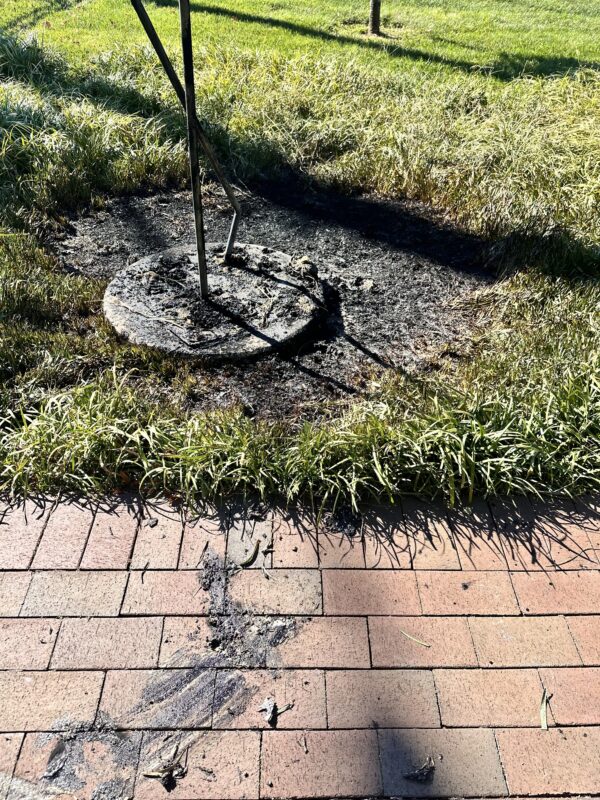
Now, all that is left is the armature, or structural skeleton, of the sculpture surrounded by ashes in blackened dirt.
“It really was an extraordinary rendition of Benjamin Harrison, and great credit to our partners at Herron School of Art and Design that they put such care and diligence into this, and, again, that’s what makes this especially disheartening,” Hyde said, adding the presidential site is disappointed to no longer have this memorial to the 23rd president during the country’s 250th birthday. “It’s really so disrespectful to the enormous amount of work that students and faculty put into realizing that vision for a new model for public art.”
The Harrison statue had been placed on the southern end of the presidential site’s property, alongside the Neighbor Way, a brick path for pedestrians and bicyclists that links Delaware and Pennsylvania streets. Calling the walkway a “love letter to the neighborhood,” Hyde said it was built as part of the Harrison home’s capital campaign, which concluded in 2023 after raising nearly $7 million, and was meant to help restore the connectivity of the Old Northside that had been lost when the interstate cut through the community.
Although the 3-D print of Harrison was always intended to be a temporary installation, the Harrison Presidential Site is planning to continue working with the Herron School of Art and its Basile Center for Art, Design and Public Life to create new artworks that can be installed and then replaced every year. Hyde said the Herron students have started the piece for 2027, drawing inspiration from the art created by Caroline Harrison, the president’s first wife, who died near the end of her husband’s term in the White House.
“This public art partnership with the Herron School of Art is really just furtherance of that commitment to the neighborhood in terms of helping with beautification and helping to deepen and recognize the historical context of the space,” Hyde said.
The collaboration with the Herron School of Art was made possible by the R.B. Annis Art & Technology Legacy Collaborative.
In addition to being a piece of art to appreciate, the Harrison statue is believed to have been the first prominent outdoor public artwork created with a 3-D printer using a polymer.
Consequently, the Herron team was studying how the material in the replica would withstand a year outside in the elements. Hyde said the testing is important in pioneering and exploring the ways in which 3-D print technology can help artists craft public art in a cost-effective manner.
The Harrison Presidential Site has started a crowdfunding campaign to offset the replacement costs for a new statue. Hyde said the Harrison home is considering the possibility of casting the statue in bronze at some point, so it would be more durable and could stay at the historic site.
“Ultimately, when it comes to public art, though, it’s an implicit trust,” Hyde said. “When you place public art, it’s also there with the recognition that the public will be respectful of it. … We had a fairly high confidence level that (the Harrison statue) would be able to endure for that full year and would have a life beyond that one-year placement, but clearly this is a vulnerability that we’re going to have to address as we look to rebuild it and to reprint it.”
Dwight Adams, an editor and writer based in Indianapolis, edited this article. He is a former content editor, copy editor and digital producer at The Indianapolis Star and IndyStar.com, and worked as a planner for other newspapers, including the Louisville Courier Journal.
The Indiana Citizen is a nonpartisan, nonprofit platform dedicated to increasing the number of informed and engaged Hoosier citizens. We are operated by the Indiana Citizen Education Foundation, Inc., a 501(c)(3) public charity. For questions about the story, contact Marilyn Odendahl at marilyn.odendahl@indianacitizen.org.